Each component of an electrical installation is designed for use at a particular rated current. When the component is used within the designed current limit it will have a specific service life expectancy, which is the length of time for which the insulation will remain operationally safe.
Circuit breaker technologies.
Each component of an electrical installation is designed for use at a particular rated current. When the component is used within the designed current limit it will have a specific service life expectancy, which is the length of time for which the insulation will remain operationally safe.
When a component is overloaded, the temperature in the insulation exceeds the design limit, the insulation begins to deteriorate and the service life will be reduced. Quantitatively, this deterioration depends on both the temperature rise and time for which the insulation is exposed to the overload. Precautions should be taken to avoid, or at least reduce to a minimum, overloading of electrical components. An overload condition can be detected by monitoring the current flowing into an item of equipment and the time for which it flows.
The method of overload sensing incorporated into circuit breakers is usually achieved through one of three different technologies:
* Solid-state electronic sensing.
* Thermal-magnetic sensing.
* Hydraulic-magnetic sensing.
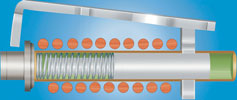
Hydraulic-magnetic mechanism as current increases
Solid state electronic sensing
This technology is often combined with microprocessor controllers and is generally restricted to larger frame circuit breakers due to cost considerations.
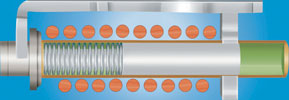
Hydraulic-magnetic mechanism showing trip bar activated
Thermal sensing
This is the oldest technology and has been used since the first appearance of miniature and moulded case circuit breakers. Thermal sensing components such as bimetals, are supported by instantaneously operated magnetic trips for short circuit protection.
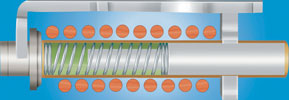
Hydraulic-magnetic mechanism remains latched after trip
Hydraulic-magnetic sensing
This technology is widely used in South Africa and eliminates the inconvenience of early tripping of thermally operated circuit breakers at elevated ambient temperatures. Hydraulic-magnetic circuit breakers have the advantage of more accurate calibration of tripping curves and make possible a variety of tripping curves to suit application-specific requirements including fractional ampere ratings.
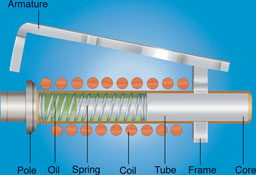
Hydraulic-magnetic circuit breakers operate on the principle of the opposing forces of a spring and a viscous fluid controlling the magnetic attraction on a ferrous piston inside a non-magnetic cylinder. The design has both a time delay operation (overload trip) and an instantaneous operation in the case of a short circuit.
When an overcurrent occurs, the magnetic force produced in the coil overcomes the core spring and the core moves towards the pole piece. The closer the core gets to the pole piece, the more magnetised the pole piece becomes. This attracts the armature, which in turn actuates the trip bar. The viscosity of the fluid and the characteristics of the spring govern the time delay. If the overcurrent is excessive, the magnetic field is such that the armature is immediately attracted to the pole piece without the influence of the core.
Zinc-based batteries power a more sustainable energy future
Electrical Power & Protection
Zinc-based batteries are gaining ground as a safe, recyclable and cost-effective energy storage option, from consumer electronics to grid-scale systems. The International Zinc Association’s Simon Norton explains why zinc is well placed to support the clean energy transition.
Read more...Energas introduces lower-cost German gas genset for South African market
Electrical Power & Protection
Energas Technologies will supply R Schmitt Enertec’s new Energy Line genset to the South African market, offering German-engineered gas-to-power generation of 400 to 500 kW at a lower entry cost through focused standardisation and a simpler standalone architecture.
Read more...ACTOM plays key role in large transmission substation project in Swellendam ACTOM Electrical Machines
Electrical Power & Protection
ACTOM has been appointed to engineer, procure, construct and commission the 1000 MVA main transmission substation for the Overberg Wind Farm in Swellendam, one of the largest substations of its kind in South Africa.
Read more...Reliable power conversion from high-voltage DC buses Conical Technologies
Electrical Power & Protection
The MEAN WELL DDRH-240 from Conical Technologies is a high-reliability DIN-rail DC-DC converter with a wide 250 to 1500 V DC input range, deriving stable low-voltage power directly from high-voltage DC buses in renewable energy, storage, charging, railway and industrial installations.
Read more...AES maintains a strong value and safety stance on boiler retrofits
Electrical Power & Protection
AES Commercial Director Dennis Williams explains when a boiler retrofit makes more sense than replacement, outlines the range of efficiency and emissions upgrades available, and draws the line at safety: a boiler not legally signed off is shut down, no exceptions.
Read more...The grid needs to become more intelligent Schneider Electric South Africa
Electrical Power & Protection
South Africa’s power grid is becoming bidirectional and far more dynamic as distributed energy resources proliferate. Schneider Electric’s Nishandra Bajinath explains why digitalisation, DERMS and aggregation are essential to keep this increasingly complex grid stable and efficient.
Read more...ACTOM’s integrated electrical solutions reduce project risk and accelerate delivery
Electrical Power & Protection
ACTOM has secured multiple orders across four divisions for the Naos-1 hybrid solar and battery project in the Free State, demonstrating its integrated model for supplying the full electrical chain from high-voltage equipment to distribution transformers.
Read more...Smarter energy management starts with intelligent electrification ABB South Africa ABB Electrification Products
Electrical Power & Protection
ABB Electrification specialists Adeline Maleka and Nokulunga Dube explain how the convergence of electrification, digitalisation and automation is helping South African industries gain real-time visibility, reduce energy waste and build operational resilience.
Read more...Mining’s decarbonisation journey starts now Schneider Electric South Africa
Electrical Power & Protection
Mining companies are embedding decarbonisation into core operational strategies as technology, advisory services and digital platforms help translate ESG commitments into measurable environmental and business outcomes.
While every effort has been made to ensure the accuracy of the information contained herein, the publisher and its agents cannot be held responsible for any errors contained, or any loss incurred as a result. Articles published do not necessarily reflect the views of the publishers. The editor reserves the right to alter or cut copy. Articles submitted are deemed to have been cleared for publication. Advertisements and company contact details are published as provided by the advertiser. Technews Publishing (Pty) Ltd cannot be held responsible for the accuracy or veracity of supplied material.










 printer friendly version