




Tribo-electric probe dust sensors are widely used as environmental emission monitors. Recent tests have highlighted the strengths and weaknesses of the variations of this technology.
Both theory and experimental results show the original DC sensor to be a linear device for the measurement of mass flow of dust enabling it to be calibrated in kg/hr or gm/sec. An additional knowledge of flow enables mass concentration to be easily computed.
AC devices, which are also sensitive to mass flow, possess an inherent response to the degree of inhomogeneity of the dust within the gas stream, resulting in an unpredictable sensitivity to gas flow, turbulence and temperature. Their calibration holds only for one particular plant condition.
The characteristics of tribo-electric dust sensors
Tribo-electric sensors have established themselves as an important tool in the determination of dust emission levels from industrial processes. The technology behind these sensors, however, is often misunderstood and, worse, often misrepresented, with mathematical theory replaced by marketing catchwords. For the technology to be used as a basis for environmental emission reporting it is vital that the theory of these devices is stated simply and unequivocally with experimental data to support the theory. It is also essential to have a clear understanding of exactly what parameter is being measured and what the limits of performance are.
Tribo-electric sensors
Small particulate matter suspended in a gas stream will carry an element of electrical charge that is generated from collisions with other particles and surfaces. The charge carried is proportional to the surface area of the particle, and for particles of a given size, to the mass of the particle. If a conducting probe is inserted into the gas stream, particles in the stream will collide with the probe and charge will be transferred to the probe as a result of the collisions.
The charge Q developed on the probe is:
Q = ΣNqn = ΣN Kmn = km and
M = ΣN mn
Where:
Qn and mn are the charge and mass of individual particles striking the probe, N is the number of particles striking the probe, K is a constant relating the charge to the particle mass and M is the total mass of particles striking the probe.
If the probe is isolated, this charge will continuously accumulate and has been known to raise a probe potential to several hundred volts. A basic safety rule is never to touch an isolated probe inserted into a flue gas stream. However, grounding the probe will cause a continuous current to flow from the probe to ground.

This current is proportional to the rate of charge transfer to the probe and is thus proportional to the mass of particles striking the probe in unit time, or, in other words, mass flow within the gas stream. A tribo-electric sensor can thus be calibrated directly in units of mass flow, eg, gm/sec or kg/hr. The device to a first order should be linear. The figures below show results of trials in both laboratory and plant conditions demonstrating the mass flow characteristics of this type of device.
Effects of velocity
As a mass flow device, the measurement is independent of velocity. In practice there are likely to be errors at very low and very high velocities when the aerodynamics of the gas stream will modify the way in which particles contact the probe. Tests under normal industrial plant conditions at flow rates between 2 and 20 m/sec indicate a linear relationship with mass flow.
Confusion arises with the fact that the vast majority of tribo-electric devices currently in use are calibrated in terms of dust concentration to read in units of mg/m3. Strictly speaking, such a calibration requires a measurement of gas velocity to convert mass flow to mass concentration, thus:
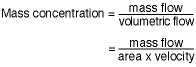
It is therefore necessary to divide the tribo sensor output by a value for volumetric flow, in order to obtain a reading in mass concentration. In practice, however, velocity is rarely measured. The calibration for mass concentration is based on the assumption that the process operates at constant flow. This calibration is in effect only applicable to one flow condition.
The simple rule is that the sensor measures mass flow directly; mass concentration requires the additional knowledge of flow.
Effects of particle size
The theory developed so far has assumed particles of a constant size so that the charge carried is proportional to both surface area and mass of the particle. In practice, particle sizes will vary, and we need to know how the sensor will react to such variations in size. The ability of an object to carry charge is purely a surface effect. Electrostatic theory holds that charge is held at the surface of an object:
Charge (q) = α surface area
and for a perfect spheroidal particle:
q = α 4πr3
Where r is the radius of the sphere.
Assuming the particle has constant density, its mass is proportional to its volume thus:

- and so the ratio of charge to mass is:
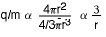
This leaves us with the uncomfortable prediction that the mass flow output of a tribo sensor will be dependent on the size of the particles in the gas stream:
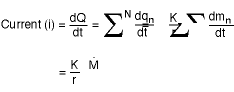
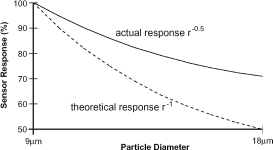
Doubling the size of the particles will halve the mass flow measurement. In practice, however, this tends not to be the case. The radius dependency is always very much lower than the 1/r predicted by this simple theory. The reason for this appears to be that particles are never perfect spheres. Surface irregularities increase the surface area without increasing the volume of the particles so that the ratio of charge to mass has a dependency very much less than 1/r.
Charge/mass α r-X
where x < 1
In an extreme case, large particles are often produced by an agglomeration of small particles, and the total surface area is simply the sum of the surfaces of the small particles while the volume is also the sum of the volumes of the small particles. In this case the ratio of area to volume and charge to mass is a constant in which case x = 0.
When making checks on the linearity of tribo-electric devices it is inevitable that changing the concentration of mass emissions on site will produce changes in particle size distribution and any particle size dependency will show as a non-linearity of measurement.
In fact, all the plant-based tests made to date have shown excellent linearity, indicating very little, if any, particle size dependency. Laboratory tests conducted with graded particles of particular sizes do, however, show a size-dependent effect (see below). Even then, it is interesting to note that the dependency is much less than the 1/r predicted for a perfect sphere, suggesting, not unnaturally, that the graded particles are not perfect spheres but have considerable surface irregularities.
AC technology
The whole discussion so far has concerned a straightforward tribo-electric device in which the current flow to ground is measured and calibrated in terms of mass flow.
While this is a beautiful, simple technique, there are practical difficulties involved with the design of such an instrument. The main design obstacle lies in the ability to measure accurately the very small currents flowing from the probe. This current can be less than a picoampere. It requires very careful design of analog amplifiers to produce a design capable of making a low drift measurement of such small currents. Many versions of instrument have been bedevilled by temperature drifts creating large zero errors.
To overcome these problems some manufacturers have resorted to the so-called AC technology. This technology is different simply in that a capacitor is placed after the electronic preamplifier to block the effects of DC drift. Unfortunately, this also blocks the basic DC signal, which is the element that is proportional to mass flow.

What, therefore, does an AC system actually measure?
The effect of adding a capacitor to the output of the DC system is to introduce a differentiation of the DC output. From equation 3:
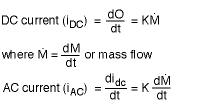
An AC system is thus attempting to measure not mass flow but rate of change of mass flow. It is claimed by the manufacturers that this output is related to mass concentration in some way.
To consider this claim, it is convenient to use an analysis made by Dr Andrew Clarke in a paper discussing particulate emissions measurement by opacity fluctuation, which is an analogous AC technology.
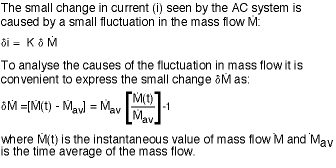
The ratio in brackets can be expressed in terms of the number of particles striking the probe of length L. Assuming a constant particle size distribution, let us define:
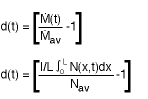
where N(x,t) is the number of particles striking the probe at time t and point x along its length L, Nav is the time average value for the number of particles striking the probe and is proportional to Mav.
D(t) becomes a measure of the degree of inhomogeneity of the particle distribution within the gas stream. For a perfectly mixed homogeneous gas under laminar flow conditions D = 0.
The AC response can now be written:
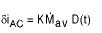
The instrument response is thus proportional to the average value of mass flow Mav. Like the DC sensor, this too is a mass flow device, not a mass concentration monitor.
However, the sensitivity of the measurement is governed by the parameter D(t), which represents the degree of inhomogeneity of the particulate distribution within the gas flow. This is a function which is influenced by a number of operating conditions, such as the manner in which the particles are produced, gas flow and turbulence effects, and temperature variations within the gas which affect the density of particulate distribution.
What is significant is that the instrument actually requires this degree of inhomogeneity, in order to operate. In the limit of a perfectly mixed laminar flow environment D = O and the AC monitor will have no response whatsoever to the particulate flow.
Effects of velocity on AC systems
While it is now possible to see that an AC system, in common with a DC system, will produce an output proportional to mass flow, unlike the DC system, it has introduced a turbulence and flow dependent element.
The higher the degree of mass flow variation the more sensitive the signal. This inhomogeneity dependence will unfortunately be completely unpredictable. It will change at different locations within a duct and will change with varying plant conditions, particularly with respect to flow and temperature.
It is of course possible to calibrate such a sensor at one particular condition of flow and temperature. It is also possible to calibrate in terms of mass concentration as well as mass flow, thus explaining the claim of the manufacturers that the AC device measures mass concentration. The most important point, however, is that the calibration is only valid for that particular plant condition. Moreover, the measurement of flow does not help in any way. The velocity dependency of the measurement is completely unpredictable, since it results from variations in a complex aerodynamic flow system.
Use of insulated probes
Some AC tribo systems utilise insulated probes. This must have an effect on the measurement, since it would clearly prevent the direct charge transfer from particle to probe. A charged particle moving over a conducting surface will induce an equal and opposite charge upon the surface. If the particle passes a grounded probe, insulated from the surface, the appearance of the particle will be detected by an increase in charge induced on the probe. The charge will increase as the particle approaches and decrease as it recedes. The current flow in the probe is the differential of the charge function.
The passing of a charged particle thus develops an AC current in the probe.
When this effect is summated over the very many particles present, the resulting AC current quickly averages to a value of zero. However, if the particulate concentration within the gas stream is not homogeneous, then the resultant charge induced on the probe will change with the varying particulate concentration.

and AC current

This is exactly the same form of relationship as exists for the direct transfer of charge. The response of the probe to mass flow is thus similar; the only difference is a different value of transfer constant K. A non-insulated probe will experience AC current components from both direct charge transfer and induction mechanisms. An insulated probe will only respond to induced currents. A DC system will have no net response to induced currents since the time average of these currents is zero.
Conclusions
DC tribo-electric devices are linear sensors of particulate mass flow. In practice, they are only slightly influenced by particle size distribution. If knowledge of flow conditions is acquired, the instrument can additionally be calibrated in terms of mass concentration or mg/m3.
AC devices are also linearly proportional to mass flow. However, they possess an unpredictable sensitivity to velocity and gas temperature effects, limiting their calibration to one particular plant condition only. While they may be applicable as an indicative sensor, their use as a quantitative device for environmental monitoring is severely limited.
| Tel: | +27 82 468 5403 |
| Email: | [email protected] , [email protected] |
| www: | www.envirosa.com |
| Articles: | More information and articles about Environmental Process Analytics |






© Technews Publishing (Pty) Ltd | All Rights Reserved
 printer friendly version