



Growing demand for greater functionality and capability means that the latest pneumatic components are becoming increasingly complex. With this notion in mind, plant engineers seeking cost-effective solutions need to know the optimum products available. After all, not all pneumatic components are made equal, so making wise selections when it comes to pneumatic components can pay huge dividends. For instance, the ability to rectify problems prior to them becoming major plant issues has the potential to save thousands in unscheduled downtime and maintenance/repair costs.
Clearly, any effective pneumatic system must be correctly sized, installed and maintained; an ethos that extends from the compressor to the machine or workstation. However, it only takes a few ill-informed decisions for things to take a dramatic wrong turn. Such an outcome could manifest in anything from wasted energy to complete system failure, and all the associated costs these incur.
To help avoid such expensive mistakes, a variety of different pathways can be considered when looking to optimise the performance of pneumatic components.
Preventative maintenance
As with any machine, vehicle or system, regular and correct maintenance will extend its working life, and pneumatic equipment is certainly no exception. Lubricators must not be left to run dry, while filters need cleaning, and contaminants – such as water, unwanted oils, metal shavings and corrosion – must be removed.
A good visual indicator here is a yellowing of the filter elements. Such discoloration would suggest that compressor oils are causing an issue. A further indicator, this time audible, is a distinct hiss, which could mean there is a system leak. Leaks typically occur where products mate or connect to the pneumatic tubing or other joining products.
Predictive maintenance
The implementation of predictive maintenance has become a high-held ambition for many modern plants, a strategy that avoids the costs of both reactive and scheduled preventative maintenance by only deploying maintenance routines exactly when needed; namely, shortly before a pneumatic component is predicted to fail.
The route to facilitating predictive maintenance is via sensors. For instance, consider the adoption of a flow sensor that sits in line with an FRL (filter, regulator, lubricator) unit. Such a device can indicate a blocked filter that might otherwise go unspotted.
If a blocked filter is allowed to continue serving a pneumatic system, several problems can result. By way of example, air supply can become restricted, contamination levels can rise, and extra heat can be generated that might compromise a system and ultimately lead to its complete failure. The cost implications of such an outcome are significant, especially when considering that a simple and inexpensive filter replacement could have avoided the whole situation.
Today, sensors have been developed for use on almost all pneumatic components. A case in point is the use of continuous position sensors on cylinders. Over time, this type of sensor is able to indicate whether heat or wear is being generated to the point of becoming an issue.
Reduce energy usage
Another way that modern pneumatic components can help plants to save money is via reduced energy consumption. As a result, the correct sizing of components becomes even more vital. Many plant engineers fall into the trap of oversizing, thinking they are playing it safe. However, a correctly sized pneumatic component is perfectly safe and avoids the extra costs associated with larger pneumatics and wasted energy.
A key tip here is to use pneumatic zoning on a manifold to mix pressures, add vacuum to the application, or manage the use of supply pressure. Pneumatic zoning allows the user to section the manifold via a gasket, thus creating different pressure zones or changing the flow, or even making one zone a vacuum. Ultimately, this technique allows a single manifold to serve the needs of various parts of the machine.
A further alternative to oversizing is to use pressure boosters, which as the name suggests, amplify the pressure or serve as a simple reservoir to store compressed air in the system for later use. Another option is to lock the regulators: a move that will prevent operators from tampering with the overall system pressure in an attempt to provide individual workstations with more compressed air. Such a step could save a lot of expense, as the opening of a regulator to increase flow rates can have many detrimental effects, not least seal damage, wasted energy, or even physical harm to operators.
Be safe, not sorry
Clearly there is a cost associated with ensuring machine/system safety, but workplace injuries will almost certainly cost more; both in expenditure and damage to market reputation. A simple risk assessment can add significant value to a pneumatics project. Any potential hazards or dangers identified by the risk assessment must be designed out, or if not possible, protected against using industry-standard solutions such as light curtains, interlocks, machine guards or safety exhaust products.
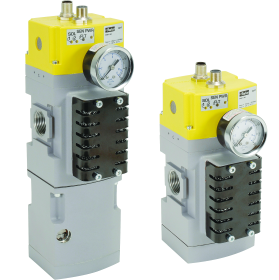
When incorporated into an air preparation system, a safety exhaust valve lets users safely and reliably shut off the pneumatic energy, stopping the flow of compressed air to the machine and allowing downstream pressure to exhaust. There are, however, a number of criteria associated with the optimum specification of a safety exhaust valve, namely: fast exhaust time to faulted condition; fast switching time; utilising series-parallel flow so that both valve elements (redundant design) shift to supply air downstream; high B10 value (life expectancy in switching cycles); and comprehensive monitoring capability to achieve the highest level of diagnostic coverage.
Consider system changes
Low-cost Ethernet-based shop-floor connectivity is the future for the manufacturing and process industries, and many are shifting in this direction. In stark contrast, numerous plants still rely on hard-wired solutions. However, the shift from long runs of wire trunking to a simple Ethernet port is not as daunting as it sounds, particularly with the advent of IO-Link.
IO-Link is fast becoming the next significant industrial network protocol as it can provide the perfect local extension to a superior industrial Ethernet network. Launched in 2008 by Siemens, IO-Link is the first IO technology for communication with sensors and actuators to be adopted as an international standard (IEC 61131-9), meaning that devices can be integrated in the same way in all commonly used fieldbus systems and automation systems, right up to ERP level.
The opportunity to save money with IO-Link is substantial as users can run field level devices back to the IO-Link master, which saves in time, wiring, component costs and troubleshooting. What’s more, today’s advanced network nodes come with many advantages, such as prognostic data for predictive maintenance, as well as built-in sensors for shorts, over-current, thermal management and cycle counting, among other functions.
For more information contact Lisa de Beer, Parker Hannifin SA, +27 11 961 0700, lisa.debeer@parker.com, www.parker.com/za
| Tel: | +27 11 961 0700 |
| Email: | parker.southafrica@parker.com |
| www: | www.parker.com/za |
| Articles: | More information and articles about Parker Hannifin - Sales Company South Africa |






© Technews Publishing (Pty) Ltd | All Rights Reserved
 printer friendly version