RS Components has announced availability of a new series of DIN rail-mount redundancy power modules from TDK-Lambda, a group company of TDK corporation and a leading maker of highly reliable power supplies for industrial equipment worldwide.
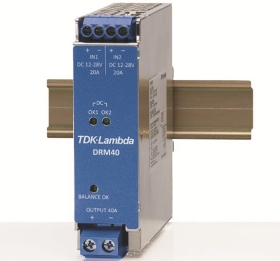
Designed for automation and general-purpose industrial applications, the DRM40 and DRM40B power modules offer 20 to 40 A current handling capability and can be used in N+1 redundancy systems and applications; alternatively, two supplies can be placed in parallel for additional power.
A key feature of the higher-end DRM40 unit is a current-balancing LED indicator, which turns on when two power supplies have been adjusted to deliver the same current, thereby making it easier to ensure load sharing. In addition, two isolated alarm signals indicate the output voltage status of each power supply, making it simple to enable remote fault monitoring. However, a lower cost unit – the DRM40B – is also available for applications not demanding these advanced features.
Designed to take up less space on the DIN rail, the DRM40 series comes in a highly compact unit with dimensions of only 35 x 125 x 124 mm. Offering an operating temperature range of –40 to 70ºC, key electrical characteristics include an internal voltage drop of only 200 mV at 40 A, enabling low power loss, a wide input voltage range of 10 to 30 V, and maximum input current of 20 A on each of the unit’s two inputs, plus a peak input capability of 2 x 30 A for 4 seconds.
Overcoming the bottling industry’s fragmented visibility Schneider Electric South Africa
IT in Manufacturing Electrical Power & Protection
Beverage bottling facilities are among manufacturing’s most energy-intensive environments, yet many still operate without granular insight into where that energy goes. Rezolia Muller-Potluri of Schneider Electric explains how tiered metering architecture and advanced
Read more...Schneider Electric introduces next-generation BlokSeT switchboard Schneider Electric South Africa
Electrical Power & Protection
Schneider Electric has launched its next-generation BlokSeT low-voltage switchboard in West Africa, offering high reliability, predictive maintenance capability and digital integration for critical infrastructure and industrial applications.
Read more...Powering South Africa’s renewable energy expansion
Electrical Power & Protection
ACTOM Distribution Transformers, the sole NECRT contract holder for Eskom, is powering South Africa’s renewable energy expansion through robust neutral earthing transformer solutions deployed across solar and wind projects in southern Africa.
Read more...You can’t digitise a blackout Schneider Electric South Africa
Electrical Power & Protection
Across East Africa, smart meters and AI promise cleaner, more reliable power, but digital tools cannot optimise a grid too weak to carry the load. Schneider Electric’s Symphrose Ochieng sets out why operators should strengthen physical infrastructure first, then add digital capability in phases.
Read more...Battery energy storage is key to powering South Africa’s manufacturing sector
Electrical Power & Protection
South Africa’s shift to renewables is creating a significant opportunity in battery energy storage, but local manufacturers face an uphill battle against cheap imports and stop-start demand. Richard van Moltke of ACTOM Static Power examines what it will take to build a sustainable local battery storage industry.
Read more...Decarbonisation is reshaping mining strategy in Africa Schneider Electric South Africa
IT in Manufacturing Electrical Power & Protection
Mining companies across Africa are embedding decarbonisation into operational strategy, driven by investor, regulatory and customer pressure to reduce emissions while improving resilience.
Read more...How to tell whether your mini-substation is new or refurbished
Electrical Power & Protection
Cosmetically refurbished mini-substations are being misrepresented as new equipment and sold back into the market, posing serious reliability and safety risks for mining, industrial and commercial operations. Trafo Power Solutions explains what to look for and what questions to ask before purchasing.
Read more...Best practices for managing the MRO supply chain in Africa RS South Africa
System Integration & Control Systems Design
RS South Africa outlines how strong data governance and digital tools can turn maintenance, repair and operations procurement into a strategic advantage across Africa.
Read more...Optimising energy reliability for African manufacturing
Electrical Power & Protection IT in Manufacturing
Unreliable power can cost African manufacturers as much as 31% in sales. Behind-the-meter power offers manufacturers in sub-Saharan Africa control, visibility and resilience in their energy provisioning.
Read more...Electrical solutions for FMCG manufacturing giant
Electrical Power & Protection
An electrical upgrade at a leading fast-moving consumer goods facility demonstrates how ACTOM Kenya turned a fragile, reactive power infrastructure into a resilient, data-driven backbone for production. The project is also a case study in bridging legacy equipment with modern automation without disrupting operations.
While every effort has been made to ensure the accuracy of the information contained herein, the publisher and its agents cannot be held responsible for any errors contained, or any loss incurred as a result. Articles published do not necessarily reflect the views of the publishers. The editor reserves the right to alter or cut copy. Articles submitted are deemed to have been cleared for publication. Advertisements and company contact details are published as provided by the advertiser. Technews Publishing (Pty) Ltd cannot be held responsible for the accuracy or veracity of supplied material.










 printer friendly version