



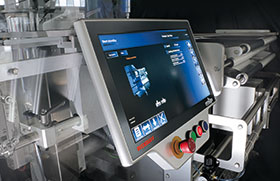
At the Interpack 2017 trade show, Italian packaging machine manufacturer MBP presented a revolutionary development. Its new vertical form-fill-seal machine combines the high speed common in continuously operating machines with the fast and flexible format change capabilities of intermittent-operation solu-tions. The totally new design of the machine relies on PC-based control and automation architecture from Beckhoff, taking full advantage of the high-performance capabilities on offer.
MBP was established in 1980 and initially specialised in designing and building multi-head weighers. Its acquisition by PFM in 2002 gave MBP access to the parent company’s experience and expertise in technology, process engineering and R&D. The PFM Group, founded in the 1960s with headquarters in Italy, is represented in 70 countries and considered among the world’s leading builders of packaging machinery. The portfolio ranges from horizontal flow wrap machines, vertical form-fill-seal (VFFS) machines and horizontal stand-up pouch packaging machines, to complete packaging systems with multi-head weighers for multiple industries.
R-series: the new VFFS concept from MBP
For Andrea Fioravanti, CEO of MBP, and head of Research and Development within the PFM Group, the decision to select automation solutions from Beckhoff was an important step in the development of the new intermittently operating R-series packaging machines. The new design had to combine the speed and simplicity of continuously operating VFFS machines with the flexibility of intermittently operated machines. For comparison, a conventional VFFS machine can pack between 80 and 100 small bags per minute during intermittent operation, while the new R-series machines output up to 150 bags per minute in test mode – a productivity increase of approximately 50 percent. “We have already shipped more than 30 R-series machines, all of which package 120 bags per minute with maximum reliability. Customers are completely satisfied with this solution,” declares Fioravanti.
High throughput is not the only outstanding feature of the new series. MBP engineers also worked hard to improve the machine’s ergonomics and reduce its footprint so that end users can more effectively utilise valuable factory floor space. For this achievement to become reality, the new foil reel control concept was critical. It employs a movable triangular foil turning device, which reduces the number of calendar rolls. This makes the machine smaller while also increasing flexibility. The machine also features an electronically controlled dancer roll. TwinCAT NC PTP software, with the appropriate libraries for dancer control and register control, automates the continuous movement of the foil and diverts it toward the discharge belts with continuous momentum and precision.
One CPU for weighing and packaging
“A major advantage of the Beckhoff automation solution is the possibility to use a single CPU to run all logic and control functions for all axes across the entire system, from weighing to packaging, as well as its extremely clear and easy-to-use interface,” says Fioravanti. MBP decided to use a CP3716 panel PC with a multi-touch display that complies with protection class IP67. The PC, which is equipped with an Intel Atom dual-core processor, was customised by adding a specific button and the MBP logo. “Due to the high performance and flexibility of the Beckhoff automation architecture, we are now able to run both the weighing system and the packaging machine with a single industrial PC with integrated screen for HMI. This offers several benefits for us as a machine builder as well as for our customers. They now have an easy-to-operate, yet powerful system that features an open design and works with all common TwinCAT 3 Motion Control software modules,” underscores Fioravanti.
The transition from a traditional PLC-based system to a PC-based control architecture has definitely made life easier for MBP: “The new architecture includes Industrie 4.0-related concepts that employ IoT communication as a major productivity catalyst. The PC-based platform enables us to take an integrated approach to control and communication-related aspects of the machine. Whether for pneumatics, stepper motors, brushless motors, sensors or data acquisition, the entire control and monitoring architecture runs on standard hardware in the form of an industrial PC. The software is integrated not only conceptually, but functionally, for example by employing TwinCAT 3 as a consistent development environment,” he adds.
Unrestricted communication via EtherCAT and the cloud
Another major factor in the development of the new R-series was the availability of a communication network like EtherCAT, which can transmit information via very simple protocols. EtherCAT can also provide links to higher-level layers that are typical in the IT world, such as Ethernet, remote maintenance tools and ERP systems. The open system design, which accommodates a wide range of communication standards and cloud computing, makes the R-series machines ready for Industrie 4.0.
With the TF6730 TwinCAT IoT Communicator from Beckhoff, MBP is able to transmit process data from the machine to any device, such as a smartphone or tablet. Plus, with the TF6735 TwinCAT IoT Communicator App, Beckhoff provides a simple solution for monitoring and analysing this data. In addition, by going through the cloud, MBP can facilitate remote support quickly and efficiently, as having real-time access to machine data makes technical services significantly faster and less expensive. The head of the support department uses an MBP-developed application to generate e-service tickets for support technicians. This enables a technician to download the information needed to perform the required service.
With these capabilities, MBP is able to offer its customers continuous machine monitoring via the cloud while keeping an eye on operating parameters like power usage, start-up current and more in its control room upon request. The data can also be used to continuously improve machine performance based on key performance indicators and proactive maintenance.
A relationship with good prospects for the future
“Without a doubt, using PC-based control technology provides huge benefits,” says Fioravanti. It enables MBP to scale the CPU depending on the size, protection class and rated performance of each individual application. The solution becomes even more ergonomic because of the wide selection of electronic interfaces, EtherCAT I/O modules, communication interfaces and servo drive solutions from Beckhoff. “We thus have at our disposal a solution that allows us to satisfy all technical requirements of today’s packaging industry in the best way possible,” concludes Fioravanti. “This is why it is only natural that we will work even more closely with Beckhoff in the future.”
For more information contact Kenneth McPherson, Beckhoff Automation, +27 (0)11 795 2898, kennethm@beckhoff.com, www.beckhoff.co.za
| Tel: | +27 11 795 2898 |
| Email: | info@beckhoff.co.za |
| www: | www.beckhoff.com |
| Articles: | More information and articles about Beckhoff Automation |






© Technews Publishing (Pty) Ltd | All Rights Reserved
 printer friendly version