



‘Education-to-employment’ a conundrum in South Africa
Over the years, while at the desk of the SAIMC leadership, some observations, beliefs and perceptions surfaced. These however, must be tested with quantitative data as they are mostly qualitative and gathered over a span of time.
The question that has shaped our observation is one that lingers in the mind of every leader at the SAIMC: “How do we prepare the youth of South Africa, with and without college degrees, for jobs with meaningful career paths?”
Business and societal needs have never been this apparent. South African employers always highlight shortage of skills in the market as a key challenge and often put emphasis on lack of preparedness, even for entry level jobs. On the other hand, this ‘skills gap’ represents a massive pool of untapped talent which can be unlocked through numerous avenues such as bursary programmes and apprenticeships, which in turn addresses the need for experience and formal qualifications. The under-utilisation of this talent pool has dire consequences, such as social unrest and despair, economic underperformance, increasing levels of crime etc.
Workforce development system
After two years of engagement with the private and public sectors, coupled with experience gained in societal projects, we propose the workforce development model indicated in Figure 1 in order to remedy some of the challenges experienced today.
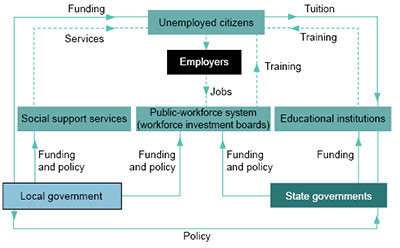
1. Employers, South African youth, society and education providers live in parallel worlds
South African employers believe that graduates are not adequately prepared and do not have the necessary skills to enter the labour market, even for first entry level jobs. The educational institutions, on the other hand, believe that the current curricula equip graduates with necessary skills required for the work environment.
The second disconnect is that educational institutions are of the view that the high student dropout rate is as a result of the course content being too difficult, while the youth express affordability as the reason behind it.
The third perspective, that of society, is that the basic education system is flawed and does not prepare our youth for higher education. In relation to the workforce development system (Figure 1), we have four major stakeholders with almost opposing perspectives. This suggests lack of integration, disconnect and necessary communication channels among stakeholders.
2. The education-to-employment system is heterogeneous and fragmented
In summary, the following are our observations:
• High costs barrier for higher learning enrolment and hence disconnect to employment.
• On-the-job training and hands-on learning appear to be more effective methods, but fewer youth are enrolled in curricula that prioritise these techniques.
• Economy and educational disconnect: first jobs afforded to youth are unrelated to their field of study and they want to change positions quickly. The question that surfaces is: what skill does the economy of today demand?
• Disengaged youth: over the years we observed troubled youth segments. These range from those who have become discouraged (“I know enough not to care”) to those who are disengaged (“I don’t care to know more”) and those who are willing yet struggling (“I want to know more”).
Although limited, we share some thoughts on what we believe could nudge us forward a notch.
Lessons from abroad
Two features stand out among leading global economies. Firstly, educational institutions and employers actively step into one another’s worlds. Employers are actively integrated into curriculum designs, and offer their employees as faculty leaders. For example, educational institutions collaborate with potential employers by having students spend some time on the job, and thus secure best student hiring guarantees. In return, employers are incentivised by state government for such participation and programmes.
Secondly, in the best programmes, employers and educational institutions work with their students from the beginning, and intensely. Instead of the traditional recruitment methods (i.e. poaching and competition) adopted in South Africa, the education-to-employment journey is treated as a continuum in which employers commit to hiring youth before they are enrolled in any skills-building programme.
Establishment of industry-specific structures
The most transformative solutions are those that involve multiple providers and employers working within a particular industry or function. These collaborations resolve the skill gap at a sector level. By splitting costs among multiple stakeholders (educators, employers and trainees), investment is reduced for all parties as an incentive for increased participation. Agreements such as non-poaching deals can also boost employers’ willingness to collaborate, even in a competitive environment.

Finally, we believe South Africa is in need of system integrators, responsible for taking a high-level view of the entire heterogeneous and fragmented education-to-employment system. The role of the system integrator is to work with education institutions and employers to develop skill solution sets, gather data, and identify and disseminate positive industry practices and examples. Such companies could be defined by sector, region, or target population.
Yours in automation,
Oratile Sematle
| Tel: | +27 11 312 2445 |
| Email: | ina@saimc.co.za |
| www: | www.saimc.co.za |
| Articles: | More information and articles about SAIMC |






© Technews Publishing (Pty) Ltd | All Rights Reserved
 printer friendly version