Regulation of motor efficiency could help stabilise SA’s power supply
September 2019
News
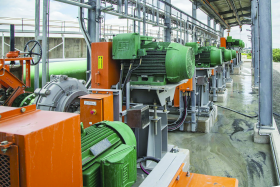
South Africa could go a long way to cut the risk of future load-shedding by adopting a minimum efficiency performance standard (MEPS) for electric motors. According to Fanie Steyn, manager rotating machines at Zest WEG Group, a MEPS would significantly reduce the peak power demand on the national grid. Importantly, the step could be made at no cost to government and would also bring substantial savings to industry’s electrical energy costs.
“The MEPS would phase out the least-efficient electric motor classes by setting a minimum standard for the efficiency of motors imported and sold in South Africa,” explains Steyn. “The essential challenge now is that about 280 000 electric motors are imported each year, many of which are low efficiency motors rated at IE1 level as standard.”
Steyn highlights the great strides recently achieved in the efficiency of electric motors. Energy savings of between 2,1% and 12,4%, depending on the individual power rating, can be made by converting from a standard efficiency IE1 motor to a premium efficiency IE3 motor. The capital cost differential is slight and is quickly recouped by lower operating costs. “It is estimated that as much as 30% of all energy produced globally is consumed by electric motors,” he adds. “It is therefore easy to see why improving motor efficiencies has a huge impact on national energy consumption.”
It is significant that more than 42 countries already have MEPS in place. These standards apply mostly to three-phase low voltage motors from 0,75 kW to 375 kW capacity. The MEPS is applied at import stage, so the process would be handled in the conventional manner by customs agencies. It would also mean lower carbon emissions from power stations. South Africa has committed to reduce these emissions by signing the Paris Agreement in 2016.
“Implementing MEPS will have significant benefits for everyone,” concludes Steyn.
Further reading:
Helping mines get results from water improvements
News
South African mines operate under constrained, water-scarce conditions where every investment must be justified. Xylem’s Chetan Mistry explains how the right water technology partner helps mines prioritise high-value water systems across the mining lifecycle.
Read more...
From solar to water, onsite plants are the next big industrial resilience shift
News
South African industrial operators who secured their energy supply with onsite solar generation now face the same imperative with water. Robert Erasmus of Sanitech argues that onsite water treatment is the next essential pillar of business continuity.
Read more...
From the editor's desk: Pushing engineering to the limit
Technews Publishing
News
Among the many things robots can do, it’s a lot of fun to follow how fast they are. They go from the Boston Dynamics cheetah, which first reached a record-breaking speed of 45,5 km/h, to the robot Charlie
...
Read more...
Schneider Electric concludes Innovation Summit Middle East and Africa
Schneider Electric South Africa
News
Schneider Electric's Innovation Summit Middle East and Africa, held in Abu Dhabi with more than 2500 attendees, explored the convergence of energy, AI and industrial software, launched an Industrial AI study and announced the NEST Accelerator Programme for energy and industrial tech startups.
Read more...
VEGA brings measurement expertise beyond mining to Electra Mining Africa 2026
VEGA Controls SA
News
VEGA used its Electra Mining Africa 2026 stand to demonstrate that its level and pressure measurement instruments extend well beyond mining, covering water, food and beverage, pharmaceuticals, chemicals, and oil and gas applications across the continent.
Read more...
Sustainable solutions for sugar
Bearing Man Group t/a BMG
News
BMG received a Special Commendation Exhibition Stand Award at the South African Sugar Technologists’ Association Congress, where it showcased an integrated turnkey drive solution designed to simplify the upgrading of ageing crushing-mill drive systems.
Read more...
Measure, Manage, Maintain: The operating model behind SA’s water resilience
Siemens South Africa
News
South Africa’s growing water crisis is putting pressure on infrastructure, municipalities and the economy. Siemens highlights how digital technologies, smarter operations and safe water reuse could help shift the country from crisis response towards a more resilient and sustainable water future.
Read more...
VEGA brings measurement expertise beyond mining to Electra Mining Africa 2026
VEGA Controls SA
News
VEGA used its Electra Mining Africa 2026 stand to demonstrate that its level and pressure measurement instruments extend well beyond mining, covering water, food and beverage, pharmaceuticals, chemicals, and oil and gas applications across the continent.
Read more...
Schneider Electric concludes Innovation Summit Middle East and Africa
Schneider Electric South Africa
News
Schneider Electric’s Innovation Summit Middle East and Africa, held in Abu Dhabi with more than 2500 attendees, explored the convergence of energy, AI and industrial software, launched an Industrial AI study and announced the NEST Accelerator Programme.
Read more...
RX Africa and Messe Muenchen India join forces to strengthen business platforms in Africa
RX Africa
News
Messe Muenchen India has announced a strategic partnership with RX Africa to strengthen the scale, reach and market impact of its premier co-located trade fairs, analytica Lab Africa and IFAT Africa, ahead of their 2027 editions.
Read more...










 printer friendly version