Power-factor correction is a mechanism to reduce operating costs associated with electricity consumption. Some of the key advantages here are reduced kVA charges, improved plant efficiency and network voltage, and reduced overloading of cables, switchgear and transformers.
“The power factor is simply the ratio of actual power (known as active power) used in a circuit, expressed in kW, to the mains power drawn, expressed in kVA,” explains ElectroMechanica (EM) product manager, Artur Socha.
Large industrial, commercial or retail operations can have maximum demand charges applied to their electricity bill. Improved power factor relates to immediate savings on the demand charges. Even sites that have switched to renewable energy sources, such as solar, still need to take power factor into account.
To determine the estimated savings that can be realised by installing a power-factor correction system, Socha reveals that EM recently launched a power-factor correction calculator to allow customers to determine savings if they are being penalised on their electricity bills with a maximum demand charge.
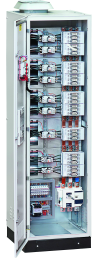
EM is capable of assembling complete power-factor systems, with the option of thyristor (fast switching) or traditional contactor switching, or a hybrid of both. Combined with active harmonic filters, also available from EM, it provides complete solutions for all aspects related to its customers’ power factor and power quality requirements. In addition, EM has a number of accredited partners to ensure customer service and technical back-up support is always on hand.
Two main products from EM play a key role in power-factor correction, namely the Lovato DCRG power-factor correction controllers and Electronicon three-phase cylindrical capacitors. Other features include expansion slots for additional steps or communication modules, the capability to operate with several units interconnected in master-slave mode, a quick current transformer (CT) programming function, and automatic identification of the direction of the CT current flow. The DCRG8 continuously reacts to load conditions.
Africa’s net-zero ambition must become operational Schneider Electric South Africa
Electrical Power & Protection
Schneider Electric’s Rohit Chashta argues that the biggest gap in Africa’s green transition is not ambition but execution, and outlines how advisory services, bankable project roadmaps, digital visibility and SF6-free switchgear can turn sustainability commitments into measurable progress.
Read more...High-efficiency half-brick DC-DC converters Vepac Electronics
Electrical Power & Protection
The Supreme series half-brick DC-DC converters from Vepac Electronics use synchronous rectification for high conversion efficiency, in a six-sided metal case built to withstand harsh industrial and transportation environments.
Read more...Zinc-based batteries power a more sustainable energy future
Electrical Power & Protection
Zinc-based batteries are gaining ground as a safe, recyclable and cost-effective energy storage option, from consumer electronics to grid-scale systems. The International Zinc Association’s Simon Norton explains why zinc is well placed to support the clean energy transition.
Read more...Energas introduces lower-cost German gas genset for South African market
Electrical Power & Protection
Energas Technologies will supply R Schmitt Enertec’s new Energy Line genset to the South African market, offering German-engineered gas-to-power generation of 400 to 500 kW at a lower entry cost through focused standardisation and a simpler standalone architecture.
Read more...ACTOM plays key role in large transmission substation project in Swellendam ACTOM Electrical Machines
Electrical Power & Protection
ACTOM has been appointed to engineer, procure, construct and commission the 1000 MVA main transmission substation for the Overberg Wind Farm in Swellendam, one of the largest substations of its kind in South Africa.
Read more...Reliable power conversion from high-voltage DC buses Conical Technologies
Electrical Power & Protection
The MEAN WELL DDRH-240 from Conical Technologies is a high-reliability DIN-rail DC-DC converter with a wide 250 to 1500 V DC input range, deriving stable low-voltage power directly from high-voltage DC buses in renewable energy, storage, charging, railway and industrial installations.
Read more...AES maintains a strong value and safety stance on boiler retrofits
Electrical Power & Protection
AES Commercial Director Dennis Williams explains when a boiler retrofit makes more sense than replacement, outlines the range of efficiency and emissions upgrades available, and draws the line at safety: a boiler not legally signed off is shut down, no exceptions.
Read more...The grid needs to become more intelligent Schneider Electric South Africa
Electrical Power & Protection
South Africa’s power grid is becoming bidirectional and far more dynamic as distributed energy resources proliferate. Schneider Electric’s Nishandra Bajinath explains why digitalisation, DERMS and aggregation are essential to keep this increasingly complex grid stable and efficient.
Read more...ACTOM’s integrated electrical solutions reduce project risk and accelerate delivery
Electrical Power & Protection
ACTOM has secured multiple orders across four divisions for the Naos-1 hybrid solar and battery project in the Free State, demonstrating its integrated model for supplying the full electrical chain from high-voltage equipment to distribution transformers.
Read more...Smarter energy management starts with intelligent electrification ABB South Africa ABB Electrification Products
Electrical Power & Protection
ABB Electrification specialists Adeline Maleka and Nokulunga Dube explain how the convergence of electrification, digitalisation and automation is helping South African industries gain real-time visibility, reduce energy waste and build operational resilience.
While every effort has been made to ensure the accuracy of the information contained herein, the publisher and its agents cannot be held responsible for any errors contained, or any loss incurred as a result. Articles published do not necessarily reflect the views of the publishers. The editor reserves the right to alter or cut copy. Articles submitted are deemed to have been cleared for publication. Advertisements and company contact details are published as provided by the advertiser. Technews Publishing (Pty) Ltd cannot be held responsible for the accuracy or veracity of supplied material.










 printer friendly version