


IT in Manufacturing


Digitalisation drives compressed air system development

Technews Industry Guide: Industrial Internet of Things & Industry 4.0 IT in Manufacturing

German company, Otto Boge (Boge), develops compressed air systems for which it offers an extensive portfolio of components, machines and complete plants. To increase the efficiency of its production, Boge has digitalised all its processes end-to-end with software solutions from Siemens PLM Software. This has enabled it to reduce its requirement for costly prototypes, simplified its quality control and release procedures and opened up whole new business models. Using new cooperation methods, digitalisation has allowed Boge to supply its customers with compressed air in the role of a service provider. It is used in the foam canons deployed by the fire department, ventilation systems for patients in hospitals and in offshore refineries.

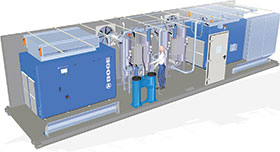
Founded in 1907, Boge develops and builds the compressed air systems needed to supply this important resource in its own factories. The plants come in a variety of forms, such as complete compressed air units built into maritime containers, can encompass as many as 45 000 parts, and are exported to 120 countries. The company has been using CAD systems for its design work since the 1980s, and since the early 2000s, its design engineers have added Solid Edge from Siemens PLM Software to their design armoury.

The modules at a glance

Today, Solid Edge is not only used to design Boge’s own piping system (AIRficient) as a method of measuring the air tightness and efficiency of important components. Boge also calls on the modular Solid Edge ‘construction kit’, comprising around 65 000 CAD components, when planning large-scale assemblies. Standard components can be added from libraries, and data from suppliers can be imported using the STEP (Standard for the Exchange of Product model data) format. As plant construction entails using a particularly high proportion of parts from subcontractors, Boge makes increasing use of synchronous technology from Solid Edge, which enables third-party geometries to be processed with ease, and then inserted into an assembly. All team members involved in the project who are not necessarily based in the same office are able to access the big picture of an assembly at any time as they work on the different components. This reduces the likelihood of errors during the initial assembly.

Direct link to the ERP system

Using the integrated FEM (Finite Element Method) module Solid Edge Simulation, it is immediately possible to check the correct dimensioning of components. This not only increases accuracy but also reduces the need for costly and time-consuming prototype production. Viewing models along the process chain simplifies many of the production steps such as quality inspection and final release. Through the direct integration of solid edge into the ERP system via the Engineering Control Centre, all relevant data, documents and processes can be managed and controlled over the entire product life cycle. To ensure that the software functions reliably, Siemens partner Solid System Team (SST) implemented the Smap3D PLM interface, which allows all processes taking place between development, purchasing, sales and production to be digitalised.

Focus on service

The advance of digitalisation has prompted Boge to explore new avenues in terms of its business models. The company is now offering its customers compressed air supplies in the role of service provider. The cooperation between SST and Boge is based on a similar footing. “Instead of being a reseller, we see ourselves as a provider of complete solutions and services along the value chain,” said Torsten Hartinger, project manager at SST.

“Because of our master services agreement with SST, we no longer have to have many competencies available in their entirety,” added Boge IT manager, Torsten Spork. “Instead we can concentrate on strategic alignment in the direction of digitalisation and innovation.”

The latest Boge innovation takes the form of the new S-4 models. Thanks to the new digital design tools, this fourth generation of the S series is easy to maintain and also highly economical in terms of energy consumption.

For more information contact Jennifer Naidoo, Siemens Digital Industries, +27 11 652 2795, [email protected], www.siemens.co.za


Credit(s)


Share this article:
Share via emailShare via LinkedInPrint this page

Further reading:

Turning system integrators into trusted technology partners
Schneider Electric South Africa IT in Manufacturing System Integration & Control Systems Design
Schneider Electric’s Alliance Partner Programme is repositioning system integrators from hardware suppliers into lifecycle-value partners. Oriel Soupen explains the competency framework, certification model and real-world results that are already helping African system integrators win higher-value, longer-term engagements.

Read more...
Why renewable projects need integrated protection and control
IT in Manufacturing
Fragmented secondary plant integration in renewable energy projects causes costly delays during commissioning. ACTOM Protection and Control’s Secondary Plant Integration solution consolidates all secondary systems under a single engineering framework, reducing risk and accelerating grid

Read more...
When digital twins move from concept to critical tool
IT in Manufacturing System Integration & Control Systems Design Maintenance, Test & Measurement, Calibration
Digital twins are moving out of the lab and onto the mine, the factory floor and the transport network where they predict failures before they happen. Amritesh Anand looks at where they earn their keep, the data and integration work behind them, and the security questions every organisation should ask before switching one on.

Read more...
How a digital foundation can overcome the LNG trilemma
Schneider Electric South Africa IT in Manufacturing SCADA/HMI
The LNG sector is racing to add capacity, but without a digital backbone, growth creates complexity rather than capability. Christophe Begat of Schneider Electric explains how connecting data, systems and analytics across the LNG value chain can resolve the trilemma of secure supply, lower emissions and tighter costs.

Read more...
Decarbonisation is reshaping mining strategy in Africa
Schneider Electric South Africa IT in Manufacturing Electrical Power & Protection
Mining companies across Africa are embedding decarbonisation into operational strategy, driven by investor, regulatory and customer pressure to reduce emissions while improving resilience.

Read more...
Siemens and HighByte partner to scale industrial AI
Siemens South Africa IT in Manufacturing Fieldbus & Industrial Networking
Siemens is expanding its Industrial Edge ecosystem through a partnership with HighByte, enabling customers to connect, contextualise and transform data from operational technology and information technology sources to build AI models and applications at scale.

Read more...
Africa on the edge of a digital future
Schneider Electric South Africa IT in Manufacturing
Edge computing promises lower latency, stronger reliability and real-time responsiveness across Africa, yet its rollout keeps colliding with one stubborn obstacle, power. Steven Santini explores how renewable microgrids, smart energy management and the right partnerships could turn the continent’s energy gap into its biggest edge opportunity.

Read more...
3D electrical systems design workflow for electromechanical innovation
Siemens South Africa Fieldbus & Industrial Networking IT in Manufacturing
Siemens has announced new 3D electrical design capabilities within its Capital software, enabling electrical and mechanical engineers to work concurrently in a shared 3D environment to reduce late-stage design changes and accelerate time to market for complex electromechanical products.

Read more...
Optimising energy reliability for African manufacturing
Electrical Power & Protection IT in Manufacturing
Unreliable power can cost African manufacturers as much as 31% in sales. Behind-the-meter power offers manufacturers in sub-Saharan Africa control, visibility and resilience in their energy provisioning.

Read more...
ISO 42001 helps organisations prepare for the realities of AI governance
IT in Manufacturing
A security specialist at Galix explains how a new international standard helps organisations build structured governance around their use of artificial intelligence.

Read more...


While every effort has been made to ensure the accuracy of the information contained herein, the publisher and its agents cannot be held responsible for any errors contained, or any loss incurred as a result. Articles published do not necessarily reflect the views of the publishers. The editor reserves the right to alter or cut copy. Articles submitted are deemed to have been cleared for publication. Advertisements and company contact details are published as provided by the advertiser. Technews Publishing (Pty) Ltd cannot be held responsible for the accuracy or veracity of supplied material.


© Technews Publishing (Pty) Ltd | All Rights Reserved

