


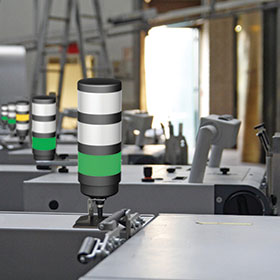
The IIoT is transforming the way manufacturers identify problems on the plant floor as the latest wireless solutions address integration challenges. A flashing red light on the plant floor often signals a problem on a production line or in a work cell. It is a familiar scene in lean manufacturing environments, where these Andon signals help plant workers quickly identify problems before they lead to excessive downtime.
Beyond the plant floor, traditional Andon alerts do not provide much information about the cause of disruptions or maintenance trends. But manufacturers can now leverage the Industrial Internet of Things (IIoT) to expand the capabilities of existing maintenance monitoring systems, such as Andon signals.
The IIoT eliminates data silos, so device-level data is accessible to the entire operations team. It provides valuable insights into machine performance, process inefficiencies and other potential risks. In this smart environment, wireless sensors enable real-time remote monitoring of machine performance. Manufacturers can use the information to increase overall equipment effectiveness (OEE), which is a calculation of manufacturing process efficiency.
How the IIoT improves machine monitoring
In today’s mobile world, wireless networks are everywhere and the advantages are clear. By eliminating the wire in conventional systems, wireless networks improve data logging and process monitoring and control, while maintaining high levels of security and integrity.
However, until recently, implementing a wireless network on the plant floor was challenging. In the past, wireless systems were difficult to install and maintain. Today, many remote monitoring solutions can be integrated into a single, inexpensive unit. Some of the key attributes of such systems include:
• Portability: I/O devices that manufacturers can easily install and then uninstall and move to a new location as monitoring requirements change.
• Less maintenance: The radio, I/O terminals and LCD screen are included within a single housing. This means fewer mechanical and wiring issues need to be incorporated into a maintenance schedule.
• Increased data analysis: A single wireless I/O device can collect both digital and analog sensor readings and forward this data to a central collection point for analysis. In addition, multiple sensor readings can be aggregated into a single gateway device before being forwarded to a host-controlled system for analysis.
Now, manufacturers can make device-level data accessible to operators and plant managers, providing valuable insights into OEE. The three primary factors included in an OEE calculation are availability, performance and quality.
The results of this calculation provide actionable insights into the critical sources of waste in a manufacturing operation. This is where access to data from sensors and indicator lights becomes very important. Logged data from sensors and indicators installed on machines can help manufacturers calculate OEE and identify steps to improve efficiency of their machines, processes, and people.
Monitor and track performance
When an operator ‘pulls the Andon cord’, or activates an alert, typically a light or display wired to the machine will only signal a stoppage or problem with the machine. It does not provide much insight into what is actually occurring internally.
IIoT-enabled alerts provide both the local machine status and remote status of each light module. Remote status indicators from wireless tower lights and other alert systems allow users to log trends in machine uptime and cycle counts. Capturing this data helps plants determine maintenance intervals and make decisions about new machine investments.
It also helps manufacturers identify whether a machine or operator is causing a bottleneck. For example, operators may blame missed production goals on machine downtime, while maintenance personnel point to inefficient workers as the root cause.
Plant managers can use real-time data collection to accurately verify when the delays were the result of machine downtime or operator inefficiency. For larger manufacturers with multiple plants, these trends can be transmitted to a central location and compared plant to plant to identify and replicate the successes of the highest-performing plants.
Condition monitoring for predictive maintenance
Wireless sensor networks also provide ongoing insight into overall machine health. By remotely monitoring different machine components, plants can detect excess vibration before it causes unplanned downtime. Typical IIoT-enabled vibration monitoring involves the use of a wireless vibration sensor that acts as a ‘check engine light’ for machines, by measuring root-mean squared (RMS) velocity. RMS velocity provides the most uniform measurement of vibration over a wide range of machine frequencies.
With Banner’s condition monitoring solution, a machine learning algorithm establishes a vibration baseline for the machine. When a machine exceeds its threshold, the wireless temperature and vibration sensor can deliver information to the local user, to a centrally located wireless tower light or to a mobile device via email or text message. The sensor can also send data to a PLC for collection.
The future of maintenance-related IIoT
Remote monitoring capabilities will continue helping manufacturers identify and remedy waste within their facilities, while advances in integration capabilities will continue to minimise costs and lead times during IIoT implementations.
The result: manufacturers can quickly and easily gather the data needed to identify the root cause of production issues and implement measures to increase efficiencies and prevent future disruptions.
For more information contact Brandon Topham, RET Automation Controls, +27 11 453 2468, [email protected], www.retautomation.com
| Tel: | +27 11 453 2468 |
| Email: | [email protected] |
| www: | www.turckbanner.co.za |
| Articles: | More information and articles about Turck Banner Southern Africa |






© Technews Publishing (Pty) Ltd | All Rights Reserved
 printer friendly version