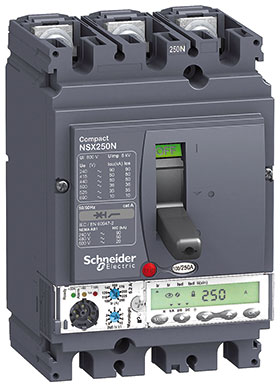
Schneider Electric has an innovative high breaking capacity for the Compact NSX range of moulded case circuit breakers (MCCBs), offering users more from their low voltage (LV) infrastructure and a cost-effective alternative to fuses over the long term.
Companies involved in the exploration, extraction and processing of natural resources look for the smartest, most cost-effective way to run their operations. Opportunities to lower capital costs and operating expenses often lie buried within a site’s LV power distribution networks.
Smart alternative to high-power fuses
The high breaking capacity of the Compact NSX MCCBs will withstand demanding fault conditions, staying reliably in service after three faults. After a fault is cleared, remote control reclosing functionality puts circuits back into operation quickly, enabling maximum operational continuity. Discrimination and coordination will isolate faults, to avoid system-wide outages. Over the long term, this reduces the cost impacts of downtime and avoids the labour and parts costs associated with fuse replacement, giving users a cost of ownership advantage.
Critical, high demand power distribution systems, operating at 440/480 V or lower, need protection against extreme short-circuit fault currents. Such faults occur in systems with multiple paralleled power sources or large numbers of motor loads. The higher breaking capacity of the Compact NSX range can be used to provide better protection and higher continuity.
Best-in-class protection
• Compact NSX has one of the highest-rated breaking capacities in its class of 100 kA for 500-690 V systems.
• Industry-leading breaking capacity of 200 kA at 440 V.
• Type II coordination for motor applications.
• Extended breaking capacity available across complete Compact NSX range from 100 to 630 A.
• Extended breaking capacity comes in the same space-saving frame sizes as all other Compact NSX models.
Class-leading performance enables the entire Compact NSX range to meet the requirements of applications that once mandated costlier, bulkier protection devices. Users can realise significant cost savings by safely running higher power densities on LV platforms or benefitting from the higher energy efficiency and reduced space requirements of a 690 V system.
Decoupling software from hardware for future-proofed process automation Schneider Electric South Africa
IT in Manufacturing
Schneider Electric explains why decoupling software from control hardware helps industrial operations modernise without disrupting production or replacing existing infrastructure.
Read more...Turning plastic waste into clean hydrogen
Electrical Power & Protection
Researchers have developed a solar-powered process that converts plastic waste into hydrogen and useful industrial chemicals while using spent acid from vehicle batteries. The approach could help create a circular system for dealing with several challenging waste streams at the same time.
Read more...Why cloud-ready BMS is reshaping building operations Schneider Electric South Africa
System Integration & Control Systems Design
Smart sensors and non-contact radar are reshaping industrial measurement, feeding connected platforms that predict failures before they happen.
Read more...SA port could generate wave energy
Electrical Power & Protection
A feasibility study has identified the potential for an 8,3 MW wave energy power station at the Port of Ngqura in the Eastern Cape, using the port’s existing breakwater infrastructure.
Read more...Schneider Electric inspires future women engineers Schneider Electric South Africa
News
Schneider Electric welcomed female engineering students from its education partner Sedibeng TVET College, Sebokeng to its Midrand headquarters for its Mandela Day Mentorship Café initiative, transforming a day of service into a day of inspiration, learning and opportunity.
Read more...South Africa’s battery manufacturing potential
Editor's Choice Electrical Power & Protection
A feasibility study commissioned by the Localisation Support Fund concludes that South Africa has the technical and commercial foundations to develop a competitive lithium iron phosphate battery manufacturing sector, anchored by growing regional demand and favourable industrial conditions.
While every effort has been made to ensure the accuracy of the information contained herein, the publisher and its agents cannot be held responsible for any errors contained, or any loss incurred as a result. Articles published do not necessarily reflect the views of the publishers. The editor reserves the right to alter or cut copy. Articles submitted are deemed to have been cleared for publication. Advertisements and company contact details are published as provided by the advertiser. Technews Publishing (Pty) Ltd cannot be held responsible for the accuracy or veracity of supplied material.










 printer friendly version