


Sensors & Transducers


Early fire warning prevents losses at waste to energy facility

February 2018 Sensors & Transducers

For companies involved in waste management, spontaneous fires are a fact of life and the critical issue is, therefore, to detect an outbreak as efficiently as possible and prevent it from spreading. For one such company in Sweden, FLIR thermal imaging cameras have played an essential role in this effort since 2016.

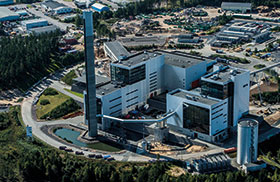
Jönköping Energi turns some 160 000 tons of waste per year into heat and electricity, sufficient to cover the annual needs of 25 000 households. Preventing and controlling fires is not only a matter of safety but also of economics.

“We have trucks bringing in waste not just from the surrounding area but from all over Europe that is dumped in a waste bunker, mixed by automatic cranes and stored awaiting transportation to the boiler,” explained plant manager, Magnus Olsson. “These waste piles can be a dangerous mix. Spontaneous combustion from biological products or other heat sources is a continual threat that needs to be monitored 24/7. Apart from the environmental consequences and obvious safety risks, an outbreak of fire can be very costly. That is why it is so important to have a reliable early warning system.”

Historically, the plant relied on aspiration-based smoke detection that pulled in air from the environment to analyse it for the presence of smoke, but its main failing was speed. For the system to generate an alarm, smoke had to make physical contact with the sensor, which was installed high up in the ceiling of the waste bunker. By the time this happened a fire could have already taken hold.

Infrared technology provides the solution

To provide the sixth sense it clearly needed, Jönköping Energi switched to a system from Termisk Systemteknik based on FLIR thermal imaging. For fire detection, infrared is a superior technology because it senses the surface temperature of material. In effect, it ‘sees’ the source of the fire in its infancy, before it has the chance to develop.

The chosen system comprises two FLIR A615 thermal imaging cameras in protective housings mounted on pan and tilt systems, one at each end of the bunker. They are controlled via Termisk’s dedicated TST Fire software so that when a hot spot is detected by one camera, the other camera is trained on it too.

The software calculates the co-ordinates of the hotspot based on the combined thermal images and an alarm is generated. From the waste bunker control room, operators can then direct the water canon to the hotspot to extinguish the fire.

“This system has proved to be very accurate as it is able to measure temperatures to a fraction of a degree,” confirmed Claes Nelsson of Termisk Systemteknik. “Thanks to the high resolution of the two FLIR cameras – 640 x 480 pixels – the entire bunker can be monitored in high detail. This enables the control room operators to detect really small hot spots. The FLIR A615 is one of our preferred FLIR cameras for this type of application as it operates with a Gigabit Ethernet interface so it integrates very well with our software.”

Compliance with GigEVision and GenICam standards allows the FLIR A615 to be integrated with a wide variety of similarly compliant equipment and is supported by a choice of third-party software such as TST Fire. Trigger and synchronisation capabilities enable it to control, or be controlled by a host of other types of equipment. When used with wireless and fibre optic line adaptors this high-performing camera can be used almost anywhere, including over long distances.

For more information contact Reynhard Heymans, FLIR South Africa, +27 (0)11 300 5622, [email protected], www.flir.com


Share this article:
Share via emailShare via LinkedInPrint this page

Further reading:

Telco sensors in conveyor belt monitoring
Sensors & Transducers
Gail Norton Instrumentation Agencies has developed a low-maintenance conveyor belt monitoring unit built on robust Telco infrared sensors, detecting belt tear and misalignment reliably in harsh coal mining environments.

Read more...
Inductive ring sensors monitor material flow in feeding technology
ifm - South Africa Sensors & Transducers
ifm’s inductive ring sensors detect metallic parts such as screws and nuts as they pass through tubes at speeds up to 35 m/s, enabling precise counting, flow control and blockage detection, with sensitivity and output functions configurable via IO-Link.

Read more...
Reliable 1D and 2D code reading made simple
SICK Automation Southern Africa Sensors & Transducers
SICK’s new sensingCam SEC200 image-based code reader brings supermarket-checkout simplicity to logistics and industrial identification, reading 1D and 2D codes reliably with quick browser-based setup, rugged IP65 construction and CRA-compliant cybersecurity.

Read more...
Market opportunity for sensors in humanoid robots
Sensors & Transducers
A new IDTechEx report forecasts the market for sensors in humanoid robots will exceed $6,59 billion by 2037, driven by perception sensors, force/torque sensors, encoders and inertial measurement units across a growing range of commercial robot platforms.

Read more...
The wireless route to safer, more efficient mining operations
Emerson Automation Solutions Editor's Choice Sensors & Transducers
Modern wireless level measurement technologies are helping mining operations improve process control, increase safety and reduce installation costs. Emerson’s Rosemount 3408 wireless non-contacting radar level transmitter uses 80 GHz frequency-modulated continuous wave radar with HART communication to reach remote assets where cabling is impractical.

Read more...
Telco sensors for harsh environments
Sensors & Transducers
Telco sensors are designed to operate where moisture, particulate contamination and surface fouling would disable conventional sensors, with a range including an adjustable five-metre infrared proximity sensor for harsh industrial environments.

Read more...
The data-driven path to sustainable manufacturing
ifm - South Africa Editor's Choice Sensors & Transducers
Smart automation is closing the gap between operational efficiency and environmental responsibility, and the data to do it is already inside the plant. With ifm’s sensing and digitalisation technologies, manufacturers can turn machine intelligence into measurable sustainability gains.

Read more...
Expanding visibility in mining operations
Emerson Automation Solutions Editor's Choice Sensors & Transducers
Advances in wireless communications, condition monitoring and sensing technologies are helping mining operators extend measurement into previously under-monitored areas, improving equipment reliability, process performance and water stewardship.

Read more...
Fiber-optic amplifiers for precise object detection
ifm - South Africa Sensors & Transducers
The OCF fibre-optic amplifier detects even the smallest or most transparent objects in confined spaces, making proven fibre-optic technology easier and more user-friendly than before.

Read more...
The next era of measurement and instrumentation
Sensors & Transducers
Smart sensors and non-contact radar are reshaping industrial measurement, feeding connected platforms that predict failures before they happen.

Read more...


While every effort has been made to ensure the accuracy of the information contained herein, the publisher and its agents cannot be held responsible for any errors contained, or any loss incurred as a result. Articles published do not necessarily reflect the views of the publishers. The editor reserves the right to alter or cut copy. Articles submitted are deemed to have been cleared for publication. Advertisements and company contact details are published as provided by the advertiser. Technews Publishing (Pty) Ltd cannot be held responsible for the accuracy or veracity of supplied material.


© Technews Publishing (Pty) Ltd | All Rights Reserved

