


Maintenance, Test & Measurement, Calibration


Cost-effective pressure calibration

February 2018 Maintenance, Test & Measurement, Calibration

An affordable solution

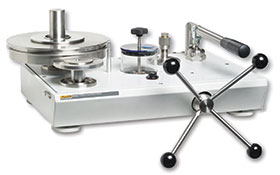
Today’s automated calibrators and state-of-the art piston gauges have a high cost of entry, but a simple and cost-effective solution to cover a wide range of pressure calibrations is the deadweight tester. For many years, deadweight testers have been trusted as accurate and reliable standards for calibrating pressure gauges, transducers, transmitters and portable calibrators. Due to their fundamental method of pressure measurement using calibrated piston cylinders and masses, they offer unmatched measurement stability and reliability. Due to excellent deadweight tester stability, owners often extend recalibration intervals beyond one year, reducing the cost of ownership.

Why deadweight testers?

A key advantage of deadweight testers is that all of the hardware required to generate pressure and precisely control and measure it can be contained within the instrument. On-board hand pumps are offered on Fluke Calibration deadweight testers to generate vacuum or air pressure, or to prime higher pressure hydraulic systems. Precise control of higher pressures is accomplished using a built-in fine control screw press. No external readouts or power supply are needed for deadweight tester operation. Deadweight testers also inherently regulate a stable test pressure once the piston is floated, solving a problem that operators of some manual pressure calibrators encounter.

Deadweight testers also measure accurately over a wide range of pressure. The uncertainty of deadweight tester measurements is a percent of the measured value (% of reading). By including multiple piston cylinders, a single deadweight tester can calibrate units under test with full scale ranges that vary by a ratio of 100:1 or more. For example, a P3025 pneumatic deadweight tester can measure from vacuum to 3500 kPa. A P3125 hydraulic model measures from 100 kPa to 110 MPa.

The business case for calibrating in-house

A deadweight tester can be purchased at a very reasonable upfront cost, often less than a third of a sensor-based calibrator with comparable specifications. Purchase of a deadweight tester can offer a favourable payback by calibrating as few as 25 pressure devices per year. Some additional economic factors to consider are:

• Calibrating in-house reduces the downtime when sending devices out.

• Shipping charges can be avoided by calibrating in-house.

• Owning a pressure standard makes calibrating devices multiple times per year practical when the application calls for it.

• Commercial labs can offer more comprehensive services to their customers with fast turnaround by acquiring pressure capability.

Fluke calibration quality

While seeking an affordable solution, calibration professionals must still ensure they are using a reliable instrument that will be convenient to use and offer years of reliable service. Fluke Calibration deadweight testers come with accredited calibration and offer features and refinements that offer practical benefits over lower performing industrial solutions:

• Dual piston models allow coverage of a very wide pressure range without changing pistons.

• A high quality fine control screw press makes it easy to control pressure precisely in both increasing and decreasing direction.

• Hand-tightened O-ring-based connection allows connection of units under test without tools or thread tape.

• Visible fluid reservoir on hydraulic models allows users to monitor the level and condition of test media.

Fluke Calibration deadweight testers include pressure generation and test connection hardware to allow operators to get started quickly. With little or no training, operators are able to perform calibrations efficiently. But as always, Fluke Calibration application experts are there to support with installation and operation assistance to make the most of an investment.

For more information contact Comtest, +27 (0)10 595 1821, [email protected], www.comtest.co.za


Credit(s)


Share this article:
Share via emailShare via LinkedInPrint this page

Further reading:

Oils don’t die, they degrade
Wearcheck Maintenance, Test & Measurement, Calibration
WearCheck explores the main ways lubricants degrade in service and how these degradation modes affect oil performance and machine reliability.

Read more...
Real-time spectrum analyser
Vepac Electronics Maintenance, Test & Measurement, Calibration
The PXE series real-time spectrum analyser covers frequencies up to 20 GHz with a 100 MHz analytical bandwidth and ultra-fast sweep speed, supporting spectrum monitoring, interference finding and RF test and measurement functions.

Read more...
Preserving a French heritage landmark
Omniflex Remote Monitoring Specialists Maintenance, Test & Measurement, Calibration
Omniflex supplied a remotely monitored impressed current cathodic protection system for the Perret Tower in Grenoble, a protected French heritage site, combining 24/7 corrosion protection with integrated surge protection against lightning strikes.

Read more...
Operational efficiencies and safety compliance with preventive maintenance programmes
Maintenance, Test & Measurement, Calibration
Konecranes explains how its Lifecycle Care Preventive Maintenance programme reduces unexpected downtime, improves safety compliance and delivers measurable financial benefits for operators of cranes and lifting equipment across any make or sector.

Read more...
Portable appliance tester
Vepac Electronics Maintenance, Test & Measurement, Calibration
Vepac Electronics’ new portable appliance tester enables precise safety testing of electrical appliances in accordance with DGUV regulation 3 and BetrSichV, with simple three-button operation and battery-powered mobility.

Read more...
Why lubrication fails in mining and what to do about it
Maintenance, Test & Measurement, Calibration
Lubrication Engineers explains the recurring failure points behind mining lubrication problems and how the right product, storage and application practices can improve equipment reliability.

Read more...
When digital twins move from concept to critical tool
IT in Manufacturing System Integration & Control Systems Design Maintenance, Test & Measurement, Calibration
Digital twins are moving out of the lab and onto the mine, the factory floor and the transport network where they predict failures before they happen. Amritesh Anand looks at where they earn their keep, the data and integration work behind them, and the security questions every organisation should ask before switching one on.

Read more...
Why asset level intelligence is now essential for resilient wastewater plants
Schneider Electric South Africa Maintenance, Test & Measurement, Calibration
Sub-Saharan Africa’s wastewater operators face mounting pressure to keep ageing plants running smoothly and meet tougher environmental standards, all while lacking visibility into the health of their medium-voltage (MV) drives and other critical rotating assets. Adding predictive analytics, digital twins and enterprise dashboards enables optimisation across multiple sites, ensuring every drop moves safely and efficiently through the water cycle.

Read more...
How multiple boilers can minimise costly downtime
Maintenance, Test & Measurement, Calibration
Associated Energy Services explains how multi-boiler systems reduce downtime risk for South African manufacturers, covering redundancy planning, fuel source diversification and the strategic management of backup boiler capacity.

Read more...
Field calibration made easy
Instrotech Maintenance, Test & Measurement, Calibration
Instrotech’s locally designed and manufactured Calog calibrator range feature a rugged IP54-rated housing, backlit display with data logging via SD card, and a lithium-ion battery with approximately eight hours of run time.

Read more...


While every effort has been made to ensure the accuracy of the information contained herein, the publisher and its agents cannot be held responsible for any errors contained, or any loss incurred as a result. Articles published do not necessarily reflect the views of the publishers. The editor reserves the right to alter or cut copy. Articles submitted are deemed to have been cleared for publication. Advertisements and company contact details are published as provided by the advertiser. Technews Publishing (Pty) Ltd cannot be held responsible for the accuracy or veracity of supplied material.


© Technews Publishing (Pty) Ltd | All Rights Reserved

