Remote projects that happen far from national power grids tend to pay a premium for generating their own energy; so they need to plan carefully and use it as efficiently as they can.
This is the advice of Zest WEG Group CEO Louis Meiring, who emphasises the opportunities presented by modern technology to reduce energy consumption in just about any industrial or mining enterprise.
“Savings of three to five percent of energy consumed on site is a realistic target for most projects, especially if the enabling technologies and equipment can be incorporated into the design at an early stage,” says Meiring. “As a group that offers both power generation solutions as well as energy efficiency technologies, we can readily identify and quantify the efficiency benefits for customers.”
He says the potential savings lie not only in the operating cost of the standalone power generating facility, but in the capital expenditure for construction, as better utilisation efficiencies can reduce the maximum output capacity required from the plant.
Alastair Gerrard, managing director of Zest Energy, says his company – which specialises in power supply solutions – works closely with EPCMs or directly with customers to plan and implement optimal solutions. This approach ensures that equipment life cycle costs are well controlled and contribute to overall project efficiency.
“In addition to ensuring the right power generation solution for customers, we enhance our value-add through our knowledge of exactly how the generated energy can be best used,” says Gerrard. “WEG’s high efficiency, IE3 rated motors, for instance, can reduce the power consumed in a range of industrial functions such as pumping, conveyor systems and ventilation.”
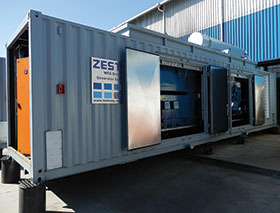
Zest Energy recently installed a turnkey diesel power generation facility for the Balama graphite project in a remote region of Mozambique.
Technology options such as variable speed drives can further enhance efficiencies and reduce the consumptive demands that a standalone power plant will have to meet; regeneration strategies also lower costs by feeding power back into the network.
“There is also potential for ‘heat and power’ co-generation as an efficiency strategy,” says Gerrard, “where heat can be drawn off equipment like engines to feed back into plant functions, rather than being dissipated with no benefit.”
He sees a trend among many industrial users towards pursuing higher energy efficiencies, as this can improve the cost-per-hour of running their assets and lead to a reduction in emissions by using more efficient technologies.
“There is also a growing interest in hybrid solutions that can incorporate renewable energy sources like solar and wind, alongside traditional fossil fuels,” concludes Gerrard.
Retrofitting for sustainability Schneider Electric South Africa
Electrical Power & Protection
As budgets tighten and sustainability targets increase, retrofit and modernisation strategies are gaining traction across Africa, allowing organisations to upgrade only what limits performance while preserving existing infrastructure and extending asset life.
Read more...USB-Datalogger for voltage 0 to 30 V DC Vepac Electronics
Electrical Power & Protection
The PeakTech 5186 is a data logger for DC voltages from 0 V to 30 V with terminals on the top of the device.
Read more...Pole-top boxes for smarter, more secure electricity networks
Electrical Power & Protection
As South Africa accelerates the rollout of smart prepaid electricity metering, innovative enclosure technology from Power Process Systems is helping utilities improve network security, reduce electricity theft and protect critical electrical infrastructure.
Read more...Simplifying electrical design compliance
Electrical Power & Protection
Referro Systems highlights how Rockwell Automation’s Global SCCR Tool simplifies short-circuit current rating compliance for complex industrial electrical systems.
Read more...Engineering resilience into Africa’s energy future
Electrical Power & Protection
Zutari’s managing director of water explains how Burundi’s landmark Jiji and Mulembwe hydropower projects demonstrate what resilient, climate-adapted infrastructure delivery looks like – and what this means for Africa’s energy future.
Read more...Voltage Tester with LED-Display Vepac Electronics
Electrical Power & Protection
The PeakTech 1094 is a reliable and robust two-pole voltage tester that has been specially developed for the safe and precise measurement of AC and DC voltages in the 12 to 400 V range.
Read more...Schneider Electric launches circuit breaker for cost-effective LV protection Schneider Electric South Africa
Electrical Power & Protection
Schneider Electric has launched its EasyPact CVS C4 moulded case circuit breaker in South Africa, extending the Easy series to 1 600 A and giving consultants, contractors, and end users a cost-effective solution for non-critical low-voltage applications.
Read more...Schneider Electric launches cost-effective, high-performance LV protection Schneider Electric South Africa
Electrical Power & Protection
Schneider Electric has launched its EasyPact NW air circuit breaker in South Africa, extending its Easy series portfolio with a cost-effective solution for non-critical low-voltage applications in commercial, industrial and residential projects.
Read more...SF6-free switchgear brings digital intelligence to mining Schneider Electric South Africa
Electrical Power & Protection
Combining pure-air switchgear with embedded digital intelligence helps mines cut greenhouse gas emissions, improve safety and meet sustainability targets while enabling real-time visibility into critical electrical assets.
While every effort has been made to ensure the accuracy of the information contained herein, the publisher and its agents cannot be held responsible for any errors contained, or any loss incurred as a result. Articles published do not necessarily reflect the views of the publishers. The editor reserves the right to alter or cut copy. Articles submitted are deemed to have been cleared for publication. Advertisements and company contact details are published as provided by the advertiser. Technews Publishing (Pty) Ltd cannot be held responsible for the accuracy or veracity of supplied material.










 printer friendly version