



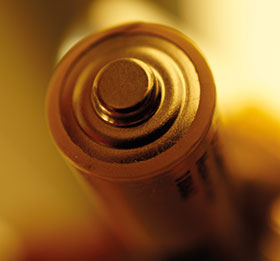
The opportunities for spin-out businesses and industries from university research projects are multiplying. The growth in this sector comes from the acceleration of technology in general, but also because the increased investment in education means there are a lot more research students, some with good ideas, but others just looking for topical subjects to latch onto for their research project. Also, industry has learnt that by funding some low cost university research, other ideas might emerge that might be of benefit.
A lot of attention is being given to new designs of battery, as there are some well-known major commercial projects where new systems are needed. First to come to mind would be batteries for electric cars like the Tesla. Here, low-cost, lightweight and relatively compact devices are needed, with high-power output and fast charging. Second are the batteries (or systems) needed to store the power generated by solar farms or wind turbines, during the hours when it is not needed, so that it is available for different times of the day. Possibly lower down the priority list are the small long-life battery systems needed for IIOT sensors and industrial sensors in general. These do not have the major numbers, or the (relatively) high price, so do not attract as much attention.
Eliminating standby power drain
So, it was all the more interesting to hear of research at Bristol University, in the UK, where Dr Stark and his colleagues in the Bristol Energy Management Research Group have developed an electronic chip that can switch on a sensor only when that sensor is being asked to provide or monitor data: for the rest of the time the chip and the circuits which it controls consume no energy at all. It may not be a new battery development as such, but it would allow a much extended battery life, by eliminating all stand-by current drain.
The principle is that the chip uses the small amount of energy transmitted in the interrogation signal from the system asking for the data, to trigger a circuit that switches the device on. The interrogation signal could be from an infrared remote control, or a wireless signal. The team developed their circuit using the same principles as those used in computers to monitor their internal power supply rails – to ensure the voltage does not dip below a certain threshold. The trigger signal uses a few picoWatts of energy, and a signal threshold level of 0,5 V, which is achievable from a passive sensor, just using the received wave energy.
The natural follow-on from this concept is that the trigger signal on some sensor applications could be derived from the event being monitored, such as a rapid increase in the sound or vibration levels of plant machinery. Also, for a security alarm, the movement of a hinge or similar could be sensed magnetically. Conventional power management techniques would be used to switch the sensor off once the data has been transmitted to, and acknowledged by, the monitoring systems.
Power storage
With solar and wind energy providing such a large part of the power used by the National Grid in certain areas, many ways are being researched to achieve power storage over the short term, such as 24 hours. There are already companies providing large storage systems with banks of conventional batteries, acting like very large uninterruptible power supply (UPS) systems. In Spain and the USA there are solar collector systems where the sun’s heat is concentrated onto a central collector, melting sodium salts: the heat is later used to drive a steam turbine. Further systems are being trialled where surplus energy is used to liquefy gases, or compress them in a high pressure chamber, later the stored gas can be used to drive a turbine generator.
A novel development of a battery cell reported recently is the use of a low cost electrolyte for use with aluminium and graphite electrodes. Dr Dai, at Stanford University, in collaboration with Taiwan’s Industrial Technology Research Institute, demonstrated such a battery powering a motorbike in 2015, but the electrolyte was expensive. The new electrolyte is 100 times less expensive – it is based on urea. Dr Dai sees this as a useful solution for storing solar power, even domestically – maybe new houses will have such a system underground, and call it a “Power storage pit”!

Nick Denbow spent thirty years as a UK-based process instrumentation marketing manager, and then changed sides – becoming a freelance editor and starting Processingtalk.com. Avoiding retirement, he published the INSIDER automation newsletter for 5 years, and then acted as their European correspondent. He is now a freelance Automation and Control reporter and newsletter publisher, with a blog on www.nickdenbow.com






© Technews Publishing (Pty) Ltd | All Rights Reserved
 printer friendly version