



The convergence of specialist skills and advanced technology is becoming critical, a trend underscored by two recent projects completed by boiler operations and maintenance expert, Associated Energy Services (AES) in the food manufacturing sector.
“Consistently collecting and interpreting data is key to optimising efficiency and productivity when operating and maintaining boilers. Remote monitoring systems (RMS) are integral to ensure effective management and safety. AES adds value by identifying and pre-empting problematic scenarios. By applying a dynamic blend of control systems, remote monitoring and human skills, we not only prevent downtime, but also improve operational efficiencies and contain costs while complementing and supporting complex production systems,” explains AES commercial director, Dennis Williams.
A tale of two projects
The first project involves a longstanding food processing client whose outdated boiler control system had become costly to maintain. AES was tasked with upgrading the system while retaining some of the existing equipment.
“The plan was to upgrade one boiler, and then after proof of concept, update the other two. However, the year-end shutdown saw our client decide to do all three at once, giving AES an extremely tight timeline. We managed to do it, even though there was some commissioning and fine-tuning in the months following the start-up,” says AES projects director, Gavin Evezard. A key feature of the upgraded system was the implementation of load balancing across the three boilers, ensuring that no single boiler carried a disproportionate share of the load.
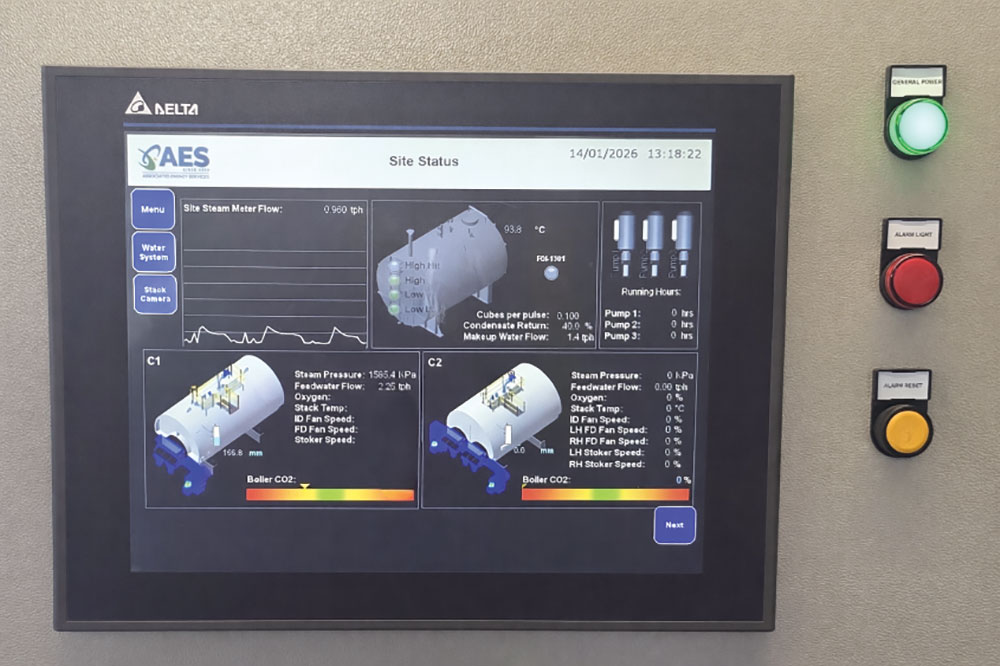
The second project, undertaken for a new food sector client, involved the installation of a fully customised control and RMS solution. The system included a web-based interface that enabled real-time monitoring, data analysis and performance tracking.
“Although the system is based on our core control ethos, the client had very specific requirements, and we customised it to meet their needs by incorporating different operating modes. At different times and in different sections of the plant, they have varying steam pressure requirements. We catered for all of that,” Evezard continues.
Supply chain constraints were also a challenge, requiring AES to rethink its approach to in-factory assembly and testing, focusing rather on onsite completion. “We had to get the standing boiler control system done so we could restart it as the operating boiler was developing problems. The aim was to give our client the redundancy on steam that they needed. We had to optimise planning and we managed to get that equipment up and running quickly to minimise delays.”
From data to decision-making
Both projects highlight the growing importance of data-driven decision making. RMS platforms allow operations management to monitor performance, investigate anomalies and conduct detailed root cause analyses, considering aspects such as fuel consumption, emissions and ensuring the right steam supply at the right pressure.
“When there are issues on the plant, we have all the data recorded on our RMS and can go back to see exactly what happened. We can do proper root cause analysis and thereby prevent any future incident or issue,” Evezard notes.
During the second project, AES incorporated additional metrics tailored to the client’s operational needs, including comparable fuel consumption rates and boiler performance indicators under manual and automatic operating modes.
Evezard emphasises that such customisation is essential in South Africa where many industrial boilers are old. “There is a large fleet of boilers which are between 30 and 60 years old. Original equipment manufacturers may no longer have the software available to diagnose or solve problems, and many operate offshore, making it expensive to bring them to South Africa. Our systems are in-house. We have the teams, skills and the keys. We can diagnose and fix problems, getting boilers operational again, and mitigating the risk and cost of downtime.”
Critical human factor
Despite advances in automation and control technology, both Williams and Evezard emphasise that human expertise remains indispensable. “Unfortunately, with solid fuel boilers specifically, a degree of operator input is needed. The control system can only do so much, but at the end of the day, a human needs to do some checks and set up the boiler in line with production facility requirements,” Evezard emphasises.
Williams concurs, particularly regarding fuel quality and safety. “If you make things too hands-off, essential safety aspects may not be addressed. Consistent human oversight mitigates the risk associated with combustion and steam vessels under pressure,” he explains.
Long-term value
Beyond immediate production efficiency gains, AES sees the two project examples cited as catalysts for longer-term partnerships. Williams notes that for AES, more than 75% of boiler upgrade projects evolve into ongoing service relationships. “The entire project becomes a proof of concept for the way forward,” he says.
Measurement is central to this value proposition. “When you have a measurable objective available, you can show the client what you are seeing in their plant and explain how you can assist. This provides tremendous value and also builds a relationship,” Evezard adds.
Furthermore, the enhanced visibility afforded by AES’s RMS and control systems is often transformative for clients. “Often they do not fully appreciate that the delivery of steam in their facility is actually a combination of converting fuel into useful steam, reticulating, and using that steam. Our RMS and control systems allow clients to actually see what is happening and understand the value of managing the boiler house and steam generation in the way in which AES does,” Williams concludes.
For more information contact AES,






© Technews Publishing (Pty) Ltd | All Rights Reserved
 printer friendly version