


Analytical Instrumentation & Environmental Monitoring


ABB extends Navigator for power applications

March 2017 Analytical Instrumentation & Environmental Monitoring

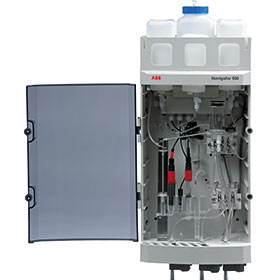
ABB’s new Navigator 500 analyser family brings a compact, reliable and accurate range of instruments for high purity water treatment and boiler chemistry monitoring applications. Providing continuous online monitoring of boiler feed water quality, the Navigator 500 Hydrazine, Dissolved Oxygen and Sodium analysers help ensure optimum efficiency of both boiler plant and ancillary equipment throughout the steam distribution loop. The second in the Navigator analyser series, the Navigator 500 joins ABB’s Navigator 600 Silica and Phosphate devices for power generation applications.

A key feature across the 500 series is its separate sensor and transmitter section design. All analysis and signal conditioning is conducted within the sensor section and transmitted digitally to the transmitter. Each transmitter can collect data from up to four sensors. This enables monitoring at multiple points without the cost associated with purchasing and installing separate transmitters. The four transmitter inputs can be used to collect signals on one parameter or can be mixed and matched, with multiple parameters being fed to one unit. In contrast to traditional single-stream devices, the Navigator 500 Sodium sensor can also be configured for multi-stream analysis, with up to three sample streams able to be handled by a single sensor unit.

Hydrazine

The Navigator 500 Hydrazine is used for applications where hydrazine is used to dose boiler feed water to reduce dissolved oxygen levels. The sensor uses an electro-chemical cell to accurately measure the amount of hydrazine in boiler feed water. This accuracy is reinforced by temperature compensation, which, coupled with a fast response time, helps ensure that readings reflect the actual feed water conditions. The information provided by the analyser makes it possible to avoid expensive over-dosing of hydrazine or the avoidance of more costly corrosion damage to the boiler plant due to the under-dosing of hydrazine.

Sodium

The Navigator 500 Sodium provides a continuous measurement of sodium concentrations. It uses ABB’s sodium ion-selective electrode and reference electrode to measure the sodium ion concentration in demineralisation plants and in the steam / water cycle of steam-raising plants. The instrument requires very little maintenance and measures sodium ion concentrations within the range 0,10 ppb to 10 ppm. This accuracy is reinforced by automatic temperature compensation, ensuring that readings reflect the actual process conditions. Other key features include a grab sample mode and automatic electrode regeneration. The grab sample mode enables the device to be used to test a sample from elsewhere in the plant. Unlike conventional devices where the operator needs to switch to analysis mode, wait for a reading and switch back to measurement mode, the Navigator 500 Sodium stores a reading in its audit log and automatically switches back to measurement mode as soon as the analysis is done. This eliminates the need for the operator to wait for a reading, which can take several minutes.

Automatic electrode regeneration helps to prolong the life of the sensor electrode, particularly useful in applications where sodium needs to be measured at very low levels for long periods. To prevent diminishing sensor performance, the analyser can be preset to automatically regenerate the electrode by adding a regeneration reagent at set periods.

Dissolved oxygen

The Navigator 500 Dissolved Oxygen analyser uses ABB’s maintenance-free dissolved oxygen sensor. Featuring an encapsulated design, the sensor removes the need for time consuming maintenance such as membrane changes or electrolyte replenishment. The ‘pump-less’ design of the instrument reduces maintenance requirements compared to alternative products. The automatic electrode regeneration feature also further reduces routine maintenance.

The release of the Navigator 500 series further strengthens ABB’s continuous water analysis portfolio for high purity water treatment applications and power cycle chemistry monitoring, augmenting its existing strengths in other parameters such as silica, phosphate, pH and conductivity.

For more information contact Jacolize Goosen, ABB South Africa, +27 (0)10 202 5000, [email protected], www.abb.com/measurement


Credit(s)


Share this article:
Share via emailShare via LinkedInPrint this page

Further reading:

Matching HVAC to the real demands of buildings and processes
Analytical Instrumentation & Environmental Monitoring
Industrial Climate Engineering director, Alin Gomes explains why effective HVAC goes beyond specifying equipment on capacity, covering load profiling, ventilation requirements, heat recovery and turnkey delivery for specialised manufacturing and processing environments.

Read more...
How SCE approaches sensor selection for critical environments
Specialised Climate Engineering Analytical Instrumentation & Environmental Monitoring
Specifying the right sensor for a critical climate involves far more than matching a datasheet accuracy figure. As an authorised Vaisala HVAC partner, SCE explains how understanding the environment, the measurement purpose and sensor placement determines effective climate control.

Read more...
Changing gas quality calls for smarter combustion control
Analytical Instrumentation & Environmental Monitoring
As South Africa prepares for a transition from declining Mozambican natural gas to a proposed methane-rich bridge, LNG, industrial users can no longer assume a constant Wobbe Index and calorific value. The compact RMG RGQ 5 provides fast, plant-level gas-quality data to support approved burner and engine settings.

Read more...
Smarter energy management starts with intelligent electrification
ABB South Africa ABB Electrification Products Electrical Power & Protection
ABB Electrification specialists Adeline Maleka and Nokulunga Dube explain how the convergence of electrification, digitalisation and automation is helping South African industries gain real-time visibility, reduce energy waste and build operational resilience.

Read more...
Getting the chemistry right
Analytical Instrumentation & Environmental Monitoring
Grace’s European production site has relied on analogue compression load cells from Minebea Intec for decades, with the long-proven measurement concept now serving as the reference for new silo projects as the company expands its capacity.

Read more...
Why measurement matters in smelting
Endress+Hauser South Africa Analytical Instrumentation & Environmental Monitoring
South African smelters returning to operation after energy constraints face new demands for tighter control, better visibility and environmental compliance. Endress+Hauser explains how modern measurement technology supports safer, more efficient furnace operation and local beneficiation.

Read more...
Sun tracking with pinpoint precision
Senseca Analytical Instrumentation & Environmental Monitoring
Senseca has introduced the SEMS-2000 solar energy measurement system, a 2-axis solar tracker with pinpoint sun-pointing accuracy that automatically monitors direct, global and diffuse irradiance for unattended outdoor solar installations.

Read more...
Women shaping engineering at ABB
ABB South Africa News
Two ABB engineers share how curiosity, mentorship and an inclusive culture have shaped their careers, and what they see as the most exciting opportunities for women in engineering across Africa.

Read more...
AMETEK expands 993X gas analyser series with explosion-proof enclosures
Analytical Instrumentation & Environmental Monitoring
AMETEK Process Instruments has added ATEX and IECEx Zone 1-certified explosion-proof enclosures to its 993X series of gas analysers, enabling reliable installation in Zone 1 hazardous locations where purge gas is unavailable.

Read more...
Why medical device leak testing matters for South Africa's MedTech future
ATEQ South Africa Analytical Instrumentation & Environmental Monitoring
As South Africa works to grow local medical technology manufacturing, non-destructive leak and flow testing is becoming a strategic quality assurance tool, helping manufacturers verify device integrity, meet regulatory requirements and improve production efficiency.

Read more...


While every effort has been made to ensure the accuracy of the information contained herein, the publisher and its agents cannot be held responsible for any errors contained, or any loss incurred as a result. Articles published do not necessarily reflect the views of the publishers. The editor reserves the right to alter or cut copy. Articles submitted are deemed to have been cleared for publication. Advertisements and company contact details are published as provided by the advertiser. Technews Publishing (Pty) Ltd cannot be held responsible for the accuracy or veracity of supplied material.


© Technews Publishing (Pty) Ltd | All Rights Reserved

