


System Integration & Control Systems Design


Developing smart tools for the Airbus factory of the future

Technews Industry Guide - Industrial Internet of Things 2016 System Integration & Control Systems Design

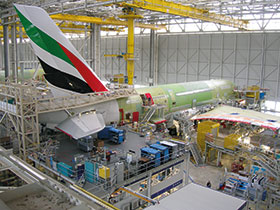
Today’s aerospace factory floor is nothing like the hectic, noisy production facility of the past. The latest techniques, designs and equipment make modern manufacturing efficient, organised and structured. But what about tomorrow? The future of the aircraft factory is a research and technology project aimed to push emerging technologies to improve the competitiveness of Airbus manufacturing processes where manual operations are still predominant today.

The challenge

Manufacturing and assembly of aircraft, which involve tens of thousands of steps that must be followed by operators, and a single mistake in the process could cost hundreds of thousands of dollars to fix, making the room for error very small.

The solution

Adding intelligence to the tools and shopfloor systems will help to simplify the production process and provide improved efficiency by managing and checking the tasks the operator is completing. Using the National Instruments (NI) System on Module, quick prototyping of these smart tools is enabled using NI’s approach to system design.

Results

Cyber-physical systems and Big Analog Data enable a smarter, operator-centric production that allows operators and machines to collaborate in the same physical environment. The Factory of the future also implies the extensive use of a modular platform with a high level of abstraction based on commercial off-the-shelf modules. One of the key components for improving efficiency in such the factories is smarter tools. These smart devices are designed to communicate with a main infrastructure or locally with operators or other tools, but only when it is required to provide situational awareness and make real-time decisions based on local and distributed intelligence in the network.

In the case of a manufacturing facility, smart tools can help simplify the production process and improve efficiency by removing physical data logs and manuals. Operators must focus on their operational tasks, during which they need to keep their hands free for using the appropriate tools. Most of the previous initiatives linked to ‘paperless projects’ were focused on ‘paper suppression,’ or replacing paper with tablets, but they still consumed ‘passive/dead data.’ Smart tools enable another alternative, ‘data in context’, which is generated and consumed continuously – in other words, ‘live data’.

Developing an aeroplane involves tens of thousands of steps that operators must follow with many checks in place to ensure quality. By adding intelligence to the system, the smart tools understand the actions that the operator must perform next and automatically adjust the tools to the proper settings, which simplifies the task for the operator. Once the action is completed, the smart tools can also monitor and log the results of the action, which improves the efficiency of the production process.

As an example, a given subassembly of an aeroplane has roughly 400 000 points that need to be tightened down, which requires over 1100 basic tightening tools in the current production process. The operator has to follow a list of steps and ensure the proper torque settings for each location using the correct tool. Because of the manual process, human error adds a lot of risk to the production. This is significant since even a single location being tightened down incorrectly could cost hundreds of thousands of dollars in the end. A smart tightening tool understands which task the operator is about to perform using vision to process its surroundings and automatically set the torque. In addition, the device can record the outcome of the task in a central database to ensure the location was set properly. With the central manufacturing execution system (MES) database and the distributed intelligence of the devices, production managers can precisely pinpoint the procedures and processes that need to be reviewed during quality control and certification.

“We evaluated several systems on modules (SOMs) and embedded single-board computers (SBCs) and there is no comparison to the software integration offered by National Instruments,” said Airbus’ Sébastien Boria. “We estimate that our time to deliver with the NI SOM is a tenth of the time using alternative approaches because of the productivity gains of NI’s approach to system design, particularly with NI Linux Real-Time and the LabVIEW FPGA module.”




Share this article:
Share via emailShare via LinkedInPrint this page

Further reading:

Turning system integrators into trusted technology partners
Schneider Electric South Africa IT in Manufacturing System Integration & Control Systems Design
Schneider Electric’s Alliance Partner Programme is repositioning system integrators from hardware suppliers into lifecycle-value partners. Oriel Soupen explains the competency framework, certification model and real-world results that are already helping African system integrators win higher-value, longer-term engagements.

Read more...
When digital twins move from concept to critical tool
IT in Manufacturing System Integration & Control Systems Design Maintenance, Test & Measurement, Calibration
Digital twins are moving out of the lab and onto the mine, the factory floor and the transport network where they predict failures before they happen. Amritesh Anand looks at where they earn their keep, the data and integration work behind them, and the security questions every organisation should ask before switching one on.

Read more...
Best practices for managing the MRO supply chain in Africa
RS South Africa System Integration & Control Systems Design
RS South Africa outlines how strong data governance and digital tools can turn maintenance, repair and operations procurement into a strategic advantage across Africa.

Read more...
Containerised Solar Solution Accelerates Delivery of Riverside 3 MW Power Plant
Proconics System Integration & Control Systems Design
Proconics was engaged by NewFields to deliver the electrical integration solution for the Riverside 3 MW Solar Power Plant in Zimbabwe. The project required a compact, modular approach that could simplify deployment, minimise site works, and support rapid commissioning in a remote location.

Read more...
Modern Energy Metering Solution Enhances Reliability and Reporting for Major Power Utility
SAM Systems Automation & Management System Integration & Control Systems Design
This project involved the implementation of a modern energy metering system for a major power utility operating within the industrial automation and energy management sector. The objective was to improve the reliability, accessibility, and accuracy of energy data while simplifying infrastructure and reducing system complexity.

Read more...
PCS Global
PCS Global System Integration & Control Systems Design
PCS Global led a digital infrastructure initiative in a southern African data centre setting, aiming to merge several essential operational systems into one cohesive platform. The objective was to break down silos, enable real-time decisions, and ensure seamless operation in a mission-critical environment.

Read more...
Seamless migration from ET 200M to ET 200SP HA for future-ready automation
Moore Process Controls System Integration & Control Systems Design
Moore Process Controls undertook a modernisation initiative spanning the mining, petrochemical, and oil & gas sectors. This project involved upgrading legacy Siemens ET200M I/O systems to the advanced ET200SP HA platform.

Read more...
Proconics Modernises Refinery Tank Automation with Compliance-Focused, Brownfield Upgrades
Proconics System Integration & Control Systems Design
Project & Industry Proconics was engaged to modernise automation and SCADA systems across a refinery tank farm. The project involved complex brownfield integration, aligning new automation with existing ...

Read more...
Project & Industry
System Integration & Control Systems Design
Project: Upgrading essential automation and SCADA systems at a coal mine.    Outcome: A modern, stable automation and SCADA environment with reduced technical debt and easier support, ready for expansion. ...

Read more...
Major digital transformation project for Isuzu Motors
System Integration & Control Systems Design
Isuzu Motors South Africa, in partnership with NoMuda and S4 Integration, has kicked off a major two-year digital transformation project to modernise its production environment.

Read more...


While every effort has been made to ensure the accuracy of the information contained herein, the publisher and its agents cannot be held responsible for any errors contained, or any loss incurred as a result. Articles published do not necessarily reflect the views of the publishers. The editor reserves the right to alter or cut copy. Articles submitted are deemed to have been cleared for publication. Advertisements and company contact details are published as provided by the advertiser. Technews Publishing (Pty) Ltd cannot be held responsible for the accuracy or veracity of supplied material.


© Technews Publishing (Pty) Ltd | All Rights Reserved