


System Integration & Control Systems Design


Are your processing applications letting you down?

March 2016 System Integration & Control Systems Design

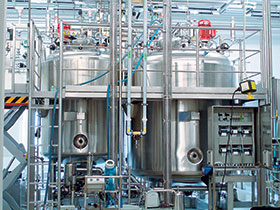
Many factory environments have applications involving the measurement, control and regulation of raw materials. These applications would fall under the realm of process automation (PA). Many other applications fall under the umbrella of factory automation (FA).

It is important to distinguish between the two, as each has its own unique requirements. While efficiency is key in both, there are enough differences to necessitate a different approach in automation.

PA systems must generally be robust and simple in order to handle corrosive liquids and hazardous materials. They are slow and continuous and therefore require less sophisticated equipment to control. FA, by contrast, calls for more complex and fast moving handling systems and control. Typical equipment would be actuated valves, tubing and pneumatic connections to solenoid valves.

It’s easy enough to get the distinction right when your plant works primarily with one type of automation. A process-focused plant, such as a water treatment facility, will have greater insight into the types of systems and components necessary to automate its processes. However, a factory with only select PA applications may lack the knowledge to optimise these particular systems.

Dangerous binds

There can be negative consequences associated with failure to automate processing applications. One such drawback is the increased exposure employees may have to hazardous material. A tyre factory that has its workers handle rubber manually is a good example.

Then there are the financial consequences. Inefficient dosing, which results in variations in the final product and wastage of raw material, is one such drawback. And with manual processing of material comes a higher chance of contamination.

Give me some sugar

Our observations have been that factory owners tend to invest heavily in automation technologies in the production environment, while continuing to process raw materials manually. Let’s take a real-life example within the food industry: a beer brewing company that has the latest technology dedicated to applications like packaging, labelling and inspecting, while relying on manual processing of sugar.

This was the case before a brewery recently chose to automate its sugar distribution system. Before, they would load sugar by hand. After installing a fully automated distribution system, the company experienced a quantum leap in efficiency. It is now able to automatically transport dry sugar from trucks to silos to the production environment, making distribution loss almost negligible. It has also reduced the chance of contamination in the final product due to cleaner raw materials.

The automation advantage

When choosing to automate processing applications within a factory environment, it is important to deal with a supplier specialising in PA. We recently dealt with a customer that had bought valve and actuator assemblies for a steam application. Because they had ordered it from a supplier that did not understand the PA environment, the components were not robust enough and started to leak.

By dealing with a company that specialises in PA, factories have access not only to the expertise required to build an optimised system, but also the availability of the specific products required. In the example above, we were able to identify and source the right components for a replacement assembly in a very short space of time.

Luckily, we are seeing more factories identify the weaknesses in their processing applications and addressing them accordingly. For those that haven’t yet made the leap, we recommend they take a close look at their processes and see which of those might be letting them down.

For more information contact Festo, 086 003 3786, [email protected], www.festo.co.za


Credit(s)


Share this article:
Share via emailShare via LinkedInPrint this page

Further reading:

Solving common automation challenges with Festo’s servo drive and servo motor solutions
Festo South Africa Motion Control & Drives
Automation projects face challenges that include limited installation space, the need for precise and repeatable linear motion, rising cycle-speed demands, and seamless integration with existing control architectures. Festo’s servo portfolio directly addresses these issues with compact, modular drive and motor solutions designed for specific applications.

Read more...
How to size and select a servo motor
Festo South Africa Editor's Choice Motion Control & Drives
Festo highlights some factors to consider in the process of sizing and selecting a servo motor effectively to ensure optimal performance, reliability and energy efficiency.

Read more...
PCS Global
System Integration & Control Systems Design
Project and industry: PCS Global led a digital infrastructure initiative in a southern African data centre setting, aiming to merge several essential operational systems into one cohesive platform. ...

Read more...
Seamless migration from ET 200M to ET 200SP HA for future-ready automation
System Integration & Control Systems Design
Project and industry: Moore Process Controls undertook a modernisation initiative spanning the mining, petrochemical, and oil & gas sectors. This project involved upgrading legacy Siemens ET200M I/O ...

Read more...
Understanding Festo Automation Experience
Festo South Africa Editor's Choice
Festo’s automation portfolio delivers solutions that help manufacturers increase productivity, flexibility and reliability while reducing lifecycle costs. Central to this portfolio is Festo Automation Experience, a unified automation platform that combines modern control technology and industrial intelligence to meet the needs of today’s smart production systems.

Read more...
Proconics Modernises Refinery Tank Automation with Compliance-Focused, Brownfield Upgrades
System Integration & Control Systems Design
Project & Industry Proconics was engaged to modernise automation and SCADA systems across a refinery tank farm. The project involved complex brownfield integration, aligning new automation with existing ...

Read more...
Project & Industry
System Integration & Control Systems Design
Project: Upgrading essential automation and SCADA systems at a coal mine.    Outcome: A modern, stable automation and SCADA environment with reduced technical debt and easier support, ready for expansion. ...

Read more...
Major digital transformation project for Isuzu Motors
System Integration & Control Systems Design
Isuzu Motors South Africa, in partnership with NoMuda and S4 Integration, has kicked off a major two-year digital transformation project to modernise its production environment.

Read more...
Modernising Vertical Filter Press Machines with Future-Focused Control Systems
System Integration & Control Systems Design
Project and Industry Pressure Filter Specialists approached us to modernise vertical filter press machines for the Minerals and Metals industry. The goal was to improve reliability, reduce downtime, ...

Read more...
Super-skilled employees: The imperative for proactive employee training
Festo South Africa News
In an era of rapid technological advancement and shifting market demands, companies are facing a significant challenge: predicting the skills their employees will need for the future.

Read more...


While every effort has been made to ensure the accuracy of the information contained herein, the publisher and its agents cannot be held responsible for any errors contained, or any loss incurred as a result. Articles published do not necessarily reflect the views of the publishers. The editor reserves the right to alter or cut copy. Articles submitted are deemed to have been cleared for publication. Advertisements and company contact details are published as provided by the advertiser. Technews Publishing (Pty) Ltd cannot be held responsible for the accuracy or veracity of supplied material.


© Technews Publishing (Pty) Ltd | All Rights Reserved

