


Maintenance, Test & Measurement, Calibration


Too many cooks in the 2,4 GHz kitchen?

Technews Industry Guide - Wireless 2014 Maintenance, Test & Measurement, Calibration Industrial Wireless

Microwave ovens are not the only things cooking in the 2,4 GHz spectrum. RF signals coming from WiFi devices, Bluetooth devices, ZigBee devices, cordless phones, wireless game pads, toys, PC peripherals, wireless audio devices and more make the 2,4 GHz frequency band a very crowded kitchen. Designing devices to function in this spectrum raises many challenges. A Bluetooth device, for example, not only has to fight for detection against WiFi and ZigBee, but it also presents issues such as high-power consumption and requests for higher data throughput. Figure 1 shows the 2.4 GHz spectrum with only Bluetooth, ZigBee, and WiFi channels.
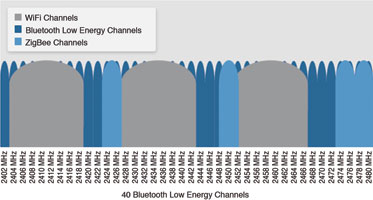
Figure 1. WLAN, BLE, and ZigBee all occupy the 2,4 GHz spectrum.

Bluetooth Low Energy

Consider the history of Bluetooth and its fight for recognition in this spectrum. Since its inception, the standard has tried to avoid interference from other signals using the following tactics:

* 2003 – Bluetooth 1.2 with adaptive frequency hopping (AFH) is released so Bluetooth channels can avoid interference from other standards in the 2,4 GHz band.

* 2004 – Bluetooth with enhanced data rates (EDR) is released and achieves 2,1 Mbit/s data rates.

* 2007 – Bluetooth 2.1 + EDR is released and allows secure simple pairing. One billion Bluetooth chips are shipped.

* 2009 – Bluetooth HS (3.0) is released and results in 24 Mbit/s, making it usable for higher data streaming. This release also opens the use of 802.11b/g radios for higher speed data.

With the most recent version of Bluetooth, Bluetooth Low Energy (BLE), 4.0, Wibree, as it was originally called, devices are expected to consume a fraction of the power that classic Bluetooth products consume. Because BLE chips spend most of their time asleep, BLE devices should last more than a year on a button cell battery without recharging. Even sending data takes only a few milliseconds – compared to the hundreds of milliseconds taken by classic Bluetooth.

BLE uses low duty cycles and is optimised to operate in small bursts so the devices consume less power. It offers the following advantages over classic Bluetooth:

* More intelligent controllers that can keep the devices asleep for longer time periods.

* Ultralow-duty cycles that can be adjusted down to 0,1 percent (compared to 1 percent in classic Bluetooth).

* Multivendor interoperability.

* Low cost and small size.

Channels for coexistence in the 2,4 GHz spectrum

Another important change is that BLE uses just 40 channels, while classic Bluetooth uses 79. Each BLE channel is 2 MHz wide compared to 1 MHz for classic. As you can imagine, Bluetooth needs to be able to differentiate its signals from others in the same band. Three of the 40 channels are located exactly between the WLAN channels, which allow easier device discovery and connection. Bluetooth devices use these channels, also known as ‘advertising channels’, to broadcast their presence and search for other Bluetooth devices. This enables Bluetooth signals to coexist with WLAN signals.

Software-based test instruments

NI offers toolkits for Bluetooth, WLAN, and even cellular standards that can be used with any NI RF vector signal analyser (VSA), vector signal generator (VSG), or vector signal transceiver (VST). The flexibility to use or upgrade hardware irrespective of the software environment is a valuable asset to test engineers who deal with the changing requirements of these RF protocols. Furthermore, engineers can upgrade test equipment to accommodate higher bandwidths, frequency ranges, or performance while maintaining their software stack. Figure 2 shows the NI PXIe-5644R VST being used with the NI Bluetooth Toolkit, which has an API that works with LabVIEW, NI LabWindows/CVI, NI Measurement Studio, and Microsoft Visual Studio.
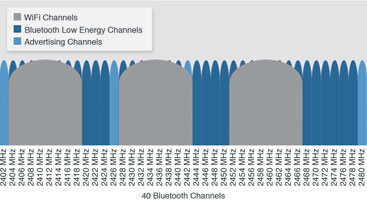
Figure 2. Advertising channels allow Bluetooth devices to connect to each other even in the presence of WLAN signals.

NI not only provides software for testing standards in the 2,4 GHz spectrum, the company also provides optimised hardware for detecting low-power RF signals in the presence of higher power saturating signals. With the software-defined nature of NI’s solution, users can test devices as well as tweak tests to see how devices react to real-world signals.




Share this article:
Share via emailShare via LinkedInPrint this page

Further reading:

Operational efficiencies and safety compliance with preventive maintenance programmes
Maintenance, Test & Measurement, Calibration
Konecranes explains how its Lifecycle Care Preventive Maintenance programme reduces unexpected downtime, improves safety compliance and delivers measurable financial benefits for operators of cranes and lifting equipment across any make or sector.

Read more...
Portable appliance tester
Vepac Electronics Maintenance, Test & Measurement, Calibration
Vepac Electronics’ new portable appliance tester enables precise safety testing of electrical appliances in accordance with DGUV regulation 3 and BetrSichV, with simple three-button operation and battery-powered mobility.

Read more...
Why lubrication fails in mining and what to do about it
Maintenance, Test & Measurement, Calibration
Lubrication Engineers explains the recurring failure points behind mining lubrication problems and how the right product, storage and application practices can improve equipment reliability.

Read more...
When digital twins move from concept to critical tool
IT in Manufacturing System Integration & Control Systems Design Maintenance, Test & Measurement, Calibration
Digital twins are moving out of the lab and onto the mine, the factory floor and the transport network where they predict failures before they happen. Amritesh Anand looks at where they earn their keep, the data and integration work behind them, and the security questions every organisation should ask before switching one on.

Read more...
Why asset level intelligence is now essential for resilient wastewater plants
Schneider Electric South Africa Maintenance, Test & Measurement, Calibration
Sub-Saharan Africa’s wastewater operators face mounting pressure to keep ageing plants running smoothly and meet tougher environmental standards, all while lacking visibility into the health of their medium-voltage (MV) drives and other critical rotating assets. Adding predictive analytics, digital twins and enterprise dashboards enables optimisation across multiple sites, ensuring every drop moves safely and efficiently through the water cycle.

Read more...
How multiple boilers can minimise costly downtime
Maintenance, Test & Measurement, Calibration
Associated Energy Services explains how multi-boiler systems reduce downtime risk for South African manufacturers, covering redundancy planning, fuel source diversification and the strategic management of backup boiler capacity.

Read more...
Field calibration made easy
Instrotech Maintenance, Test & Measurement, Calibration
Instrotech’s locally designed and manufactured Calog calibrator range feature a rugged IP54-rated housing, backlit display with data logging via SD card, and a lithium-ion battery with approximately eight hours of run time.

Read more...
Repair and maintenance services boost system efficiency by 30%
Maintenance, Test & Measurement, Calibration
Following the expansion of its local sales and services network, Rittal South Africa continues to offer comprehensive onsite installation, repair and maintenance services to customers nationally.

Read more...
Control systems, remote monitoring and human skills in the food sector
Editor's Choice Industrial Wireless
The convergence of specialist skills and advanced technology is becoming critical, a trend underscored by two recent projects completed by Associated Energy Services in the food manufacturing sector.

Read more...
Keeping lifting equipment safe and securely on track
Maintenance, Test & Measurement, Calibration
In the hustle and bustle of mining production, the focus on the servicing of lifting equipment can unintentionally be sidelined. This situation can easily be avoided with a customised Konecranes Service Agreement that offers a comprehensive and systematic approach to asset management.

Read more...


While every effort has been made to ensure the accuracy of the information contained herein, the publisher and its agents cannot be held responsible for any errors contained, or any loss incurred as a result. Articles published do not necessarily reflect the views of the publishers. The editor reserves the right to alter or cut copy. Articles submitted are deemed to have been cleared for publication. Advertisements and company contact details are published as provided by the advertiser. Technews Publishing (Pty) Ltd cannot be held responsible for the accuracy or veracity of supplied material.


© Technews Publishing (Pty) Ltd | All Rights Reserved