Becker Mining's underground WiFi solutions
September 2013
Fieldbus & Industrial Networking
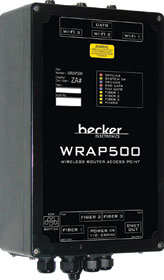
Becker Mining South Africa has a locally designed and manufactured Wi-Fi system that ensures safe and efficient communication underground. This system does not limit usage to a single technology, but encompasses migration and integration of many technologies.
The Becker WRAP (wireless router access point) provides a high-speed backbone for wireless VoIP, seamless roaming of devices, advanced vehicular dispatch systems, process automation, as well as any device which can utilise a wireless, serial or fibre backbone. Its versatile design means a combination of communications backbones can be used to optimise the system. For example, fibre can be used for high data throughput. In working sections of a coal mine, where there is frenetic activity, a wireless mesh topology is recommended.
“Becker Electronics has made a substantial investment in researching and testing underground WiFi systems to overcome the problems with conventional Wi-Fi systems in underground conditions,” says Johann Smit, Becker Mining South Africa. “A critical feature of this advanced system is its intrinsically safe design, which enables safe use in hazardous and harsh mining conditions underground. What’s important about Becker’s systems is that each product can be installed as a single standalone system, or can be deployed using a phased approach to minimise large initial capital outlay.”
WRAP is the primary component in creating the Becker WiFi IS backbone. The internal layer 3 router contains the logic to route all network traffic to the correct interface card or to the correct fibre point. The route of network traffic is based on the rules configured into the router itself. Firewall rules can also be configured to control bandwidth usage of protocols, as well as to provide network security. This system incorporates on board tag readers, which reduces the equipment necessary in a full tagging and tracking solution.
WRAP supports various configuration implementations ranging from traditional distributed antenna backbones, to mixed configurations of distributed and leaky feeder backbones, using redundant WDS (wireless distribution system) and redundant fibre optic loops.
The unit incorporates an additional fibre optic port for teeing off the main backbone and used for connection to a switch. Each unit also includes an RS-485 bus to communicate with any industrial serial device, such as multiple Becker UATRs (UHF active tag readers) for tracking implementations.
Systems include near and far field proximity detection, collision avoidance and leaky feeder systems, as well as WiFi, underground tracking of personnel and vehicles and underground remote evacuation signalling. Fibre optic and digital radio networks, belt rip detection for overland conveyors and scada and Ethernet network solutions are also available.
For more information contact Johann Smit, Becker Mining South Africa, +27 (0)11 617 6300, info@za.becker-mining.com, www.za.becker-mining.com
Further reading:
XPlanar aids innovation in laser processing
Beckhoff Automation
Fieldbus & Industrial Networking
Aalborg University is among the first in the world to test Beckhoff’s XPlanar intelligent transport system in advanced laser processes, opening the door to faster, tool-free production of metal parts.
Read more...
Belden expands edge computing portfolio with ProLinx Edge Gateway
Fieldbus & Industrial Networking
Belden has released the ProSoft Technology ELX3 ProLinx Edge Gateway, combining operational technology protocol conversion with Docker-based edge application hosting on a single ruggedised hardware platform for deployment in harsh industrial environments.
Read more...
Anybus Communicators are CRA-ready
Industrial Data Xchange (IDX)
Fieldbus & Industrial Networking
HMS Networks has upgraded its Anybus Communicator range to meet new EU cybersecurity rules, giving industrial manufacturers and integrators an easier path to compliance.
Read more...
Remote I/O modules provide flexible options for distributed applications
Fieldbus & Industrial Networking
Dinkle International is now stocking the iO-GRID NEMO industrial-grade remote input/output modules, offering support for five leading industrial Ethernet protocols and a range of discrete channel configurations for distributed automation applications.
Read more...
Local energy solutions rewiring resilience across Africa
News Fieldbus & Industrial Networking
Engineers across Africa are developing practical, scalable energy and mobility solutions supported by the Africa Prize for Engineering Innovation.
Read more...
Daudin expands fieldbus modular remote I/O series
Fieldbus & Industrial Networking
: The Dinkle iO-GRID X modular remote I/O family is now available, offering fieldbus coupler modules for major industrial Ethernet protocols, and over 20 types of I/O modules to help integrators and equipment builders create flexible, efficient control systems.
Read more...
Siemens and HighByte partner to scale industrial AI
Siemens South Africa
IT in Manufacturing Fieldbus & Industrial Networking
Siemens is expanding its Industrial Edge ecosystem through a partnership with HighByte, enabling customers to connect, contextualise and transform data from operational technology and information technology sources to build AI models and applications at scale.
Read more...
Automotive Ethernet media converter
Fieldbus & Industrial Networking
HMS Networks has introduced its first automotive ethernet product under the PEAK brand. The PAE-Media Converter is a compact device designed to connect automotive Ethernet (100BASE-T1 or 1000BASE-T1) with standard Ethernet (100BASE-TX or 1000BASE-T) networks.
Read more...
3D electrical systems design workflow for electromechanical innovation
Siemens South Africa
Fieldbus & Industrial Networking IT in Manufacturing
Siemens has announced new 3D electrical design capabilities within its Capital software, enabling electrical and mechanical engineers to work concurrently in a shared 3D environment to reduce late-stage design changes and accelerate time to market for complex electromechanical products.
Read more...
Long-distance signal delivery is critical to rail safety
Omniflex Remote Monitoring Specialists
Fieldbus & Industrial Networking
A remote monitoring specialist explains why fibre optic technology is increasingly replacing copper cabling in safety-critical railway signalling systems.
Read more...










 printer friendly version