


Maintenance, Test & Measurement, Calibration


Instrotech introduces rugged temperature calibrator

April 2013 Maintenance, Test & Measurement, Calibration

Many primary measurements in process plants are analog in nature and only become digital after processing. Temperature often starts out as voltage derived from a thermocouple or from a charge in resistance from metals like platinum, nickel or semiconductors or measured infrared radiation. Pressure, flow and force are measured by physical deformation of strain gauges. This means that in plant maintenance, commissioning and instrumentation workshops, process calibrators remain indispensable.

Since most field transmissions have error limits of less than 0,5%, calibration equipment needs to be an order of one magnitude higher (0,05%). Modern single chip voltage references, 24 bit serial A/Ds and 20 bit D/As can be within full-scale limits of 0,01%. The trick is to design input circuits with low-drift amplifiers for voltage and high stability shunts for current and resistance, for minimum additional error.

Where a precision instrument like a process calibrator is going to be used in the field, it must be rugged, both physically and electrically, and have an acceptable battery life. Besides the normal CE requirements, for electrical emission and noise immunity, inputs need additional surge protection via heavy duty MOVs and high-speed fuses.

Instrotech’s Calog range

Instrotech’s locally designed and manufactured Calog range of portable process control calibrators incorporate the modern component technology, comprehensive feature capabilities and tough package design, making the units ideal for use in servicing, repairs in workshops and in tough plant environments.

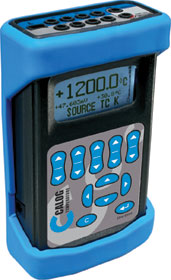
The handheld Calog-Temp multifunctional temperature calibrator is a high-precision instrument for the calibration and troubleshooting of process control instrumentation. It has selectable automatic, manual or internal cold junction compensation. Temperature can be displayed digitally or in the form of a trend, ideal for monitoring temperature over time or optimising PID controllers. Inputs and outputs are isolated from each other and can be displayed simultaneously making this unit ideal for measuring temperature or calibrating 2, 3 or 4-wire transmitters. The mA output can be set to track the temperature for use as a transmitter replacement in emergencies.

In RTD mode the calibrator is suitable for 2, 3 or 4-wire measurement or sourcing of platinum and nickel RTDs as well as ohms and mA. RTD, ohms and mA can be measured or sourced and as they are isolated from each other, and can be displayed simultaneously making this unit ideal for measuring temperature or calibrating RTD transmitters. Data-logging (SD card) and downloading via the on-board USB port is standard. It measures mA, mV, thermocouple, ohm and resistance temperature detector (RTD) in a single device. It simultaneously measures and sources ten commonly used types of thermocouples (K,J,T,B,R,S,E,N,U,L) and seven (Pt50, Pt100, Pt200, Pt500, Pt1000, Ni100 and Ni120) resistance temperature detectors (RTD). It measures mA (passive or active) with a 24 V power supply whilst sourcing or simulating mV, TCs, RTDs or ohms to calibrate transmitters. The thermocouple ranges have automatic internal cold junction or manual or external temperature compensation. The temperature ranges are isolated from the mA and can be displayed simultaneously. Injecting thermocouple mV (or RTD ohms) into a transmitter while measuring the output (mA) simplifies field or workshop calibration.

A plug-in extender is supplied with spring terminals for bare wire connection directly to thermocouple wires or compensating cables. The cold junction correction is built into this unit. The backlit LCD display can be selected for measurement in a clear, precise numeric display or as a graph for use when logging temperature or mA over longer periods. This is ideal for when monitoring ovens or optimising PID control.

For more information contact Hugh du Plessis, Instrotech, +27 (0)11 462 1920, [email protected], www.instrotech.co.za


Credit(s)


Share this article:
Share via emailShare via LinkedInPrint this page

Further reading:

Infrared thermometers for electrical, industrial and HVAC applications
Comtest Maintenance, Test & Measurement, Calibration
: Comtest, distributor of Fluke test and measurement equipment, explains how handheld infrared thermometers are transforming maintenance in electrical, industrial and HVAC environments, with three measurement strategies and a wide range of practical applications.

Read more...
Reverse-engineering legacy industrial gearbox parts
Maintenance, Test & Measurement, Calibration
WEG Africa’s turbine workshop uses 3D scanning technology to reverse-engineer components for legacy gearboxes, turbines and compressors, enabling equipment to run for decades after OEM support and spare parts have dried up.

Read more...
Unlocking ICCP remote monitoring
Omniflex Remote Monitoring Specialists Maintenance, Test & Measurement, Calibration
Cathodic protection keeps buried and submerged pipelines safe from corrosion, but verifying it traditionally means costly, hazardous manual site visits. Omniflex explains how a retrofit module brings remote monitoring to ageing transformer rectifiers without replacing functional infrastructure.

Read more...
Microdieseling – the explosions you never hear
Maintenance, Test & Measurement, Calibration
Microdieseling is a pressure-induced thermal degradation mechanism in which entrained air bubbles are compressed so rapidly that the surrounding oil ignites, producing soot, varnish and sludge. WearCheck explains how it happens, why the damage varies, and how oil analysis detects it.

Read more...
Electrostatic spark discharge – when static strikes back
Wearcheck Maintenance, Test & Measurement, Calibration
WearCheck technical manager, Steven Lumley explains how static electricity accumulates in modern low-conductivity lubricants, why compact system designs and fine filtration make ESD more likely, and how to recognise the degradation it leaves behind.

Read more...
High-speed cameras for crash testing
Horne Technologies Maintenance, Test & Measurement, Calibration
Vision Research has expanded its Phantom C-series with two cameras optimised for crash and safety testing, offering 4 and 8 megapixel sensors rated to 170G, up to 1180 frames per second, and Phantom Academy application training planned for South Africa next year.

Read more...
SKF extends remanufacturing expertise to bearing clearance modification
SKF South Africa Maintenance, Test & Measurement, Calibration
Using its clearance modification expertise, SKF helped a mining equipment OEM salvage spherical roller bearing inventory that would otherwise have been scrapped, confirming a new capability within its remanufacturing services and avoiding redundant procurement.

Read more...
When maintenance-system compliance starts replacing plant reliability
Wearcheck Maintenance, Test & Measurement, Calibration
WearCheck ARC division manager, Annemie Willer argues that the greatest threat to effective maintenance is no longer a lack of technology, but the gradual replacement of technical judgement by CMMS compliance, leaving no one owning the machine.

Read more...
Automatic lubrication systems drive mobile mine machine reliability and uptime
SKF South Africa Maintenance, Test & Measurement, Calibration
SKF’s Lincoln P203 progressive lubrication systems are improving reliability and uptime on mobile machines at a Zambian gold mine, with installation of 45 units completing by October 2026.

Read more...
Nitration: the acid you didn’t see coming
Wearcheck Maintenance, Test & Measurement, Calibration
Nitration is as destructive as oxidation in many engines but far less understood. WearCheck technical manager, Steven Lumley explains how nitrogen oxide gases degrade lubricants, why the process is difficult to detect, and what oil analysis can reveal before damage occurs.

Read more...


While every effort has been made to ensure the accuracy of the information contained herein, the publisher and its agents cannot be held responsible for any errors contained, or any loss incurred as a result. Articles published do not necessarily reflect the views of the publishers. The editor reserves the right to alter or cut copy. Articles submitted are deemed to have been cleared for publication. Advertisements and company contact details are published as provided by the advertiser. Technews Publishing (Pty) Ltd cannot be held responsible for the accuracy or veracity of supplied material.


© Technews Publishing (Pty) Ltd | All Rights Reserved

