



Aalborg University (AAU) says it is one of the first in the world to test the XPlanar intelligent transport system from Beckhoff in advanced laser processes. The aim is to meet industry requirements for more flexible and sustainable production. The result is a fast and precise production concept under software control that can transform the development and manufacture of metal parts.
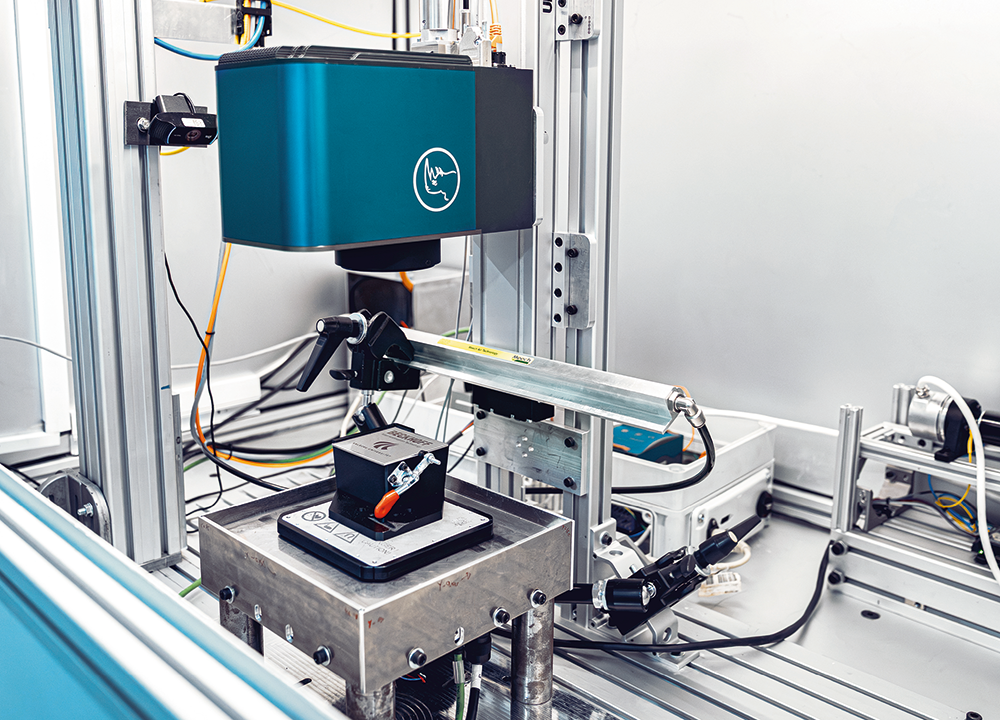
Dr Morten Kristiansen, lecturer, has spent more than 15 years researching laser processes in the Department of Materials and Production at AAU. His mission is to develop new methods for faster shaping of metal parts in small and medium-sized series using lasers. “Laser technology represents a completely new way of thinking about production which is precise, flexible, and under digital control from the very first second. While traditional manufacturing requires big presses, complex tools and long setup times, laser processes can produce the same, or even more advanced, components without physical tools,” says Kristiansen.
Flexibility, cutting waste and significantly reducing production costs will be crucial in the smart factories of the future. The research team at AAU is therefore working on replacing traditional, tool-based processes with digital methods that free up both time and capital and facilitate rapid adaptation to market needs.
Rotation with micrometre precision
The XPlanar planar motor system heralds a venture into new territory for AAU. This modular transport system uses movers to position and rotate workpieces in six degrees of freedom with micrometre precision above the XPlanar tiles, which function as highly compact, fully integrated drive units.
In the AAU system, a small metal plate is attached to the XPlanar mover via a workpiece carrier, which is moved under the laser with rapid movements. The laser bends, shapes and engraves the metal. “When we saw XPlanar for the first time, we recognised its potential immediately. Instead of moving the laser head with an expensive robot, we can simply control the XPlanar mover to move the workpiece. This ensures far greater precision, flexibility and a smoother process. At the same time, we can combine multiple processes in a single machine,” says Kristiansen.
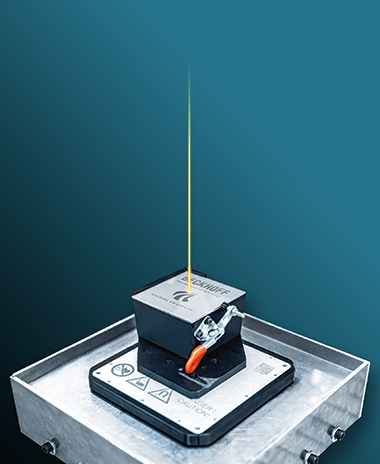
Precision is crucial, and with repeatability of ±5 µm, XPlanar is more precise than even the most advanced robots, according to Kristiansen. This allows XPlanar to be integrated directly into an overall production system in which the workpieces are automatically transported between the stations. “Where conventional production requires separate machines and manual handling, our system can handle everything quickly, precisely and under software control,” he says. The system can easily be expanded by adding stations, and each mover can be customised for a specific product. This means that several individual products can be designed in parallel. “It is like having a digital production laboratory where we can test several different products simultaneously and see the differences in real time,” he continues.
Suitable as an all-in-one laser platform
The XPlanar technology was tested for 12 months and is the subject of a thesis by Mads Holm Andersen and Mads Augustinus Frøhlich under the supervision of Kristiansen. Their work concludes that magnetic levitation technology has great industrial potential in laser-based processes, and can form the basis for an integrated all-in-one laser platform for the sheet metal industry.
“The processing time per workpiece is kept to a minimum as XPlanar can set workpieces aside to cool down while other workpieces are processed by the laser. The processing times for the workpieces we produce are five minutes, and the total time from design to finished workpiece is between one and two hours due to the cooling time. This production time can be compared with traditional manufacturing techniques, which can have a lead time of four to six weeks if tools have to be made first before the workpiece can be produced,” says Frøhlich, research associate at AAU’s Department of Materials and Production.
“XPlanar is ideal for prototypes, small and medium quantities and on-demand production. Only the required number of workpieces is produced, and workpiece waste can be reduced by at least 10%. This corresponds approximately to the quantity that is typically overproduced on a press brake with a conventional production line,” says Frøhlich.
From experiment to industrial potential
“The industry has not yet exploited the full potential of lasers. With XPlanar, we may be able to set a new industry standard for digital, precise and modular production in a continuous workflow. This is quite unique,” says Kristiansen. AAU is already working with industrial partners to bring the technology to market maturity. The aim is to test the solution in real production environments within a few years, for example, in the metal, electronics and medical technology industries, where work involves small precision components and frequent design changes.
According to Kristiansen, TwinCAT as an open software platform and the close technical cooperation with Beckhoff are key to unlocking the ability to think experimentally and develop new innovations. The open standards, flexible software and multiple interfaces make it possible to integrate everything from sensors and image processing through to laser systems, without being tied to one manufacturer. “The technology from Beckhoff is extremely accessible. We can download the software, test the solutions and connect to a huge ecosystem of components. This means that both researchers and students can try out ideas in practice and build on them without having to start from scratch. The combination of precision, speed and software freedom makes Beckhoff an ideal partner for research environments where innovation comes from experimentation,” he explains.
The collaboration between AAU and Beckhoff dates back more than 15 years, and is based on a shared curiosity to explore the limits of automation. The experts from Beckhoff were directly involved from the first proof of concept and provided rapid, personalised support when new ideas needed to be implemented. “They always get back to us quickly, share their knowledge and help us to understand the solution rather than just making corrections. This helps us to improve,” says Kristiansen.
| Tel: | +27 11 795 2898 |
| Email: | [email protected] |
| www: | www.beckhoff.com |
| Articles: | More information and articles about Beckhoff Automation |






© Technews Publishing (Pty) Ltd | All Rights Reserved
 printer friendly version