



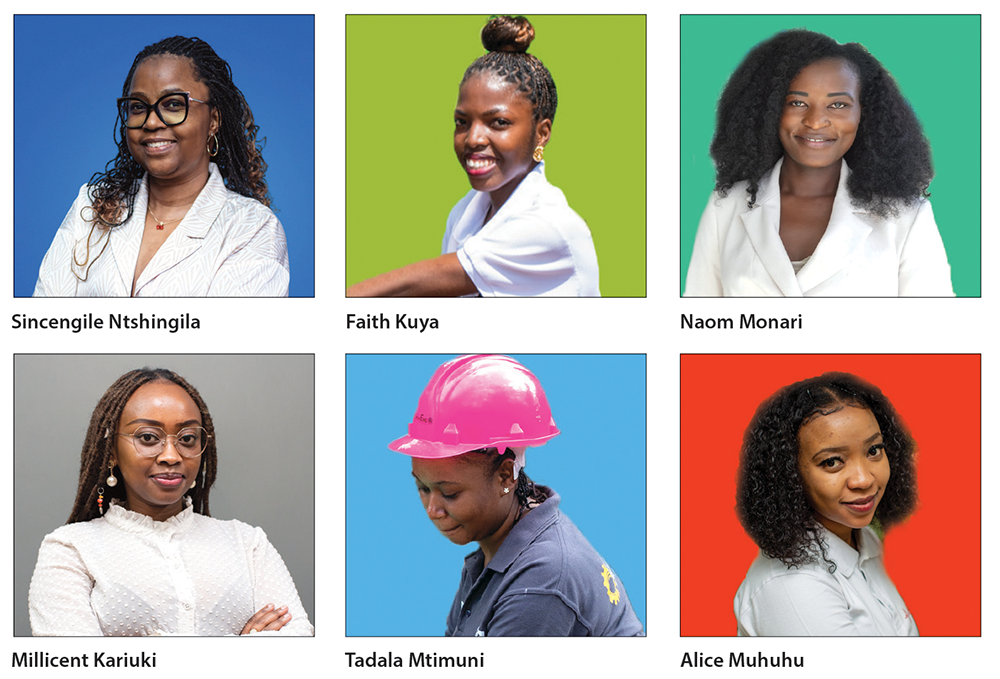
Across Africa, women engineers and entrepreneurs are developing practical technologies to address everyday challenges in healthcare, water, mobility, education and essential services. Designed around local realities, from limited infrastructure and specialist shortages to affordability constraints, their innovations focus on solving real problems for communities that cannot wait for systems to catch up.
Their work offers a timely reminder that women are entering engineering in greater numbers and helping define what engineering is for. The women shortlisted for the 2026 Africa Prize for Engineering Innovation are part of a growing generation of innovators using engineering to expand access to critical services across the continent.
In South Africa, Sincengile Ntshingila is rethinking how future biomedical researchers learn core laboratory skills. Her innovation, LabZero, is a low-bandwidth virtual tissue culture lab that allows students and early-career researchers to practise mammalian cell culture workflows before they enter a physical laboratory. The platform guides users through procedures such as aseptic gowning, reagent preparation, cell seeding, growth monitoring and cryopreservation. It also models key laboratory equipment including biosafety cabinets, incubators and pipetting systems, helping learners understand what to do and in what order. If users introduce contamination risks or miss critical steps, the system flags errors in real time.
In Rwanda, Millicent Kariuki is helping improve the public transport experience by making travel information more accessible and predictable. HarakaPlus is a smart mobility platform that brings live bus location and passenger-demand data into informal and semi-formal transport systems. The platform combines GPS tracking, passenger inputs and route information to provide commuters with estimated arrival times through a smartphone app, web platform or USSD service. At the same time, transport operators can access dashboards that help them understand passenger demand and make more informed dispatch and fleet management decisions.
In healthcare, distance, cost and specialist shortages can determine whether people receive timely care, but in Kenya, Naom Monari is bringing kidney care closer to patients who have previously had to travel long distances for their regular, life-saving dialysis treatments. Renal Roads is an innovative new mobile dialysis unit, built from a repurposed shipping container and designed explicitly to serve rural and hard-to-reach communities. Dialysis is usually tied to fixed hospital infrastructure, specialist equipment and reliable water systems. Monari’s model changes that by placing dialysis machines, purified water systems, clinical-grade interiors, solar power and backup systems inside a mobile unit that can rotate between communities.
Also in Kenya, medical doctor Alice Muhuhu is using engineering to make cardiac screening more accessible in lower-resource health facilities. MoyoECG, developed through Aurora Health Systems, is an AI-powered wearable electrocardiogram device designed to help frontline healthcare workers detect abnormal heart rhythms and other cardiac conditions earlier. It captures heart signals from multiple angles, supports interpretation through embedded artificial intelligence and can operate in settings with limited internet connectivity or unstable electricity.
In Tanzania, another innovative female engineer, Faith Kuya is addressing one of the most fundamental infrastructure gaps, safe, reliable drinking water. WaterBank, developed by SafeSip, is a solar-powered, self-running water utility designed for off-grid communities. The system treats water at the point of dispensing through a multi-stage filtration process and can also desalinate borehole water where salinity is high. It uses remote monitoring and AI to detect early signs of faults such as clogging or pressure changes, so technicians can respond before breakdowns interrupt supply. Customers access water through prepaid RFID cards, with mobile money top-ups reducing the need for cash handling.
In Malawi, Tadala Mtimuni is also focused on safe drinking water, but at the household level. MalawiDrop is a low-cost refillable water treatment device made of two stacked buckets connected by a cartridge containing chlorinated resin. As untreated water flows through the cartridge, it releases a controlled dose of chlorine to disinfect the water quickly and consistently. The device is designed to avoid the challenges of manual dosing, where too little chlorine may leave water unsafe and too much can create unpleasant taste or smell. Its refillable cartridges can last from months to years depending on use, while proposed community ‘water champions’ and local kiosks provide demonstrations, access points and refills.
Women across Africa are participating in engineering innovation while shaping its priorities. The Africa Prize has now supported 48 women from 17 countries, including the 2026 shortlist, while the Africa Innovation Fellowship has supported 207 women from 26 countries since 2019, including the current cohort. The Royal Academy of Engineering has invested more than £3 million in Africa Prize alumni and their businesses through further grants, training, accelerator spots, communications support and networking opportunities.
For more information visit https://africaprize.raeng.org.uk/






© Technews Publishing (Pty) Ltd | All Rights Reserved
 printer friendly version