



Industrial sensors today do more than measure values, they communicate them. According to recent market analysis, more than 65% of new industrial sensor installations now feature smart sensors with real-time data capabilities, driven by demand for remote monitoring and predictive insights across manufacturing, energy and chemical industries.
Smart sensors can pre-process data at the edge, filter noise, validate readings and even flag anomalies before they propagate into bigger problems downstream. For engineers tasked with maintaining process control, these capabilities mean fewer blind spots and faster response times, especially in complex systems where temperature, pressure or level variations can signal process drift or potential faults. The growth in the sensor space is telling too, with the global smart sensors market valued at nearly $59 billion in 2024 and projected to expand significantly over the coming decade.
Radar takes the lead
One of the most striking technology shifts in industrial instrumentation has been the accelerated adoption of radar level measurement, particularly non-contact 80 GHz radar. Unlike ultrasonic devices that rely on sound and can be thrown off by dust, temperature swings or foam, radar measurements use electromagnetic waves that are insensitive to such disturbances, meaning more reliable readings in harsh industrial environments. VEGA’s radar sensors like the VEGAPULS family demonstrate these benefits practically. Compact radar units deliver precise distance measurements, with very narrow beam angles that easily navigate around internal obstructions such as ladders or agitators.
The market trends back this up. Microwave and radar solutions accounted for more than 35% of the installed base in level sensing in 2025 and are expected to grow at a CAGR around 9,5% through 2031 as industries favour non-contact measurement for reliability and low maintenance.
Software, connectivity and the IoT imperative
Instrumentation no longer lives in isolation. Sensors and measurement systems are now nodes in broader process networks, part of the Industrial Internet of Things (IIoT). This connectivity means that level, pressure or temperature readings can be aggregated, visualised and acted upon across a plant or even globally. The IIoT sensors market gives a sense of scale. After exceeding $17,5 billion in 2024, it is forecast to accelerate at a CAGR of around 36% through 2034, driven by industrial automation and connected infrastructure.
Instrumentation is only as valuable as the insight it delivers. Sensors that speak digital protocols and connect to enterprise systems enable a new era of predictive analytics. Industrial IoT adoption continues to surge, with forecasts showing the market expanding rapidly through the next decade as plants embrace connected assets and remote monitoring.
Raw measurement is only step one. The next frontier is using data to predict failures. When pressure spikes or vibration signatures change, advanced analytics and AI can infer equipment stress, flag a likely failure window and help schedule servicing before breakdowns occur. This kind of predictive maintenance shifts engineering from reactive firefighting to proactive optimisation, improving plant availability and cutting unplanned downtime.
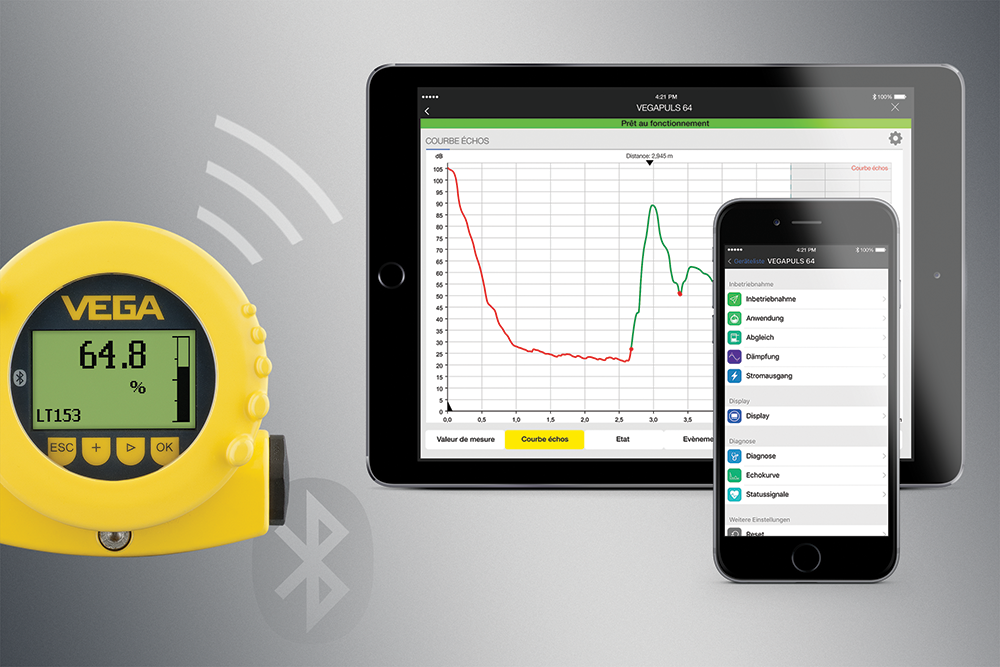
VEGA champions this trend with tools like myVEGA, a digital platform that allows engineers to configure devices, access documentation and manage instrument data from a single interface. Combined with Bluetooth or fieldbus connectivity, this capability transforms ordinary measurement into a dynamic data feed powering smarter decisions.
The real payoff is the context and predictive insight that emerges when disparate measurements are stitched together into higher-level analytics. Modern instrumentation platforms feed into cloud systems and analytics engines where machine learning can spot patterns, predict deviations and surface actionable alerts, long before operators would have noticed a shift.
Smarter, smaller, more connected
The measurement and instrumentation landscape is heading towards instruments that are simultaneously smaller, smarter and more integrated with digital ecosystems. Modular and software-defined measurement platforms are enabling configuration flexibility and scalability in test and measurement deployments.
For process engineers and automation architects, these advancements bring tangible benefits:
• Greater precision in challenging process environments
• Faster insight into plant health and performance metrics
• Lower total cost of ownership through maintenance-free, non-contact technologies
• Better decision support via IIoT and analytics integration
The era of ‘dumb sensors’ and manual gauges is over. In their place stand intelligent instruments that know their environment, talk to one another and help engineers keep plants running safely and efficiently in a competitive global landscape.
VEGA will be exhibiting at Electra Mining Africa 2026 at the Johannesburg Expo Centre, Nasrec, from Monday 7 to Friday 11 September. Visit VEGA’s stand B15, Hall 4.






© Technews Publishing (Pty) Ltd | All Rights Reserved
 printer friendly version