



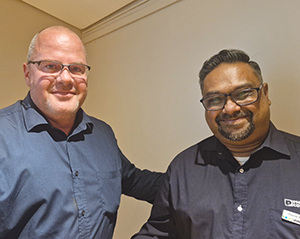
The Johannesburg Branch was pleased to have Phoenix Contact host our May technology event. Shamil Surbun, business unit manager for Automation delivered a CPD-accredited presentation titled ‘From Sensor to Cloud: How SPE and APL Are Transforming Industrial Connectivity’. We sincerely thank Shamil and Phoenix Contact for their support and for sharing valuable technological insights.
He explained that the rapid growth of IIoT is changing how industrial systems are designed, connected, and managed. As organisations seek real-time visibility and data-driven decision-making, traditional automation architectures are being pushed beyond their limits. Although legacy fieldbus and analogue systems remain reliable, they often have limited bandwidth, shorter communication ranges, and multiple protocol-conversion layers that restrict scalability and access to critical data.
To address these changing needs, industry is moving toward decentralised network architectures that provide seamless connectivity from field devices to enterprise and cloud platforms. At the heart of this shift are two key technologies: Single Pair Ethernet (SPE) and Advanced Physical Layer (APL), which bring the benefits of Ethernet directly into the field.
SPE introduces a fundamentally simpler approach to industrial networking by transmitting data over a single pair of wires rather than the traditional four pairs used in Ethernet. This significantly reduces cabling requirements and installation costs, while maintaining high performance. SPE supports data rates of up to 1 Gbps, distances of up to 1 kilometre at lower speeds, and incorporates Power-over-Data-Line, allowing both power and communication to run over the same cable. This combination enables compact, efficient connections to sensors and actuators without the need for additional gateways, simplifying architectures and improving data transparency across the network.
While SPE is well suited to discrete manufacturing environments, APL brings Ethernet connectivity into the process industries, including hazardous areas. APL enables high-speed, long-distance communication, typically between 200 and 1000 metres, while supporting intrinsic safety requirements. By combining power and data on a single cable and eliminating the need for protocol conversion or intrinsic safety barriers, APL significantly simplifies plant design and reduces engineering complexity.
The transition from traditional technologies such as 4–20 mA and fieldbus systems to Ethernet-based communication represents a major step forward. Where older systems often provided limited data, typically a single measurement value, modern Ethernet-enabled devices deliver rich datasets, including diagnostics, asset information and process variables, all accessible through a single interface. This enables improved visibility, faster decision making and better asset management across operations.
The benefits are particularly evident in commissioning and maintenance activities. Tasks such as instrument calibration, which previously required time-consuming onsite intervention, can now be performed remotely with near-instant feedback. Data transfer speeds are significantly improved, enabling rapid diagnostics and reducing downtime, while also enhancing overall operational efficiency.
SPE and APL also support the growing demand for smart devices and connected systems. Sensors are no longer limited to basic measurement functions, but can provide detailed insights into process conditions and equipment health, enabling predictive maintenance and advanced analytics. This aligns closely with the broader industry drive toward digitalisation and fully integrated, data-driven operations.
Supported by strong industry collaboration, including initiatives such as the SPE Industrial Partner Network, these technologies are gaining rapid momentum. Standardisation and cross-industry cooperation are ensuring interoperability and accelerating adoption, positioning SPE and APL as foundational technologies for the future of industrial communication.
As digital transformation continues to shape the industrial landscape, the need for seamless, secure and scalable connectivity becomes increasingly critical. SPE and APL address this need by enabling true end-to-end Ethernet communication, from the sensor all the way to the cloud, unlocking new levels of efficiency, flexibility and insight in modern automation systems.
| Tel: | +27 11 312 2445 |
| Email: | [email protected] |
| www: | www.saimc.co.za |
| Articles: | More information and articles about SAIMC |






© Technews Publishing (Pty) Ltd | All Rights Reserved
 printer friendly version