



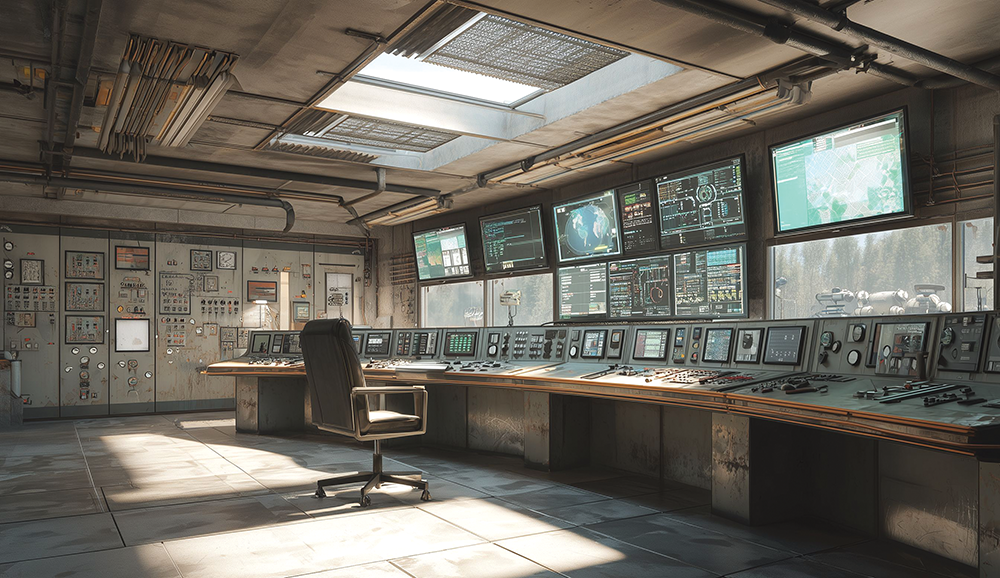

Today’s control rooms are evolving. Slowly but surely, we’re seeing the dense landscape of humming workstations and tangled cables disappearing, replaced by leaner, virtualised endpoints at the edge.
These modernised control rooms feature distributed control system, or DCS architecture consolidated into centralised compute environments replacing traditional PCs with thin clients.
The breaking point
For years, the standard model was simple: one operator, one PC. But in practice, this created a fragile and high-maintenance ecosystem. Each workstation became its own failure point, exposed to dust, heat and vibration. Over time fans clog, disks fail and performance degrades. Maintenance teams are forced into a perpetual cycle of patching, cleaning, troubleshooting and replacing individual machines.
This fragmentation also leads to inconsistency with different hardware generations, configurations and software versions often slowing down decision making, and increasing the risk of human error, particularly in high-pressure situations.
Then there is the hidden cost of power and heat. Rows of PCs generate significant thermal load, increasing strain on HVAC systems and reducing overall equipment lifespan. Add to this a widened cybersecurity attack surface, multiple endpoints, local accounts, USB access, and the risks continue to multiply.
Virtualised control
Instead of distributing compute power across dozens of individual PCs, processing is consolidated into a centralised virtualisation host, or cluster. From there, multiple operator sessions, whether remote desktop control/RDC or human machine interface/HMI are delivered to thin clients on the control room floor. This changes capacity planning entirely. Rather than sizing and maintaining each workstation individually, engineers allocate CPU, memory and storage centrally, scaling up by adding resources to the host or spinning up new virtual machines.
Standardised virtual machine templates ensure every operator experiences the same interface, performance and configuration. Lifecycle planning is also simpler; it is far easier to refresh a few central servers every five to seven years instead of constantly replacing ageing These centralised operations feature built-in resilience; if one component fails another will take over silently in the background.
Smarter spaces
Space is important. Replacing big, clunky machines with thin clients eliminates the need for bulky towers and also reduces the obligatory rat’s nest of cables whilst mitigating heat production.
The result is a cleaner, quieter and more ergonomic workspace. Operators can work across multi-monitor setups without physical constraints, and control rooms can be designed around people.
Also, flexibility takes on a whole new meaning If you need an additional console for a plant expansion or shutdown event it’s not a problem. Plug in a thin client, connect it to the network and assign the relevant session.
Designing for performance and experience
Centralisation, however, does not mean performance compromise, especially when multiple operator sessions share the same infrastructure.
Best practice is to separate workloads into dedicated virtual machines. Operator HMIs, engineering tools, historians and support services each run independently. This prevents resource contention and ensures that demanding taskslike high-refresh graphics or trend analysis do not impact operator responsiveness.
Also, multi-monitor setups, dynamic graphics and alarm conditions all place additional load on the system. Here, it is important to carefully manage the system by validating performance in real-world conditions, stress testing it during factory and site acceptance phases to ensure consistent responsiveness.
Built-in resilience
One of the most powerful aspects of the centralised architecture is how multiple layers of redundancy work together to maintain operator visibility. At the network level, dual independent paths ensure continuous communication. This means that if one path fails, traffic is automatically rerouted. Furthermore, network interface card teaming combines multiple network interfaces into a single logical connection, providing both load balancing and seamless failover.
Thin clients can also be dual homed, maintaining connectivity even if a cable, port or switch fails. Meanwhile, at the virtualisation layer, replicated virtual machines and failover mechanisms ensure that even if a server goes down, operator sessions continue running on another host.
In the end, a centralised system featuring DCS and thin clients overcomes a lifetime of bulky machines, tangled cables, dust and unpredictable operation. It is time the control room becomes leaner, virtualised and highly resilient.
| Tel: | +27 11 254 6400 |
| Email: | [email protected] |
| www: | www.se.com/za/en/ |
| Articles: | More information and articles about Schneider Electric South Africa |






© Technews Publishing (Pty) Ltd | All Rights Reserved
 printer friendly version