




[Sponsored] Innovative technology for shrinking catalytic converters, designed and built in South Africa by Jendamark Automation for the global market, relies on the precision of SEW-EURODRIVE’s highly dynamic servo-geared units and software.
Based in Gqeberha in the Eastern Cape, Jendamark Automation is a specialist in advanced automated assembly systems for powertrains, catalytic converters, hydrogen technologies and other automotive components. Yanesh Naidoo, executive innovations director at Jendamark Automation, says that 95% of the locally produced machines are exported and in operation in Europe, India and the United States of America.
“The shrinking machine, or ‘shrinker’, is a core component within our catalytic converter assembly cell,” Naidoo says. “This cell is a highly automated production environment in which multiple machines, robots and laser measurement systems operate in coordination.”
The process begins with the core of a catalytic converter, a ceramic brick or monolith coated with precious metals such as platinum or palladium that converts exhaust gases into less harmful emissions. This brick is wrapped in a thick spring-like insulation mat and inserted into an outer casing or can of stainless steel. In this process, there are many variable factors to consider, he explains.
“Because the ceramic monolith is extruded and baked, its diameter can vary slightly, by two or three millimetres in a passenger vehicle converter and up to ten millimetres in a truck converter,” he says. “This makes the size of every monolith slightly different.”
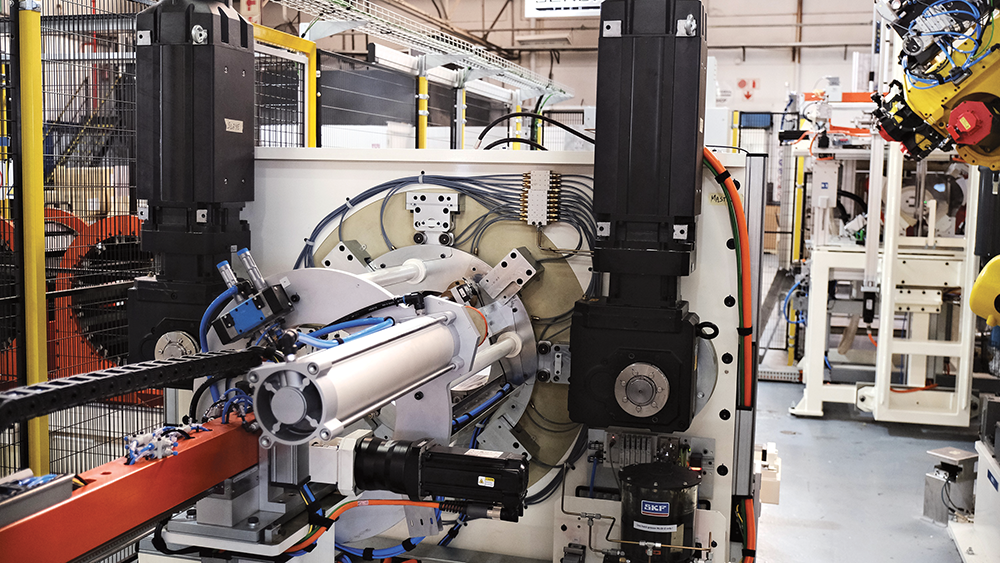
To secure the monolith inside the casing with the right spring load, the casing itself has to be adapted. This is the key function of the shrinking machine: to reshape the stainless steel casing to the exact diameter required for each brick and mat combination. Shrinking stainless steel to tolerances of 50 microns requires enormous force and control, which the shrinker achieves by closing a set of heavy tapered segments around the can.
“For a passenger vehicle converter we use twelve segments, while for a commercial vehicle converter which is larger, we use sixteen,” Naidoo says. “We pull a massive steel ring back over those segments and as the ring moves the segments close in, collapsing the can evenly around the monolith.”
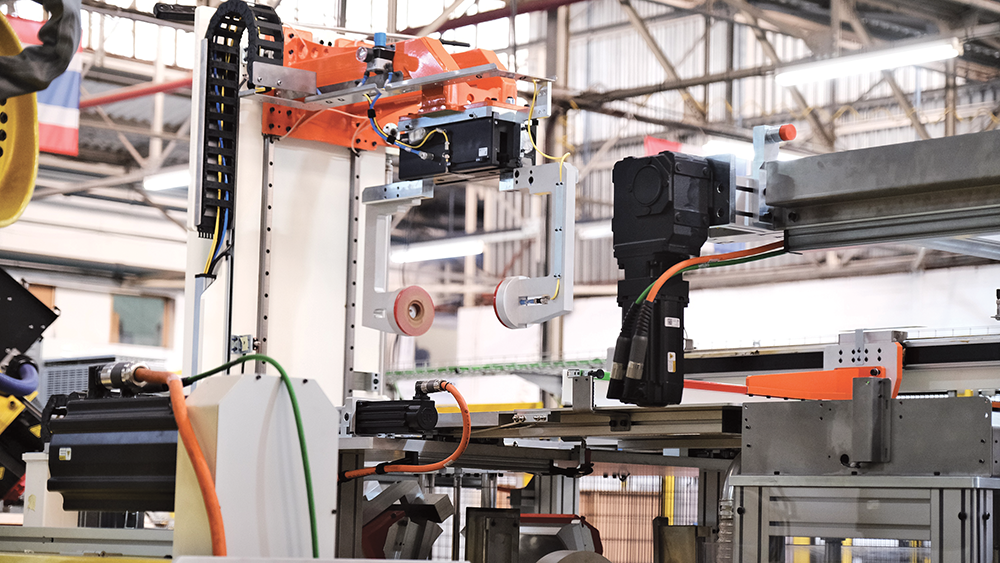
Driving this motion are two powerful SEW-EURODRIVE servo motor systems, each connected to precision roller screws that pull the ring from both sides. Synchronising these drives is critical.
“If one side is pulled just a few millimetres more than the other, this will damage these very expensive roller screws,” he explains. “This is where SEW-EURODRIVE’s technology comes into its own; the drives and controllers keep the two motors synchronised to within a very fine tolerance, even at the high speeds we need to hit our 30 second cycle times.”
The speed at which Jendamark Automation’s shrinker operates is one of its critical advantages, and this has been achieved through its innovative tool changer. He explains that flexibility is particularly important in converter production for commercial vehicles as variants change every few hours. Previously, each change required a lengthy manual tool change which would mean two to three hours of downtime.
“This is why we developed an automatic tool change system for the shrinker,” he says. “We have two cartridges outside the machine, one of which is preloaded with the next set of 16 segments. When the operator hits ‘tool change’ the machine ejects the old set, inserts the new one and locks everything down automatically, all in about 45 seconds.”
This innovation, also powered by SEW-EURODRIVE servo drives, has transformed productivity. “We have reduced tool changing times significantly, giving our customers more production time per shift, allowing them to produce around 80 additional parts,” he says. “With two or three tool changes a day, the gains are massive.”
The entire catalytic converter assembly cell can contain up to 30 SEW-EURODRIVE servo drives, powering and synchronising multiple machines from laser measuring systems to robotic handlers. Behind the scenes, Jendamark’s proprietary variant manager software orchestrates these movements.
“Every part coming down the line is slightly different, so every 30 seconds a new set of parameters such as diameters, spring loads, and positions is sent to the drives,” Naidoo says. “There are no fixed positions so it is completely dynamic, adapting in real time.”
Parallel to this performance is an equivalent focus on reliability, as customers require minimal downtime to ensure that their processes and products remain viable. He notes that a USA customer, Cummins has been running Jendamark’s shrinker for almost six years, during which time it has produced over three million catalytic converters.
“Apart from greasing the screws, there has been no major maintenance and no drive failures at all,” he says. “This is a testament to the robustness of our overall design and of the reliability of SEW-EURODRIVE equipment. The customer was so impressed that they decided to standardise globally on Jendamark’s machines. They had two other suppliers’ machines next to ours on the same line. Now they’re replacing these with Jendamark machines, because of the reliability and consistency of quality.”
Phillip Steyn, branch manager at SEW-EURODRIVE in Gqeberha, says the project exemplifies how advanced motion control systems enable complex automation.
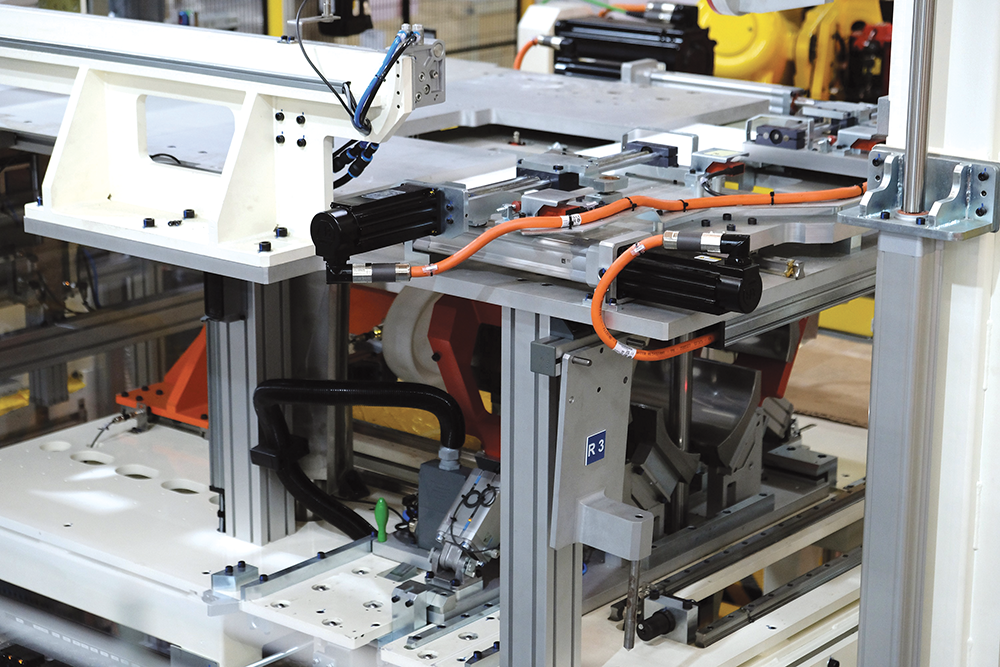
“Our MOVIAXIS multi-axis servo system, combined with our efficient servo motors and dynamic gearboxes, provides the accurate positioning and torque that this machine needs,” he says. “The challenge was to deliver very high torque while maintaining precise synchronisation and feedback at rapid speeds.”
He notes that it is easier to be accurate when machinery is moving slowly, but it becomes much more challenging in the context of high-speed machines like this one. SEW-EURODRIVE’s control architecture ensures that every motion, from the synchronised pulling of the ring to the positioning of the auto-tool change mechanism, is tracked and verified before the next cycle begins.
“There is a great deal of feedback between the drive and the upper-level controller,” Steyn explains. “The system scans the input data, the product types and can sizes, and adjusts torque and position in real-time. It is the brain and the muscle working together.”
For more information contact SEW-EURODRIVE,
| Tel: | +27 11 248 7000 |
| Email: | [email protected] |
| www: | www.sew-eurodrive.co.za |
| Articles: | More information and articles about SEW-EURODRIVE |






© Technews Publishing (Pty) Ltd | All Rights Reserved
 printer friendly version