



As automation systems evolve toward higher speeds, tighter tolerances and greater intelligence, the role of position feedback is critical. Rotary encoders are at the heart of motion control, directly influencing accuracy, smoothness, energy efficiency and long-term reliability.
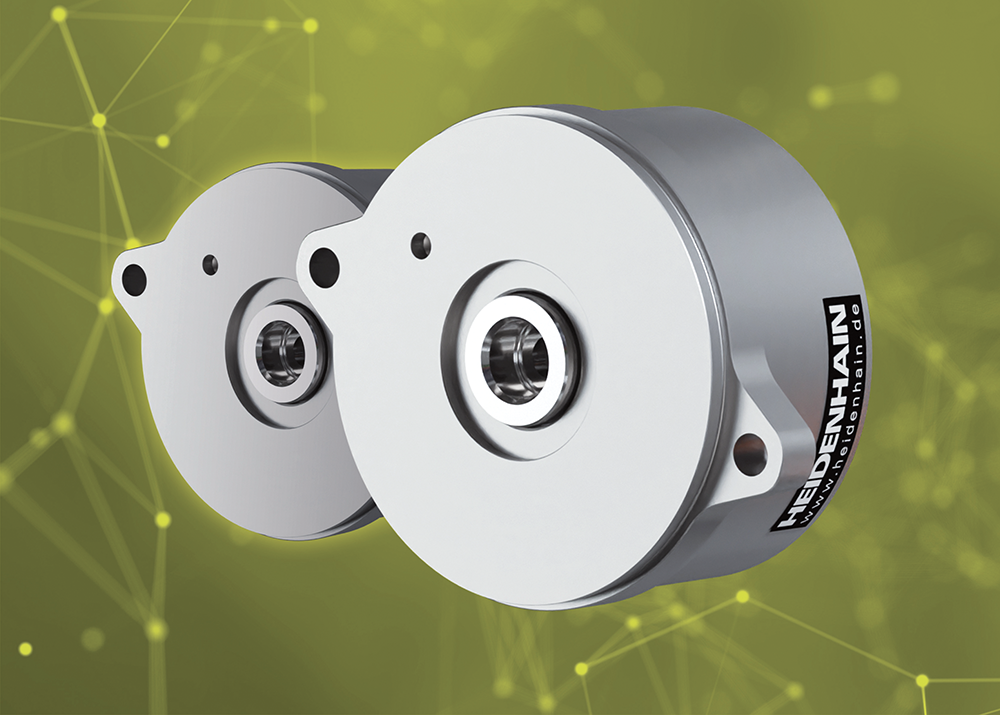
As automation systems evolve toward higher speeds, tighter tolerances and greater intelligence, the role of position feedback is critical. Rotary encoders are at the heart of motion control, directly influencing accuracy, smoothness, energy efficiency and long-term reliability.
With the launch of the ECI 1122 and EQI 1134 rotary encoders, positioning specialist, HEIDENHAIN has introduced a new benchmark in inductive scanning technology that raises the bar for motion control and precision automation. Engineered for high-performance automation environments, these next-generation encoders are designed to meet the growing demands for precision, stability and data transparency in modern motion systems.
They address several of the most pressing challenges faced by machine builders and system integrators today: minimising speed ripple, reducing position noise, simplifying cabling and unlocking deeper operational insight from within the motor itself. While they retain the familiar form factor of HEIDENHAIN’s established inductive encoder family, their internal architecture represents a significant technological leap.
HEIDENHAIN is a pioneer in measurement, control and drive system technology. The company specialises in measurement and control technology products and solutions for demanding positioning tasks in industries such as machine tools, automation, electronics, robotics, and elevators.
In South Africa, HEIDENHAIN’s advanced encoder solutions are supplied and supported by ATI Systems, a specialist provider of industrial automation, motion control and sensing technologies. The company has been appointed as the HEIDENHAIN dealer in South Africa from 1 January 2026.
Higher resolution
One of the most notable enhancements in the ECI 1122 and EQI 1134 is the 22-bit single-turn position resolution, a substantial improvement over previous generations. This increase in resolution delivers a measurable reduction in both position noise and speed ripple, particularly at low speeds where motion irregularities are most noticeable and most damaging to process quality.
For applications such as servo-driven production machinery, robotics, packaging systems and machine tools, this smoother motion translates into better surface finishes, improved repeatability and more stable control loops. In high-dynamic axes, reduced speed ripple also supports quieter operation and lower mechanical stress, contributing to longer service life of both the motor and the driven mechanics.
This performance gain is achieved without altering the external dimensions or mechanical interfaces of the encoder. As a result, the new generation can be integrated into existing motor designs with minimal redesign effort, supporting both new developments and upgrades of proven platforms.
Advanced ASIC design
At the heart of the new inductive scanning technology lies a newly developed application-specific integrated circuit (ASIC), manufactured using 180-nanometre semiconductor technology. The ASIC strikes a carefully engineered balance between robustness, reliability and miniaturisation, key requirements for industrial encoders operating in electrically noisy, thermally demanding environments.
In addition to its core signal-processing function, the ASIC introduces a novel concept for encoder intelligence through the integration of an application-specific integrated processor (ASIP). This is a significant departure from conventional encoder designs where the device’s role is largely limited to position feedback.
The ASIP enables the encoder to collect and process operating data directly at the motor interface, a position unmatched in terms of relevance and accuracy. Because no other electronic component sits closer to the motor, the encoder becomes an ideal sensor node for capturing critical information such as load conditions, cumulative operating time and motor temperature.
From position feedback to operational insight
The ability to gather this data opens the door to a new class of functionality. Rather than serving solely as a feedback device, the encoder becomes an integral contributor to condition monitoring and predictive maintenance strategies.
The operating data collected provides a reliable basis for identifying abnormal load patterns, excessive thermal stress or deviations from expected duty cycles. Over time, this insight can be used to optimise machine operation, prevent unplanned downtime and extend service intervals. For asset-intensive industries, this results in a significant improvement in availability, reduced maintenance costs and a measurable increase in overall equipment effectiveness (OEE).
EnDat 3 integration enables single-cable solutions
Another key innovation in the ECI 1122 and EQI 1134 is the direct implementation of EnDat 3 on the scanning ASIC as a single-chip solution. This marks the first time HEIDENHAIN has integrated its latest digital interface so deeply into the encoder architecture.
The immediate benefit is compatibility with the HMC 2 single-cable solution, which combines power supply and high-speed bidirectional data transmission in a single motor-to-controller cable. For machine builders, this offers clear advantages: fewer cables, reduced installation effort, lower material costs, higher data rates and reduced space requirements, and simplified routing through cable chains and drag systems.
From a system perspective, the EnDat 3 interface delivers higher data rates and enhanced communication capabilities compared to earlier interfaces. This ensures fast, deterministic transmission of position data as well as diagnostic and operating information, even in highly dynamic applications.
Designed for future expansion
Beyond current functionality, the high-performance EnDat 3 interface sets the stage for future developments. HEIDENHAIN has already indicated that additional sensor data, such as acceleration or vibration information, could be integrated directly into the EnDat 3 signal path.
This approach eliminates the need for external sensor boxes or separate communication cables that were a feature of previous solutions. By consolidating sensing, data processing and communication within the encoder itself, system complexity is reduced while data quality and reliability are improved.
This future-oriented design philosophy ensures that the new inductive scanning platform will remain relevant as automation systems continue to evolve toward greater connectivity and intelligence.
As industrial systems increasingly move toward data-driven decision making, embedding intelligence at the sensor level represents a major step forward.
Flexibility across applications and interfaces
While the new generation is based on EnDat 3, HEIDENHAIN has maintained flexibility to support a wide range of control architectures. In addition to EnDat 3, the new inductive technology will also be available with SSI and programmable TTL interfaces, allowing integration into both modern and legacy systems.
Over time, HEIDENHAIN plans to extend this next-generation inductive scanning technology across its full range of inductive encoders. Its countless options, including an SSI interface or a programmable TTL interface as an alternative to EnDat 3, promise a host of benefits. This will ensure consistent performance, diagnostics and interface options across different encoder types and application classes. For users, this means greater standardisation, simplified spare parts management and a clearer migration path toward future-ready automation platforms.
Supporting automation trends
Taken together, the ECI 1122 and EQI 1134 align closely with current trends in industrial automation with higher accuracy, increased dynamic performance, improved process reliability and strong focus on cost efficiency across the entire system lifecycle.
By reducing cabling, improving signal quality and enabling smarter maintenance strategies, these encoders deliver value far beyond their core function. They support machine designs that are not only more precise, but also more resilient and easier to operate over the long term.
Local expertise from ATI Systems
ATI Systems has built a strong reputation for delivering high-quality solutions, backed by deep technical expertise and local support. The company represents a portfolio of leading international manufacturers and works closely with customers across manufacturing, mining, energy, and process industries. Beyond product supply, ATI Systems offers application engineering, system integration support and technical consultation, helping customers select and implement the most appropriate technology for their specific requirements.
With a strong focus on precision measurement and automation reliability, ATI Systems plays a key role in enabling South African industry to adopt cutting-edge motion control solutions. Their partnership with HEIDENHAIN ensures local access to the latest encoder technologies, supported by knowledgeable engineers who understand both the products and the operating environments in which they are deployed.
| Tel: | +27 11 383 8300 |
| Email: | [email protected] |
| www: | www.atisystems.co.za |
| Articles: | More information and articles about ATI Systems |






© Technews Publishing (Pty) Ltd | All Rights Reserved
 printer friendly version