In the 1970s and 80s, the hardwired alarm annunciator was essential to industrial control rooms, particularly in high-risk sectors such as nuclear, petrochemical and oil and gas. These wall-mounted panels with flashing lights and hardwired inputs served as the front line of safety monitoring, giving operators clear visibility of the alarm through pattern recognition. However, the 1990s brought a shift. Gary Bradshaw, director at alarm annunciator developer Omniflex, explains how the company saw the market differently to then established players like Highland and Rochester, and how it reshaped the industry.
“The rise of the digital age and PC-based systems and graphical interfaces led many to view the traditional annunciator market as obsolete. Major players in the sector either scaled back investment or consolidated, leaving the market seemingly in decline. At Omniflex, we recognised that while the technology was evolving, the fundamental need for reliable, unambiguous alarm systems in critical environments wasn’t going away. In fact, it was becoming more important.”
As competitors exited the space or shifted focus, Omniflex chose to remain active. The company adapted to emerging technologies, like scada DCS and HMI, positioning itself not just as a hardware provider, but as a solution partner in integrated alarm systems.
A pivotal moment came in 1994 with the Milford Haven explosion. This catastrophic event exposed serious flaws in alarm management. During the incident, operators were overwhelmed by an avalanche of screen-based alarms, and were unable to distinguish urgent threats from routine warnings.
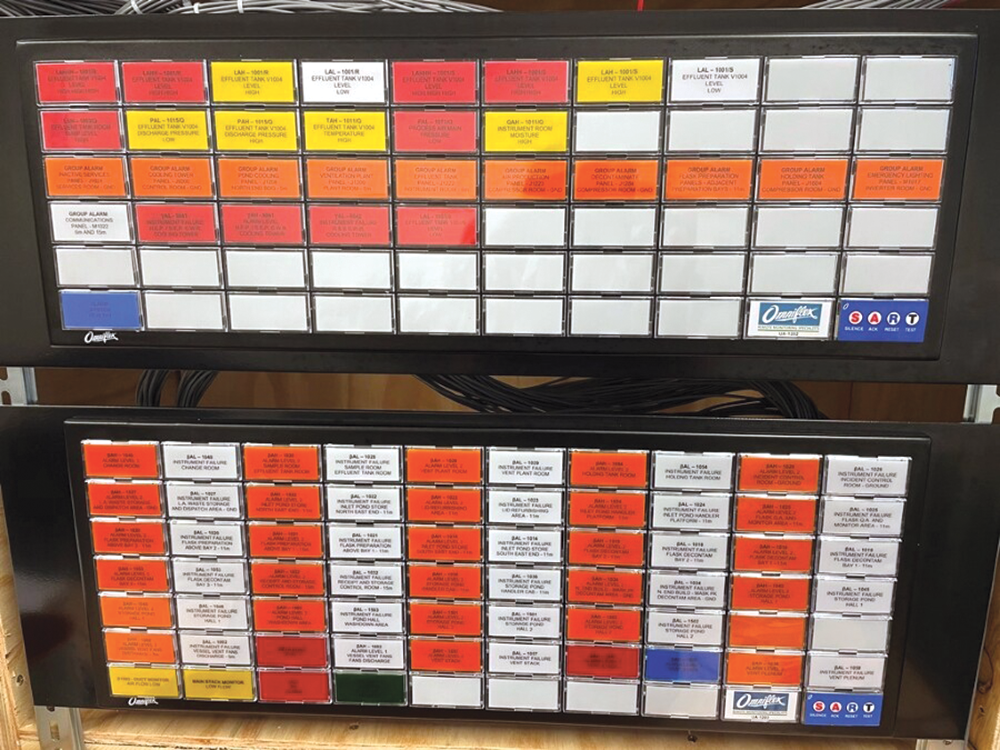
This tragedy accelerated the development and adoption of the IEC61508 SIL and the EEMUA191 Alarm Standard which called for clear prioritisation of alarms, including colour coding, and the importance of the hardwired alarm annunciator due to its clear display format giving pattern recognition and concise operator guidance. Recognising the implications of this shift, Omniflex worked closely with a committee member involved in drafting the EEMUA 191 standard.
Responding to evolving regulations, Omniflex continued to develop its already successful OMNI range of alarm annunciators, ensuring that they aligned with IEC61508 and EEMUA191. This range of modern annunciators features a compact design and flexible configuration, and can integrate seamlessly with scada and PLC systems.
The OMNI range filled a critical gap in the market just as demand for high-integrity alarm systems resurged. It gave Omniflex a strong competitive advantage as others had exited the space.
Changing regulations can breathe new life into technologies once considered outdated. By anticipating the impact of safety standards, like IEC61508 and EEMUA191 and investing accordingly, Omniflex helped shape what the modern alarm annunciator sector looks like today.
Siemens modernises WinCC Unified engineering
SCADA/HMI
Siemens has launched SIMATIC AX WinCC Unified Elements, an IT-style engineering application for the WinCC Unified system that lets automation engineers build and deploy visualisation projects using code-based workflows, Git integration and AI-generated configuration
Read more...Omniflex delivers ICCP systems in London Omniflex Remote Monitoring Specialists
Maintenance, Test & Measurement, Calibration
Omniflex has supplied impressed current cathodic protection systems for landmark London buildings, protecting reinforced concrete from corrosion and extending the service life of commercial, retail and heritage sites.
Read more...The control room used to run one plant, now it runs the world
SCADA/HMI
Industrial control rooms are evolving from single-site interfaces into network-wide command centres. Modern SCADA and HMI platforms now deliver real-time visibility, dynamic forecasting and cross-facility coordination, fundamentally reshaping how industrial operations achieve resilience.
Read more...Modernising acid cooler protection without disrupting production Omniflex Remote Monitoring Specialists
Maintenance, Test & Measurement, Calibration
Omniflex has supplied an advanced anodic protection control system to phosphate producer Foskor, replacing a legacy transformer rectifier system while maintaining uninterrupted production. The distributed PowerView CP solution provides remote monitoring and DCS integration.
Read more...Effective alarm management for safer, more productive operations Adroit Technologies
SCADA/HMI
Adroit Technologies addresses alarm flooding and nuisance alarms with its Adroit Alarm Management solution.The platform combines performance dashboards, mobile escalation via Adroit AIR, and an integrated digital logbook to turn alarms into actionable operational intelligence.
Read more...Upgrading alarm systems for critical industries Omniflex Remote Monitoring Specialists
PLCs, DCSs & Controllers
Omniflex’s OMNI16R alarm annunciator platform provides a direct replacement for legacy CSA systems such as MPAS 90 and SA9100, enabling operators in oil and gas, nuclear and power generation to modernise alarm infrastructure without sacrificing the clarity required for safe operations.
Read more...Rethinking corrosion protection in process plants Omniflex Remote Monitoring Specialists
Maintenance, Test & Measurement, Calibration
Remote monitoring is changing how cathodic and anodic protection systems are managed in process plants, giving operators continuous visibility of corrosion protection performance and enabling more proactive maintenance decisions.
Read more...Rethinking corrosion protection in process plants Omniflex Remote Monitoring Specialists
Maintenance, Test & Measurement, Calibration
Omniflex explains how integrating remote monitoring and cloud-based platforms into cathodic and anodic protection systems is helping process plant operators stay ahead of corrosion and make smarter maintenance decisions.
Read more...What you need is a nerve centre for your building Schneider Electric South Africa
SCADA/HMI
Schneider Electric’s Anoop Hariparsad explains how a building management system acts as a single nerve centre, cutting energy use and improving safety and guest experience.
Read more...Preserving a French heritage landmark Omniflex Remote Monitoring Specialists
Maintenance, Test & Measurement, Calibration
Omniflex supplied a remotely monitored impressed current cathodic protection system for the Perret Tower in Grenoble, a protected French heritage site, combining 24/7 corrosion protection with integrated surge protection against lightning strikes.
While every effort has been made to ensure the accuracy of the information contained herein, the publisher and its agents cannot be held responsible for any errors contained, or any loss incurred as a result. Articles published do not necessarily reflect the views of the publishers. The editor reserves the right to alter or cut copy. Articles submitted are deemed to have been cleared for publication. Advertisements and company contact details are published as provided by the advertiser. Technews Publishing (Pty) Ltd cannot be held responsible for the accuracy or veracity of supplied material.










 printer friendly version