



For control and automation engineers, the challenge of data silos is all too familiar. Manufacturing plants typically rely on a patchwork of specialised systems, scada for visualisation, historians for time series data, MES for execution, and ERP for business processes. Each speaks its own dialect, and system integrators often spend significant effort creating custom point to point integrations, commonly known as ‘spaghetti code’, just to share basic information between systems. In some cases, information is copied into large databases, data lakes or data warehouses, where an effort is made to provide a single source of truth from which business intelligence applications can reliably draw information. These integrations become expensive to maintain as systems are upgraded. Moreover, the complexity increases exponentially with the addition of every new data source.
With digital initiatives like IIoT, AI, advanced analytics and real-time process optimisation becoming key competitive drivers, this fragmented data landscape poses a serious constraint. Simply put, a smart factory cannot be optimised while data remains locked in isolated silos with a tangle of point-to-point integrations.
An architectural concept that’s gaining prominence for resolving this challenge is the Unified Namespace (UNS).
Unified Namespace: A shift in architecture
The Unified Namespace is an architectural pattern, or a centralised, hierarchical data infrastructure for the entire enterprise. It is not a product you can buy, the UNS is more a concept. Think of the UNS as a live, evolving directory where every process value, status and event in the factory has a well-defined, standardised address. It promises to act as an information backbone, providing context, continuity and accessibility for all stakeholders and automation systems.
The UNS concept has the potential to be foundational for supporting new technologies such as AI agents that work across multiple systems.
Why context and standardisation matter
From an operational perspective, information context is essential. Consider process data. Knowing a motor is drawing 15 amps is informative, but knowing exactly which motor (e.g., AlrodeBrewery/Site_A/Filling_Line_3/Motor_M101) under which recipe or production schedule is actionable. The power of UNS is that every data point is enriched with its industrial context.
The UNS drives three core operational benefits:
• Decoupling systems for agility
Traditionally, integrating new applications such as predictive maintenance, OEE dashboards or custom analytics requires one-off connections to a patchwork of sources (PLCs, historians, databases). This approach is slow and costly.
With UNS, the information flow is fundamentally changed. Devices (PLCs, sensors, software) publish their data into the namespace through a central broker using the agreed structure. Applications simply subscribe to the relevant namespace topics, regardless of device age or vendor. Engineers no longer need to worry much about differences between legacy protocols like Modbus and modern IIoT devices. This decoupling not only accelerates project timelines, but also makes ongoing maintenance more manageable.
• Event-driven efficiency
Legacy systems often rely on polling, which involves continually querying devices for updates. This is inefficient, especially as industrial networks scale. UNS typically employs a publish/subscribe model, with most data being transmitted only on change.
For example, a sensor reports temperature only when it changes by a defined increment, not at fixed intervals. This conserves bandwidth and reduces edge processing loads, a crucial advantage in bandwidth-constrained environments. The message payload will normally contain the namespace information (e.g. Plant1/TankA/Temperature/TI1005) together with a timestamp and the process value. The message payload is however not limited to single process values and depending on the requirement, you could also pass arrays of information such as a short burst of recent time series data.
• Consistent hierarchy
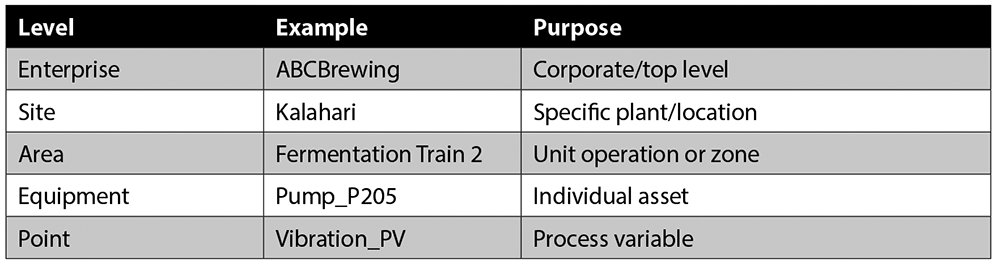
A usable UNS structure should reflect the physical and organisational reality of the plant, leveraging standards such as ISA-95. A standard hierarchy might look like (see Table):
This alignment ensures that both front-line engineers and higher-level applications (or AI agents) can reference and interpret data efficiently and correctly across the enterprise.
UNS vs alternative data architectures
It’s important to understand that UNS, while powerful, is not the only architectural approach. Several vendors are advancing Industrial Knowledge Graphs. These are platforms that ingest and semantically contextualise data and related documents, linking business, operational and equipment relationships.
• UNS acts as a real-time broker, facilitating live data flow using topic-based addressing.
• Knowledge Graphs emphasise persistent semantic modelling, enabling complex queries across operational and business contexts.
For system integrators, this distinction has practical implications:
• With a classic UNS, consuming apps subscribe directly to a broker like MQTT.
• Knowledge Graphs often provide an API layer, abstracting the underlying data transport. This makes it simpler for higher-level apps but sometimes limits real-time flexibility.
Knowledge Graphs can be advantageous for cross-domain AI but do add abstraction and cost. Both architectures are converging, and integration strategies will likely become more hybridised as digital maturity advances and vendors release new products.
Foundation technologies and standards
The effectiveness of a UNS depends heavily on a robust, standardised foundation. Historically, the protocol of choice is Message Queuing Telemetry Transport (MQTT). This is a lightweight, event-driven protocol that is well suited to industrial needs and reliable over bandwidth-constrained links. However, standard MQTT is not specific enough for industrial-grade requirements.
Key enhancements and standards are:
• Sparkplug B: An open specification layered on MQTT. It enforces a strict topic structure, utilises efficient payload encoding, and mandates device state management (‘birth’ and ‘death’ messages) for robust system awareness.
• OPC UA Pub/Sub: Offers strong information modelling and security, with support for
pub/sub messaging over protocols like MQT. OPC UA is an attractive alternative, especially in regulated or enterprise-scale settings.
• Custom Implementations: Some organisations opt for standard MQTT with custom JSON payloads, trading strict specification for flexibility.
• Vendor platforms: Major industrial and cloud vendors provide proprietary ingestion and modelling services, often abstracting the transport and offering high-level APIs for data access.
Practical guidance for control and automation engineers
Adopting a UNS is an incremental journey, not an overnight transition. Here are some key considerations:
• Start with structure, not technology: Design the namespace hierarchy aligned to your business and operational reality (ISA-95 is a proven template). Good foundational architecture is 90% of the effort.
• Demand edge reliability: Whether you choose Sparkplug B, OPC UA Pub/Sub or another mechanism, ensure your gateways and field devices implement robust state management. Real-time awareness of device health is non-negotiable.
• Maintain vendor agnosticism: Avoid lock-in by choosing brokers, gateways and protocols that support open standards, fostering the freedom to connect both legacy and future solutions.
Preparing your factory for the post-silo era
I think that the UNS is an important enabler for the backbone of modern manufacturing IT. By standardising communication and deeply contextualising data, UNS frees you from the endless cycle of integration troubleshooting, and redirects focus towards value creation.
As industry looks toward AI-enabled optimisation, engineers and technical managers must be familiar both the technical underpinnings and the architectural principles of UNS. Now is a good time to invest in these foundational skills, align your integration strategies with open standards, and require that your suppliers and technology partners do the same.

About Gavin Halse
Gavin Halse, an experienced chemical process engineer, has been an integral part of the manufacturing industry since the 1980s. In 1999, he embarked on a new journey as an entrepreneur, establishing a software business that still caters to a global clientele in the mining, energy, oil and gas, and process manufacturing sectors.
Gavin’s passion lies in harnessing the power of IT to drive performance in industrial settings. As an independent consultant, he offers his expertise to manufacturing and software companies, guiding them in leveraging IT to achieve their business objectives. His specialised expertise has made contributions to various industries around the world, reflecting his commitment to innovation and excellence in the field of manufacturing IT.
For more information contact Gavin Halse, TechnicalLeaders, [email protected], www.technicalleaders.com, www.linkedin.com/in/gavinhalse






© Technews Publishing (Pty) Ltd | All Rights Reserved
 printer friendly version