



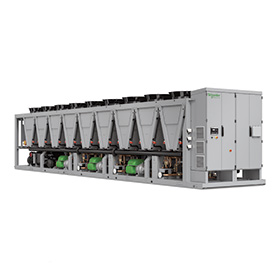
Schneider Electric has launched the Uniflair XCA, a new series of air-cooled and free-cooling chillers designed to meet the rapidly evolving demands of AI-driven, high-density liquid-cooled data centres. The Uniflair XCAC air-cooled, and Uniflair XCAF free-cooling series integrate oil-free centrifugal compressors with magnetic bearing technology and built-in variable-speed drives, forming a fully optimised cooling platform engineered to deliver excellent energy performance and operational stability across diverse thermal loads and ambient conditions.
Equipped with a high-efficiency spray-type evaporator, the XCA line features six sizes of oil-free centrifugal chillers ranging from 1200 to 2500 kW that deliver excellent thermal performance and use low-GWP refrigerants to significantly reduce environmental impact. Their wide operating range accommodates elevated water temperatures, making the chillers particularly suited for AI-optimised data centres and advanced liquid cooling infrastructures, where energy efficiency and sustainability are priorities.
“Energy efficiency, adaptability and reliability are essential components of liquid cooling systems for AI-optimised data centres, and we’ve designed the Uniflair XCA line with these design features at the forefront,” says Andrew Bradner, senior vice president, cooling business at Schneider Electric. “With adaptable water operating temperatures and versatile deployment options, the XCA line features a system-level approach that gives operators scalability, enhanced performance and long-term peace of mind as data centre complexity continues to rise.”
Accelerating the shift to sustainable, high-capacity cooling
As AI, GPU clusters and liquid cooling architectures drive unprecedented power densities, cooling systems have become central to data centre reliability and cost control. Uniflair XCA addresses these challenges through an integrated high-efficiency architecture built around several key capabilities.
• Oil-free magnetic bearing centrifugal compressors: These eliminate lubrication systems to reduce maintenance, contamination risks and mechanical losses, while delivering up to 25% higher efficiency and ultra-low acoustic levels.
• Advanced heat-exchange architecture: Combining spray evaporator technology with V-shape microchannel coils, this delivers thermal performance while significantly reducing refrigerant charge, material usage and overall environmental footprint.
• Optimised heat-rejection architecture: Combining a new V-shape coil design and a new generation of large-diameter EC fans, this delivers higher heat exchange efficiency with increased airflow, lower acoustic impact and stable operation, even at high ambient temperatures.
• Enhanced free-cooling capabilities: With high water temperatures (up to 33°C outlet) and enhanced coil geometry, XCAF free-cooling models significantly boost annualised performance. The system can operate in extreme environmental conditions (from -20 to 52°C), and in moderate climates it can achieve up to 60% energy savings compared to mechanical cooling alone, extending free-cooling availability and significantly reducing reliance on mechanical cooling.
• High configurability: With numerous electrical, hydraulic, noise control and performance enhancement options, the system can be customised to meet specific operational needs, improving efficiency and reducing management costs.
• High-efficiency quick restart: Built for mission-critical applications, the system supports a quick restart, restoring full operational capacity within three minutes of a power outage to minimise service interruptions.
• Sustainable by design: Decarbonisation is engineered into the core of Uniflair XCA. Fully aligned with EU F-Gas Regulation 2024/573, the platform adopts ultra-low-GWP refrigerants as standard.
Together, these features translate into lower energy expenditure, simplified maintenance and predictable long-term operation, enabling data centre operators to focus on business continuity, rather than system intervention.
Software-defined cooling
Building on Schneider Electric’s digital expertise, the XCA introduces a new generation of firmware features that optimise performance in real time.
• Variable-speed pump algorithms: For constant flow, constant temperature differential or constant head pressure.
• Advanced fan modulation: Enabling low-noise and ultra-low-noise profiles based on temperature, load or time schedules.
• Energy metering and real-time water flow measurement: For enhanced visibility.
These capabilities deliver predictive efficiency, reduced compressor cycling and higher overall system stability.
| Tel: | +27 11 254 6400 |
| Email: | [email protected] |
| www: | www.se.com/za/en/ |
| Articles: | More information and articles about Schneider Electric South Africa |






© Technews Publishing (Pty) Ltd | All Rights Reserved
 printer friendly version