



Imagine a factory floor where machines communicate with each other with such precision that even a millisecond of delay can lead to costly downtime. How can we prevent a scenario like this and ensure the timely, accurate transmission of data? What if an advanced Ethernet technology, prioritising every millisecond, galvanised a complete shift in industrial automation?
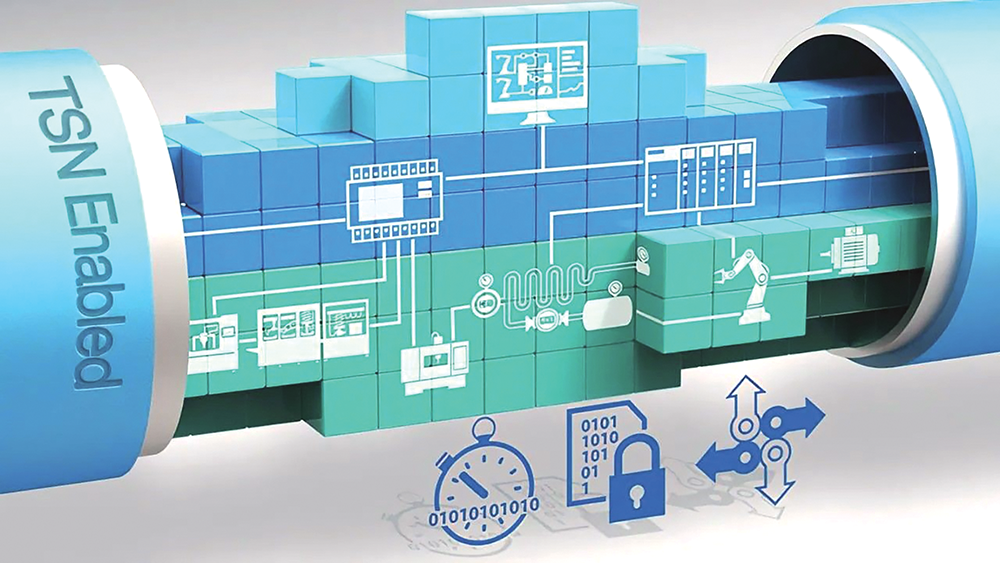
This is the promise of time-sensitive networking (TSN), a cutting-edge technology set to revolutionise industrial automation. Analysts project that the global TSN market will grow by a staggering 58,3% annually, reaching a value of USD 1,7 billion by 2028, according to a MarketsandMarkets report. In this article, we will explore what is driving the rise of TSN, how it is reshaping industrial efficiency, the challenges when deploying this technology, and ways to tackle these challenges.
The key benefits of adopting TSN
An example of TSN’s transformative power is a major home appliance manufacturer, which achieved significant improvements across several key areas:
• Deterministic communication: The low-latency, deterministic traffic scheduling of TSN allowed for precise control and synchronisation of production line devices. This enhanced real-time control and overall system responsiveness, crucial for maintaining high performance in data-intensive environments.
• Interoperability: TSN enabled the seamless integration of diverse production equipment from different vendors, simplifying network management and optimisation. This streamlined network management and optimisation ensured consistent compatibility and performance throughout the production line.
• Convergence of IT and OT: By unifying IT and OT systems on a single network, TSN streamlined operations, reduced overheads and enabled faster decision making.
• Simplified network complexity: TSN consolidated network communications into a single, simplified architecture based on standard Ethernet, reducing complexity and costs while allowing for easy scalability.
• Enhanced productivity: TSN’s ability to prioritise control data and ensure timely transmission enhanced productivity for the manufacturer, resulting in reduced downtime, faster response times and increased equipment effectiveness.
The cumulative effect of these enhancements was improved operational efficiency, higher productivity and substantial progress towards the manufacturer’s goals for efficiency and precision.
Possible hurdles when adopting TSN technology
TSN offers convincing benefits that make it appealing for businesses to integrate their systems and assets into a unified TSN-powered industrial network. While there are benefits to combining mission-critical and non-critical networks, integrating a new technology such as TSN will introduce additional challenges. Organisations considering implementing the new technology may have concerns regarding these requirements. The key challenges include:
• Growing data volumes: As more devices and applications connect to networks, the amount of data traffic surges, requiring high-bandwidth capabilities to effectively handle this increased demand. While Gigabit and 10G connections are crucial for speed, they also come with increased costs and complexity in network resource management. The effective handling of bandwidth becomes even more critical as advanced applications like AI and machine learning continue to put a strain on these systems.
• Network management complexity: With the growth of connected devices in a converged TSN network, managing the network will become more complex. Sophisticated management and configuration tools ,such as central network controllers, are essential for simplifying these processes. However, enterprises may be overwhelmed when implementing these solutions, given the need for technology investment, training and ongoing maintenance.
• System compatibility: Using products that adhere to relevant testing specifications or are integrated into established testbeds makes achieving a smooth TSN implementation easier. These standards ensure compatibility and reliability, which are critical for easing integration challenges and speeding up efficiency gains. However, finding, validating and integrating these standardised products can be time consuming and resource intensive, often requiring specialised expertise to navigate the various standards and certifications.
The path to successful TSN integration
It is important to recognise that TSN integration involves complexities. The benefits are substantial, but there are also challenges. To ensure a successful deployment, organisations must consider multiple critical aspects, including the following:
• Full Gigabit performance: As data demands increase in industrial environments, efficient handling of higher data volumes necessitates high-bandwidth capabilities. Therefore, it is crucial to choose TSN solutions that support full Gigabit speeds on each port to ensure robust network performance.
• Easy configuration: Look for intuitive management tools such as web-based graphical user interfaces that simplify device setup and management. This is particularly important for large-scale deployments where complexities can escalate.
• Compact and flexible design: Choose equipment with a compact and adaptable design that can easily fit into small areas.
• Compatibility: Make sure the products align with the required testing specifications or are included in existing testbeds. Adhering to these standards helps guarantee seamless compatibility and reliable performance, essential for successful TSN integration.
| Tel: | +27 11 781 0777 |
| Email: | [email protected] |
| www: | www.rjconnect.co.za |
| Articles: | More information and articles about RJ Connect |






© Technews Publishing (Pty) Ltd | All Rights Reserved
 printer friendly version