



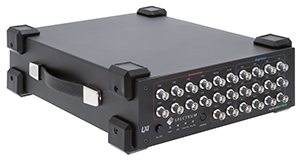
The hybridNETBOX is an innovative instrumentation platform that combines a multi-channel arbitrary waveform generator (AWG) and a digitiser in a single portable unit. With the unique capability for simultaneous signal generation and acquisition, these powerful tools are perfect for applications involving stimulus-response or closed-loop type testing.
The new models offer a choice of two or four AWG channels combined with the same number of digitiser channels. The AWG channels can generate almost any waveshape thanks to the use of the latest, high resolution, 16-bit digital to analogue converters (DAC). Models are available with output rates of either 625 MS/s or 1,25 GS/s and signal bandwidths up to 400 MHz (600 MHz available as an option). At 625 MS/s, the channels can be programmed to output signals with amplitudes up to ±3 V into a 50 Ω load or ±6 V into high impedance (1 MΩ). The models running at 1,25 GS/s can output signals with an impressive ±2,5 V into 50 Ω and ±5 V for 1 MΩ.
For signal acquisition, the digitiser channels feature similarly outstanding performances. Users can select from models that provide 16-bit resolution and sampling rates of 180 or 250 MS/s or 14-bit resolution and sampling rates of 400 or 500 MS/s. Each channel is fully programmable with six adjustable input ranges, from ±200 mV to ±10 V full scale, signal offset and selectable input impedance of 50 Ω or 1 MΩ. Both the AWG and the digitiser showcase a flexible clocking system that allows the selection of almost any output or sampling rate setting, enabling users to generate or acquire signals at exactly the speed they require.
With the ability to create and acquire electronic signals at the same time, hybridNETBOX units are ideal for a wide variety of automated testing applications. For example, it can reproduce and capture echo signals such as those found in radar, sonar, lidar or ultrasound. The hybridNETBOX is also suited to ATE applications where components and subassemblies need to be tested in a fast and automated way, and can quickly ascertain the functionality and tolerance of devices or units under test by exercising it with numerous easily adjusted complex signals. This powerful testing process can be deployed in a host of applications like bus testing, MIMO communications, circuit verification, robotics, automotive and scientific experiments.
Oliver Rovini, technical director at Spectrum Instrumentation, says: “Since we launched the first hybridNETBOX models in 2020, we’ve received positive feedback from engineers and scientists that require both waveform generation and signal acquisition in manual, automated or remotely controlled applications. These new models will extend the frequency range and allow us to address even more applications. Being portable LXI instruments, they’re easy to integrate into almost any system. Just connect them to a PC or network via the Gbit Ethernet port and start generating, acquiring and analysing signals.”
Each hybridNETBOX includes Spectrum’s own control software, SBench 6 for signal generation, acquisition, display, signal processing, storage and reporting. SBench 6 allows waveforms to be created using standard functions and mathematical equations. Data can be acquired with the digitiser part and then be transferred to the AWG for replay. Data sharing with other programs or devices such as oscilloscopes is possible using built-in, import/export functions for transferring data in binary, ASCII or wave formats. Fully programmable, the hybridNETBOX comes with drivers for Windows and Linux operating systems, as well as programming examples for C++, LabVIEW, MATLAB, Visual Basic .NET, JAVA, Python and other popular languages.
To help with waveform generation and acquisition, the hybridNETBOX has a large amount of on-board memory (2 x 2 GSamples) and includes a number of operating modes. For instance, it is possible to output signals using Single-Shot, Loop, FIFO Streaming, Gated Replay and Sequence Replay modes. This flexibility permits the user to generate almost any signal or combination of signals and develop test routines that can go from simple to complex. Similarly, signals can be acquired using Single-Shot, FIFO Streaming, Multiple Recording, Gated Sampling, and ABA (sample rate switching) modes. These can be combined with a variety of flexible trigger modes (Channel, External, Software, Window, Re-Arm, Logic or Delay) to make sure that important events are never missed.
In addition to the digitiser and AWG channels, the front panel of each hybridNETBOX includes multiple digital I/O connectors. These make it easy to integrate units into a test system. For example, synchronous marker outputs are available that can be used on the AWG channels to allow precise control of other devices or instruments. Similarly, it is possible to synchronise the unit with other equipment, by applying an external clock and triggers.
| Tel: | +27 11 454 8053 |
| Email: | sales@vepac.co.za |
| www: | www.vepac.co.za |
| Articles: | More information and articles about Vepac Electronics |






© Technews Publishing (Pty) Ltd | All Rights Reserved
 printer friendly version