



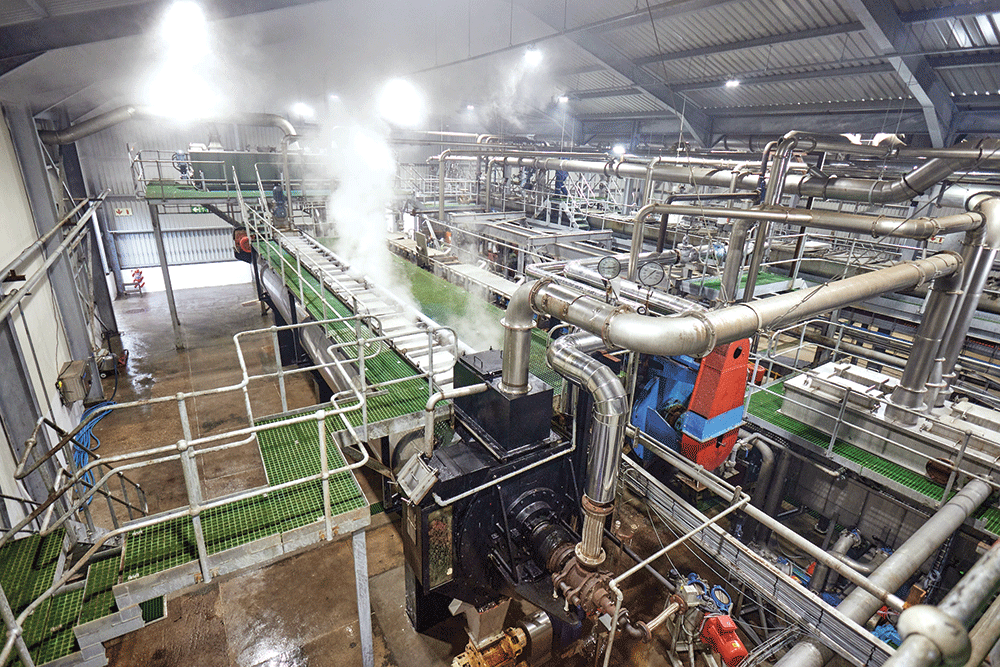
The science behind steam use and heat transfer is fundamental to many processes and will remain a requirement for many industries into the future. “The mode of steam generation might change, and the fuels might change, but the steam will be needed,” says Associated Energy Services (AES) commercial director, Dennis Williams.
The evolution of industrial process steam boilers has included upgraded control systems and instrumentation, with the focus shifting from the construction of steam boilers to optimising combustion, improving efficiency and reducing emissions. When it comes to utility boilers the size of an Eskom power station, change has centered on boiler materials and design intending to increase generation steam pressure to the supercritical phase to drive power generation efficiency, and to then consider carbon capture and storage to drive overall boiler thermal efficiency.
‘Steamy’ mix of old and new
The question around steam boilers is whether South African industry has kept up. Williams says that the local boiler fleet is best described as ‘legacy plant’, evidenced by a buoyant refurbished steam boiler market. This is because older boilers are extremely resilient and, with proper operation and care, can last between 20 and 40 years. “There are however ways for the combustion element (energy input mechanism) to be evolved via retrofits on control systems, fuel switches or technology replacements,” he suggests.
New fuels have also ushered in various changes, with more gas-fired, biomass and novel fuel systems being implemented. However, the main differentiator between South African boilers and those used in North America and Europe is the use of coal, which has been replaced by alternative fuel sources, particularly gas. “On larger scale plants, there has been a lot of activity in fluidised bed systems, including bubbling and recirculating fluidised bed boilers. Their lower combustion s suitable for the use of solid fuels and has a positive effect on NOx generation. Fluidised bed boilers have been used in a few limited applications in South Africa, but the substantial capital investment cost has detracted from this,” he continues.
Williams believes that steam remains popular primarily because it is an excellent and efficient heat transfer mechanism. It possesses both latent and sensible heat energy (temperature), allowing it to deliver significant amounts of energy with smaller flows compared to other heat transfer methods that rely only on sensible heat. As a result, steam can maintain precise and effective temperature control within a system.
Myriad steam applications
The use of steam is widespread across a large number of industries. Williams notes that in South Africa efforts to improve local industries - such as the food and textile sectors - could see an increased demand for steam.
The right boiler for the job
He explains that there are primarily two types of boilers: fire tube and water tube. Fire tube boilers consist of cylindrical vessels filled with water, featuring tubes that run through them to carry hot flue gas. Heat is transferred from the gas through the tubes to the water surrounding them, eventually generating steam. In contrast, water tube boilers contain less water per unit of steam produced and have upper and lower steam drums connected by boiler tubes. In this design, water boils inside the tubes, with steam rising to the top and collecting in the steam drum. There’s also the option of a combined design that incorporates both water tube and fire tube elements. Williams emphasises that optimising efficiencies and understanding a client’s immediate and future operational needs are crucial in selecting the right boiler. This decision should be robust and well-founded, aligning with the long-term business strategy.Boilers are expensive to buy, operate and maintain, and can have a long service life if properly maintained, but a selection error may have a negative impact on many fronts.
The perfect partner
AES is the ideal partner, with years of experience spanning various industries, operations, and energy facilities. This extensive background enables them to offer essential on-the-ground insights related to Capital Expenditure (CapEx), Operating Expenditure (OpEx), and other relevant aspects when clients are in the market for boilers. After collaborating with clients to grasp their overall objectives, AES can present an array of viable steam boiler options and clarify the technical details associated with each one.
“We can then support the execution of a project on a turnkey basis or blend the turnkey project with an operations and maintenance Service Level Agreement (SLA), ensuring a longer-term partnership of at least three years. AES is committed to delivering solutions while taking full responsibility for the operational outcomes of our clients,” Williams concludes.






© Technews Publishing (Pty) Ltd | All Rights Reserved
 printer friendly version