Ensure seamless integration and reliable performance with CANbus solutions
January 2025Editor's Choice
Fieldbus & Industrial Networking
Modern industrial applications require robust and effective communication. The CANbus product range guarantees smooth integration and data transfers throughout systems. CAN protocol gateways are used for converting protocols, CAN-to-fibre converters for extended range and better signal quality, and CAN serial cards for versatile connectivity. The case studies below show how Moxa products are practically applied and the benefits they offer. They demonstrate how our solutions can support and enhance your CANbus communication needs, ensuring reliable performance in different industrial environments.
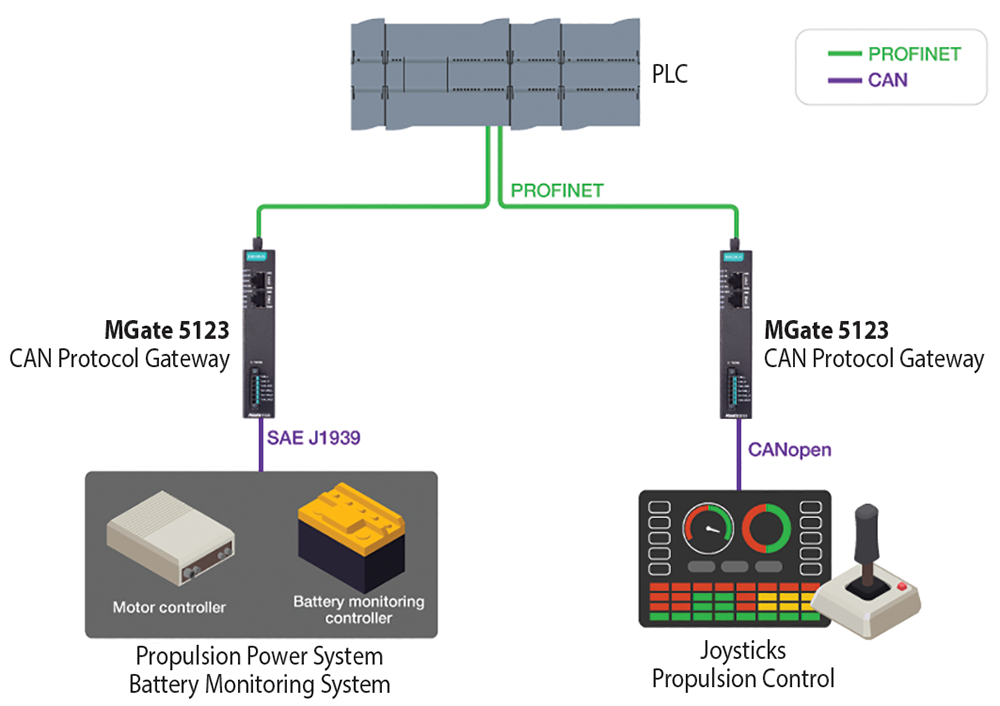
Ship integrated electric propulsion system using CAN protocol gateways
The system requirements are:
• To address environmental concerns, modern marine propulsion systems are incorporating batteries, requiring the connection of devices between the bridge and the propulsion system to the
PLC for control.
• The devices use various protocols such as J1939 (battery), intelligent joysticks (CANopen), and PLC (PROFINET), which require protocol conversions.
• Because of limited space in the electrical cabinet, the protocol gateway must be small.
Why choose Moxa:
• The MGate 5123 is flexible, supporting J1939 or CANopen for end devices and converting to PROFINET for PLC.
• The compact design fits into limited installation spaces.
• Integration of heterogeneous systems is sped up with built-in protocol diagnostics, traffic monitoring and event logging for efficient troubleshooting.
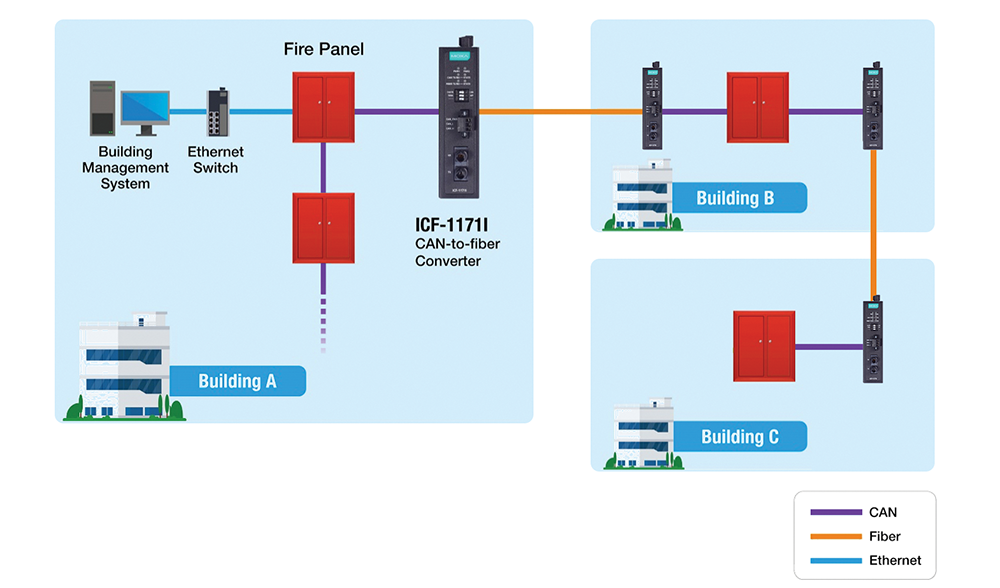
CAN-to-fibre converters: Fire alarm system
The system requirements are:
• Baudrates limit CAN bus communication distances. The higher the baudrate, the shorter the communication distance. CAN-to-fibre converters extend communication distances of fire panels between buildings.
• The ACK mechanism of the CAN-to-fibre converter is a must.
Why choose Moxa:
A CAN baudrate up to 1 Mbps and CAN FD baudrate up to 5 Mbps are supported; fibre transmission distance can be extended up to 40 km using single-mode, or 2 km using multi-mode.
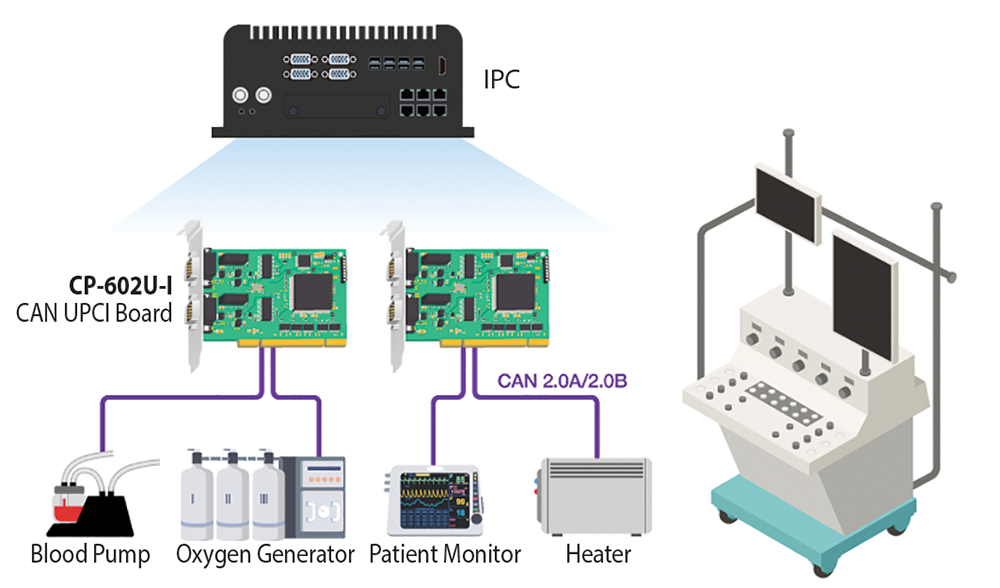
Heart-lung machine system: CAN interface cards
The system requirements are:
• A medical components provider is using CAN interface for reliability and effectiveness, especially for heart-lung machines.
• Most medical equipment uses Industrial PC to integrate the device and develop the application, and might involve modular design.
• The medical machine cabinet space is a constraint.
Why choose Moxa:
• The machine maker can insert the Moxa CAN card into the box-type IPC to easily integrate the CAN interface on its IPC system.
• Moxa’s commitment to developing drivers that support various IPC OS ensures customers can easily integrate CAN cards into their systems, regardless of the OS types, legacy or modern platforms.
South Africa’s space balls
Editor's Choice News
South African engineers are preparing to take low-frequency radio astronomy to the Moon with three locally developed B.A.L.L.S. spheres aboard China’s Chang’e-8 mission. This could pave the way for a 55-antenna lunar array and marks another step in the country’s growing space engineering capability.
Read more...Practical tips to build a successful engineering career
Editor's Choice
Award-winning civil engineer, Tinashe Mukalela of AvenirHoldings shares ten practical tips for young engineers navigating a competitive job market, from professional registration and mentorship to emotional intelligence and leadership development.
Read more...Why mining operations need local lightning early warning Senseca
Editor's Choice Electrical Power & Protection
Lightning can develop into a serious mining hazard before the first local strike, leaving crews little time to stop work and reach safety. Local early-warning technology can provide valuable lead time, allowing mines to connect developing storm conditions to defined trigger actions that protect people, explosives and equipment.
Read more...XPlanar aids innovation in laser processing Beckhoff Automation
Editor's Choice Motion Control & Drives
Aalborg University is among the first in the world to test Beckhoff’s XPlanar intelligent transport system in advanced laser processes, achieving micrometer-precise workpiece positioning and dramatically shorter lead times compared with traditional tool-based manufacturing.
Read more...The wireless route to safer, more efficient mining operations Emerson Automation Solutions
Editor's Choice Sensors & Transducers
Modern wireless level measurement technologies are helping mining operations improve process control, increase safety and reduce installation costs. Emerson’s Rosemount 3408 wireless non-contacting radar level transmitter uses 80 GHz frequency-modulated continuous wave radar with HART communication to reach remote assets where cabling is impractical.
Read more...Nine things your emergency control room must now have Oculus Operational Innovations
Editor's Choice IS & Ex
A new South African regulation, effective since March 2025 with no transition period, sets out nine mandatory requirements for underground mine emergency control rooms, and specifies who must be in charge at all times.
Read more...Protecting the digital mine RJ Connect
IT in Manufacturing
As mining becomes increasingly connected and automated, cyber threats are emerging alongside the benefits of digitalisation. RJ Connect and provides rugged networking, edge computing and cybersecurity technologies from MOXA to help protect critical mining operations from evolving attacks.
Read more...AES maintains a strong value and safety stance on boiler retrofits
Editor's Choice
When retrofitting and upgrading boilers, operational experience, technical knowledge of different boiler types, operating conditions and water treatment count. Through operating 79 boilers, AES knows what works and what does not.
Read more...The data-driven path to sustainable manufacturing ifm - South Africa
Editor's Choice Sensors & Transducers
Smart automation is closing the gap between operational efficiency and environmental responsibility, and the data to do it is already inside the plant. With ifm’s sensing and digitalisation technologies, manufacturers can turn machine intelligence into measurable sustainability gains.
Read more...The hydrogen economy is moving from concept to industrial reality VEGA Controls SA
Editor's Choice Pressure Measurement & Control
Scaling the hydrogen economy requires safe, efficient and tightly controlled processes across generation, storage, distribution and end use, underpinned by accurate instrumentation for pressure, temperature, level and flow measurement.
While every effort has been made to ensure the accuracy of the information contained herein, the publisher and its agents cannot be held responsible for any errors contained, or any loss incurred as a result. Articles published do not necessarily reflect the views of the publishers. The editor reserves the right to alter or cut copy. Articles submitted are deemed to have been cleared for publication. Advertisements and company contact details are published as provided by the advertiser. Technews Publishing (Pty) Ltd cannot be held responsible for the accuracy or veracity of supplied material.










 printer friendly version