Saving energy and minimising energy waste are two of the most critical aspects of energy use. Energy saving means looking at your power consumption rates, and developing a power quality management energy-saving plan.
Benchmarking electrical energy consumption
The first step in developing a power quality management programme is benchmarking your current electrical energy consumption. Through an initial survey, you can look for quick and easy solutions to start with. Track areas that contribute to your energy usage outside significant assets, like supplementary electrical heating, lighting being left on, and computers not being switched off.
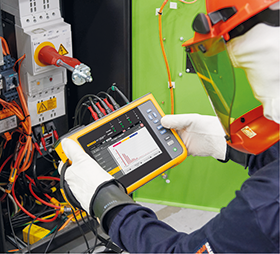
Once you’ve identified these quick wins, continue with more detailed studies. Run load studies on assets throughout the area using the Fluke 1777 three-phase power quality analyser. These measurements can show where you could see significant energy-saving opportunities, such as switching off some systems during the night.
Advanced power quality considerations
The next step in reducing energy consumption is to see where energy waste arises. One area is conductors. As current flows through conductors, some energy will turn into wasted energy as heat. What is the best solution? Consider the conductor sizing. Following the National Electric Code (NFPA 70 or NEC 100) gives guidance on the size of a conductor. The primary consideration for conductor sizing is ensuring the safe operation of the conductors with the most appropriate insulation. This depends on the length, cross-sectional area, and anticipated current rating required. This can provide minimised energy losses, typically 2% or less, and an acceptable voltage drop in the conductor. Some additional possibilities would be installing higher efficiency loads, and checking to see if motors might be oversized for the current application.
Wasted power
These codes and guidelines are fine for new installations, but don’t always work out ideally once the cabling installation is completed and the loads are installed. Over time, the equipment may change with additions or adjustments; moves and age can significantly affect waste energy. Key areas where energy waste may occur are related to your power quality, especially voltage regulation, harmonics, power factor, and unbalanced loads.
Voltage regulation works to reduce energy consumption in voltage-dependent loads. It reduces or controls the voltage levels within the equipment manufacturer’s specifications to return energy savings. As more efficient loads are installed at a transformer, the voltage in the system may rise or be incorrectly controlled. To catch voltage regulation issues, use a Fluke 1777 power quality analyser to look for transient voltages and voltage imbalance. Both issues can lead to failure, unplanned downtime, and expensive repairs.
Harmonics distort the voltage and current so that the ideal sine wave for voltage is not maintained. One of the most recognised effects of harmonics in electrical systems is the excess heat they create in the conductors carrying them. This results in overheating in phase and neutral conductors, known as ‘triplen harmonics’.
The additional heat causes cable runs, motor windings, and transformer issues. The overheating can cause significant damage or complete failure, either of which could lead to unplanned downtime and expensive repairs. To measure and diagnose harmonics, use a Fluke 1770 series three-phase power quality analyser.
The additional heat due to an unbalanced load causes issues with cable runs, motor windings, and transformers. The overheating can cause significant damage or complete failure, either of which could lead to unplanned downtime and expensive repairs. To measure and diagnose harmonics, use a Fluke 1770 series three-phase power quality analyser.
Once power quality studies reveal areas where energy is being wasted, you can take steps to fix the issues:
• Set up a preventive maintenance routine so you can continue to measure against your benchmark and catch issues as they arise.
• Install harmonic filters on loads that add to your facility’s harmonic distortion.
• Address the sources of unbalance. This may mean setting up a repair or replacement schedule for large motors with mechanical unbalance issues.
• Mitigate unbalanced load issues. In some cases, this may mean adjusting single-phase loads to be more equally distributed across the phases.
Africa’s net-zero ambition must become operational Schneider Electric South Africa
Electrical Power & Protection
Schneider Electric’s Rohit Chashta argues that the biggest gap in Africa’s green transition is not ambition but execution, and outlines how advisory services, bankable project roadmaps, digital visibility and SF6-free switchgear can turn sustainability commitments into measurable progress.
Read more...Infrared thermometers for electrical, industrial and HVAC applications Comtest
Maintenance, Test & Measurement, Calibration
: Comtest, distributor of Fluke test and measurement equipment, explains how handheld infrared thermometers are transforming maintenance in electrical, industrial and HVAC environments, with three measurement strategies and a wide range of practical applications.
Read more...High-efficiency half-brick DC-DC converters Vepac Electronics
Electrical Power & Protection
The Supreme series half-brick DC-DC converters from Vepac Electronics use synchronous rectification for high conversion efficiency, in a six-sided metal case built to withstand harsh industrial and transportation environments.
Read more...Zinc-based batteries power a more sustainable energy future
Electrical Power & Protection
Zinc-based batteries are gaining ground as a safe, recyclable and cost-effective energy storage option, from consumer electronics to grid-scale systems. The International Zinc Association’s Simon Norton explains why zinc is well placed to support the clean energy transition.
Read more...Energas introduces lower-cost German gas genset for South African market
Electrical Power & Protection
Energas Technologies will supply R Schmitt Enertec’s new Energy Line genset to the South African market, offering German-engineered gas-to-power generation of 400 to 500 kW at a lower entry cost through focused standardisation and a simpler standalone architecture.
Read more...ACTOM plays key role in large transmission substation project in Swellendam ACTOM Electrical Machines
Electrical Power & Protection
ACTOM has been appointed to engineer, procure, construct and commission the 1000 MVA main transmission substation for the Overberg Wind Farm in Swellendam, one of the largest substations of its kind in South Africa.
Read more...Reliable power conversion from high-voltage DC buses Conical Technologies
Electrical Power & Protection
The MEAN WELL DDRH-240 from Conical Technologies is a high-reliability DIN-rail DC-DC converter with a wide 250 to 1500 V DC input range, deriving stable low-voltage power directly from high-voltage DC buses in renewable energy, storage, charging, railway and industrial installations.
Read more...AES maintains a strong value and safety stance on boiler retrofits
Electrical Power & Protection
AES Commercial Director Dennis Williams explains when a boiler retrofit makes more sense than replacement, outlines the range of efficiency and emissions upgrades available, and draws the line at safety: a boiler not legally signed off is shut down, no exceptions.
Read more...The grid needs to become more intelligent Schneider Electric South Africa
Electrical Power & Protection
South Africa’s power grid is becoming bidirectional and far more dynamic as distributed energy resources proliferate. Schneider Electric’s Nishandra Bajinath explains why digitalisation, DERMS and aggregation are essential to keep this increasingly complex grid stable and efficient.
Read more...ACTOM’s integrated electrical solutions reduce project risk and accelerate delivery
Electrical Power & Protection
ACTOM has secured multiple orders across four divisions for the Naos-1 hybrid solar and battery project in the Free State, demonstrating its integrated model for supplying the full electrical chain from high-voltage equipment to distribution transformers.
While every effort has been made to ensure the accuracy of the information contained herein, the publisher and its agents cannot be held responsible for any errors contained, or any loss incurred as a result. Articles published do not necessarily reflect the views of the publishers. The editor reserves the right to alter or cut copy. Articles submitted are deemed to have been cleared for publication. Advertisements and company contact details are published as provided by the advertiser. Technews Publishing (Pty) Ltd cannot be held responsible for the accuracy or veracity of supplied material.










 printer friendly version