Understanding standby, prime, and continuous gensets
March 2024
Electrical Power & Protection
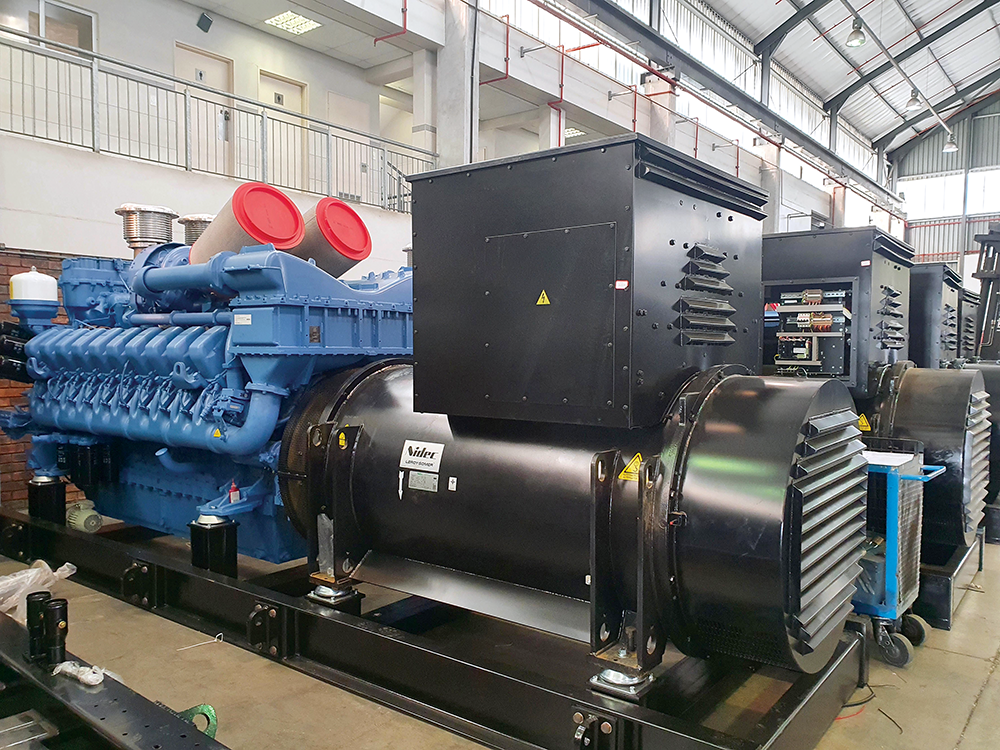
The increasing reliance of South African businesses on generator sets (gensets) to mitigate power disruptions highlights a crucial need for proper selection based on specific operational demands. Despite their growing usage, there’s still widespread confusion about how to choose the appropriate genset, often leading to inefficient and costly decisions.
Understanding the differences between standby, prime, and continuous applications is essential to optimise genset performance and longevity. This is according to Craig Bouwer, senior manager at WEG Africa, who explains that many customers mistakenly select gensets based solely on nameplate rating.
“Understanding the specific application of the genset is crucial for the right selection, and the first step is knowing that genset applications are broadly categorised into standby, prime, and continuous, each with distinct operational requirements,” he says.
Standby gensets are seldom used, and are typically kept for emergency situations. These units have a limit on operational hours per year and a specific load factor. In South Africa, due to frequent loadshedding, few gensets are used solely for standby purposes. Prime and continuous applications are more common in the country. Prime gensets can run unlimited hours annually with variable loads, but maintaining an average load factor below their maximum rating. Continuous gensets also operate unlimited hours, but with a constant and predetermined load.
Damian Schutte, engineering manager at WEG Africa, explains that understanding the difference between prime and continuous ratings is also critical. The load factor is a key differentiator and not the unlimited time requirement, with prime applications having variable loads, and continuous ones having fixed loads.
Schutte uses a vehicle analogy to illustrate the differences: a continuous genset is like a car on cruise control operating at a steady speed within its capacity on a long-distance trip, while a prime genset is akin to a vehicle driving in the city. Standby can be perceived as racing between traffic lights.
The choice of genset rating impacts its expected lifespan and maintenance needs. For example, continuous power may be required in mines during loadshedding to supplement limited grid power, while industrial applications like workshops, with variable loads, would need a prime-rated genset.
Bouwer notes that standby power remains vital in essential service sectors for health and safety reasons, especially in environments like mines, hospitals, and data centres.
WEG Africa, as an original equipment manufacturer, uses these categories to guide customers in their genset choices, aiming to match their specific needs and expected service life. The company cautions against oversimplifying the selection process by just matching the total load with a genset’s nameplate rating, as this can lead to premature failure and additional costs.
“To ensure the correct choice, we work closely with customers to assess their load requirements, usage frequency, and operational conditions, and through this process ensure optimal genset selection,” Bouwer concludes.
Further reading:
Africa’s net-zero ambition must become operational
Schneider Electric South Africa
Electrical Power & Protection
Schneider Electric’s Rohit Chashta argues that the biggest gap in Africa’s green transition is not ambition but execution, and outlines how advisory services, bankable project roadmaps, digital visibility and SF6-free switchgear can turn sustainability commitments into measurable progress.
Read more...
High-efficiency half-brick DC-DC converters
Vepac Electronics
Electrical Power & Protection
The Supreme series half-brick DC-DC converters from Vepac Electronics use synchronous rectification for high conversion efficiency, in a six-sided metal case built to withstand harsh industrial and transportation environments.
Read more...
Zinc-based batteries power a more sustainable energy future
Electrical Power & Protection
Zinc-based batteries are gaining ground as a safe, recyclable and cost-effective energy storage option, from consumer electronics to grid-scale systems. The International Zinc Association’s Simon Norton explains why zinc is well placed to support the clean energy transition.
Read more...
Energas introduces lower-cost German gas genset for South African market
Electrical Power & Protection
Energas Technologies will supply R Schmitt Enertec’s new Energy Line genset to the South African market, offering German-engineered gas-to-power generation of 400 to 500 kW at a lower entry cost through focused standardisation and a simpler standalone architecture.
Read more...
ACTOM plays key role in large transmission substation project in Swellendam
ACTOM Electrical Machines
Electrical Power & Protection
ACTOM has been appointed to engineer, procure, construct and commission the 1000 MVA main transmission substation for the Overberg Wind Farm in Swellendam, one of the largest substations of its kind in South Africa.
Read more...
Reliable power conversion from high-voltage DC buses
Conical Technologies
Electrical Power & Protection
The MEAN WELL DDRH-240 from Conical Technologies is a high-reliability DIN-rail DC-DC converter with a wide 250 to 1500 V DC input range, deriving stable low-voltage power directly from high-voltage DC buses in renewable energy, storage, charging, railway and industrial installations.
Read more...
AES maintains a strong value and safety stance on boiler retrofits
Electrical Power & Protection
AES Commercial Director Dennis Williams explains when a boiler retrofit makes more sense than replacement, outlines the range of efficiency and emissions upgrades available, and draws the line at safety: a boiler not legally signed off is shut down, no exceptions.
Read more...
The grid needs to become more intelligent
Schneider Electric South Africa
Electrical Power & Protection
South Africa’s power grid is becoming bidirectional and far more dynamic as distributed energy resources proliferate. Schneider Electric’s Nishandra Bajinath explains why digitalisation, DERMS and aggregation are essential to keep this increasingly complex grid stable and efficient.
Read more...
ACTOM’s integrated electrical solutions reduce project risk and accelerate delivery
Electrical Power & Protection
ACTOM has secured multiple orders across four divisions for the Naos-1 hybrid solar and battery project in the Free State, demonstrating its integrated model for supplying the full electrical chain from high-voltage equipment to distribution transformers.
Read more...
Smarter energy management starts with intelligent electrification
ABB South Africa ABB Electrification Products
Electrical Power & Protection
ABB Electrification specialists Adeline Maleka and Nokulunga Dube explain how the convergence of electrification, digitalisation and automation is helping South African industries gain real-time visibility, reduce energy waste and build operational resilience.
Read more...










 printer friendly version