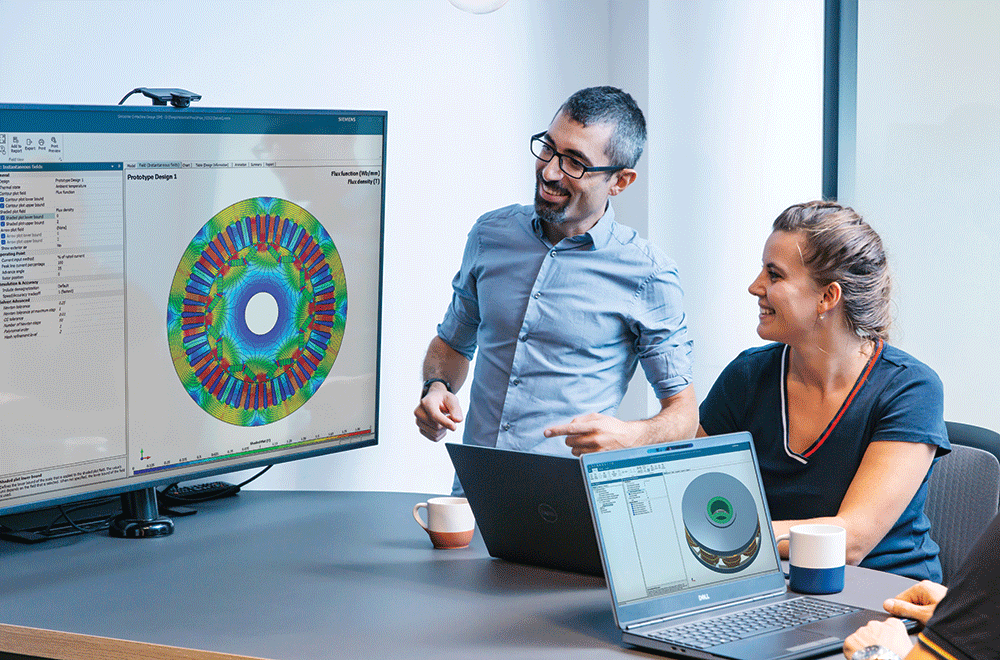
Siemens Digital Industries Software’s Simcenter E-Machine Design software helps electric vehicle (EV) manufacturers and their associated supply chains to predict the performance of e-machines accurately, including axial flux electric drive units. The new solution from the Siemens Xcelerator portfolio of industry software brings together electromagnetic and thermal simulation, helping reduce reliance on physical prototyping, and enabling the EV industry to accelerate innovation.
“The electric vehicle industry is facing challenges from many directions, including supply chain issues, the ability to scale, and the pursuit of innovation driven by increasingly demanding customers,” said senior vice president, Jean-Claude Ercolanelli. “By adopting cutting-edge simulation capabilities to develop new products and technologies in shorter timescales than ever achieved, the EV industry can focus on delivering the innovation required to stay relevant in a rapidly changing market.”
Axial flux motors can positively impact the EV range due to their increased power density; but engineers adopting them face more challenging heat dissipation requirements due to their compact size and complexity, and difficulties in accommodating the required air gap. The complex nature of these motors is challenging engineers, and many are turning to advanced simulation to help reduce development costs and time.
Delivered as part of the latest updates to the Simcenter software, the new Simcenter E-Machine Design solution allows engineers to use parameterised templates and analytical modelling in the early stages of development. They can then continue working on their design in 3D with full Finite Element Analysis (FEA) simulations when more complex investigations are required, such as advanced thermal interactions.
Simcenter now also includes a simplified electric vehicle powertrain development process, from motor design to noise, vibration and harshness (NVH). Electromagnetic loads from the new Simcenter E-Machine Design software are easily transferred to Simcenter 3D software for further acoustics and mechanical motion performance analysis.
The new smart virtual sensing capability empowers test engineers to simulate the unmeasurable. The new tool integrates simulation with physical testing to enable physical test teams to position virtual sensors in critical areas where physical sensors cannot be placed due to location or the complex geometry. This enables measurement of the unmeasurable by using a reduced order model featuring virtual sensors that run in real time alongside a physical test. It combines data from physical strain gauges with a reduced order model to compute operational loading conditions. This enables engineers to calculate results at the ‘unreachable’ critically located virtual sensor.
Design space exploration is also now fully integrated into Simcenter 3D, enabling the automation of design parameter modification, updating the simulation model, reviewing results, and iterating to explore design tradeoffs or achieve an optimal result. The associative integration of CAD geometry, simulation modelling and automation allows the creation of hundreds of runs without user intervention, helping designers and engineers explore more possibilities for their products.
Even in autonomous systems, human insight is important Schneider Electric South Africa
IT in Manufacturing
As AI, IIoT and digital twins reshape industrial operations, Schneider Electric’s Kobus Vermeulen and Bafana Msibi argue that the operator’s role is shifting from controlling equipment to interpreting intelligence, validating AI recommendations and making decisions that improve
Read more...AI-based quality inspection scales across P&G operations Siemens South Africa
IT in Manufacturing
Siemens and Procter & Gamble are expanding an AI-based visual inspection system across P&G’s manufacturing operations worldwide, inspecting products in real time at full line speed, and reducing scrap rates by 10 to 20% depending on the product.
Read more...How sustainability unlocks real business impact Rockwell Automation
IT in Manufacturing
Sustainability has moved from a compliance obligation to a strategic driver of resilience and value for manufacturers. Rockwell Automation explains how its Triple A framework and connected-data approach help producers cut energy, water and waste while improving productivity.
Read more...Mining’s AI future will depend on people as well as technology
IT in Manufacturing
South Africa’s mining industry is embracing digitalisation and AI, but AvenirHoldings chief executive officer, Tshidi Mndzebele says the real test is whether the people behind the industry are equipped to move forward with it, and outlines five things mining needs to get right.
Read more...How BIC overcame operational silos to integrate technology and people Rockwell Automation
IT in Manufacturing
Manufacturing giant BIC deployed Plex MES from Rockwell Automation at its Bizerte plant in Tunisia, replacing fragmented, partly in-house software with a single cloud-based execution system that broke operational silos and improved shop-floor visibility.
Read more...AI in industry is an early warning system, not a guarantee Schneider Electric South Africa
IT in Manufacturing
Schneider Electric’s Paul Steyn argues that AI in industrial maintenance is only as good as the infrastructure and people behind it, and explains the three layers a facility needs before predictive maintenance can deliver on its promise.
Read more...SA’s mining industry must put people at the heart of its digital future
IT in Manufacturing
South Africa’s mining industry employs around 470 000 people while its digital transition accelerates. Avenir’s chief executive officer, Tshidi Mndzebele argues that technology should enable and upskill the workforce rather than replace it, setting out five ways mining can make technology work for its people.
Read more...Quality control supports efficient tissue production Valmet South Africa
IT in Manufacturing
Valmet’s advanced quality control technology is helping tissue producers improve product consistency while reducing energy and raw material consumption. Its latest installation at KORO Paper in Vietnam combines real-time measurement, process optimisation and non-contact, nuclear-free quality control.
Read more...Patented algorithm maximises operator efficiency Rockwell Automation
IT in Manufacturing
Rockwell Automation piloted a patented anomaly detection algorithm and FactoryTalk DataMosaix at its Twinsburg electronics plant, giving operators 30 to 60 days’ advance warning of stencil failure, improving fail rates by 22% and achieving a 200% return on investment.
Read more...Measure, Manage, Maintain: The operating model behind SA’s water resilience Siemens South Africa
News
South Africa’s growing water crisis is putting pressure on infrastructure, municipalities and the economy. Siemens highlights how digital technologies, smarter operations and safe water reuse could help shift the country from crisis response towards a more resilient and sustainable water future.
While every effort has been made to ensure the accuracy of the information contained herein, the publisher and its agents cannot be held responsible for any errors contained, or any loss incurred as a result. Articles published do not necessarily reflect the views of the publishers. The editor reserves the right to alter or cut copy. Articles submitted are deemed to have been cleared for publication. Advertisements and company contact details are published as provided by the advertiser. Technews Publishing (Pty) Ltd cannot be held responsible for the accuracy or veracity of supplied material.










 printer friendly version