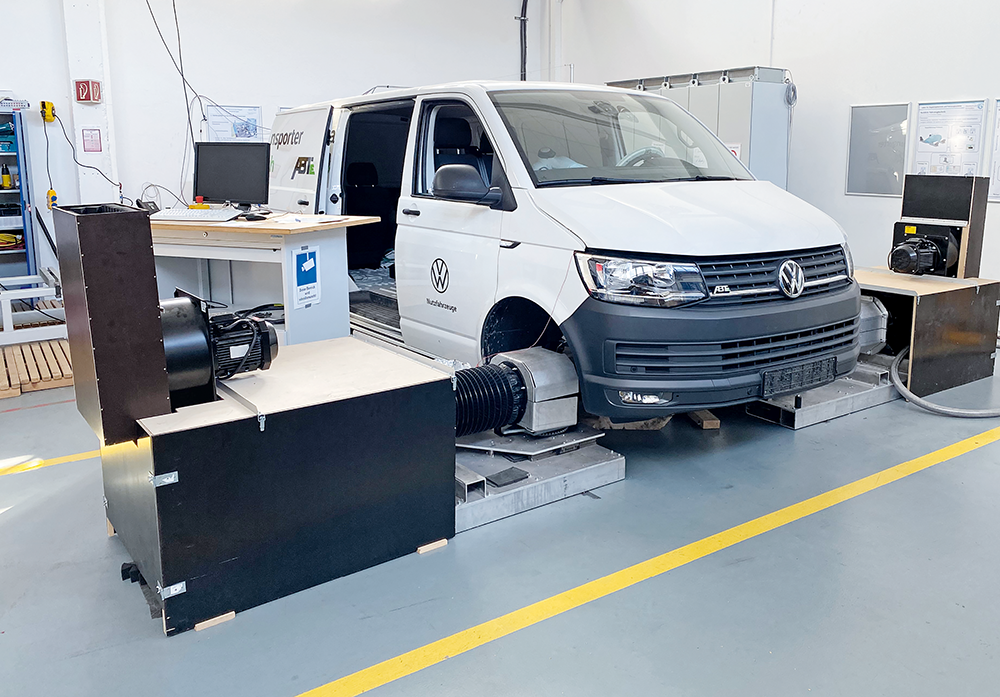
For small series producers and manufacturers with a wide range of vehicle variants, being able to count on comprehensive test bench technology that is fast, flexible and cost-effective is hugely important. Kempten University of Applied Sciences has implemented a test bench just like this for ABT e-Line, allowing it to perform tasks such as testing Volkswagen vans that have been converted to an electric drive. PC-based control technology from Beckhoff serves as the central feature of the standard industrial components used for testing vehicle functions.
The aim of the test bench is to test both new vehicles and new functions as quickly as possible, and also examine how individual functions influence each other. Vehicles can be tested in their original roadworthy condition, rather than having to be modified. In the case of an electric vehicle, the aim is to test whether the HVAC systems, which draw their power from the high-voltage battery, have an influence on the vehicle’s most important functions, such as switching on, switching off and driving. This involves specifying a test cycle that repeatedly starts, stops and accelerates the vehicle. The state of the vehicle changes as a result, ie. the HVAC system is switched on or off and the battery charge level is varied.
The output motors flanged to the vehicle wheels provide resistance to the propulsion of the wheels, which is intended to simulate driving on a road. A robot inside the vehicle turns the ignition key, moves the gearshift and operates various buttons, such as those for interior climate control. Linear motors on the pedals press the accelerator and brake pedals, while a steering motor turns the steering wheel. A second robot outside the vehicle plugs and unplugs the various charging cables into and out of the charging socket.
Measurement technology is used to acquire the currents and voltages in the vehicle’s wiring harnesses for subsequent analysis. The Beckhoff control platform communicates with the individual components and the vehicle via the CAN bus. This central control unit coordinates the individual components and controls them accordingly. A range of different tests can be implemented, all with different procedures. The seamless integration of the CAN devices in the EtherCAT control system is ensured by nine EtherCAT terminals and one-channel communication interfaces that integrate any CAN and CANopen devices.
During the test procedure, the vehicle faces driving conditions like those on a real road. For this purpose, a drive test bench moves the wheels according to the simulated torques and can even accommodate steering movements. The simulation is so close to reality that the vehicle does not even ‘realise’ that it is on a test bench. Even the driver’s actions are simulated by corresponding actuators. Industrial robots perform most of the actions to facilitate as many different actions as possible. The surroundings are also simulated, along with how the vehicle communicates with the environment – for example via GPS. In addition to developing the real test bench, Kempten has also created a digital twin of the system. Not only does this facilitate pre-commissioning of the test bench, but it also offers comprehensive visualisation and monitoring of the system.
Dr Andreas Stiegelmeyr, professor of mechanical engineering at Kempten, describes the requirements and implementation of the system as follows: “We developed a test bench that can test most vehicle functions using standard vehicle interfaces. This makes it possible to test functions with a high degree of connectivity with minimal effort, regardless of the vehicle type. We have created a great alternative for vehicle manufacturers, with a wide range of vehicle variants, for manufacturers of small series in particular.”
He adds that Kempten chose a system from Beckhoff as the central control because it already offers many different interfaces to industrial components. The control technology can also be easily expanded by adding EtherCAT terminals, and even optimally distributed throughout a space due to the exceptional freedom of the EtherCAT topology. The sheer volume of hardware and software products available means many measurement and control tasks can be completed with minimal effort. And to top it all, PC-based control from Beckhoff offers a clear cost advantage over systems from the automotive sector.
| Tel: | +27 11 795 2898 |
| Email: | [email protected] |
| www: | www.beckhoff.com |
| Articles: | More information and articles about Beckhoff Automation |






© Technews Publishing (Pty) Ltd | All Rights Reserved
 printer friendly version