



‘Rob’, an electrical engineer at a US paper mill, knows those challenges well. He’s responsible for electrical and electronic issues related to two large tissue machines that generate several tons of paper towels an hour. Installing and troubleshooting those systems was great preparation for the gargantuan tissue machines he works on today. Each machine is run by coordinated drive systems with about 12 drives and motors, plus auxiliary equipment that adds another 100 motors or so to each machine. The motors range from half a horsepower to a 6000 horsepower behemoth.
“I troubleshoot everything from variable-frequency drives (VFDs) and motors to programmable logic controllers (PLCs) and instrumentation. We’ve got a lot of valves, a lot of instrument sensors and a lot of coordinated drive systems,” Rob says.
On any given day, Rob gets trouble calls ranging from nuisance issues to potential catastrophic failures.
Starting with the basics
Motor and drive problems are the most common calls. “Normally your first check is to do an insulation check on the motor and wiring to make sure it’s not shorting to ground somewhere,” Rob explains. “If the insulation check is reading low, that’s usually a dead giveaway that it’s time to change out the motor.”
Few things are as disposable as paper towels. But the next time you nonchalantly toss away (or compost) a paper towel, keep in mind that there’s a lot more to it than meets the eye. Paper towels are manufactured through a finely tuned system of electrical, electronic and mechanical components. Coordinating all those components and keeping them running productively 24 hours a day is challenging, to say the least.
Sometimes, however, the problems are a bit more complicated. “If you’ve got a sporadic fault or the motor is tripping out because it’s pulling too many amps or it doesn’t have enough resistance, you have to investigate further,” he adds.
Because the machines run 24 hours a day, troubleshooting is done with the machines running, if at all possible. “If it’s a smaller component, a lot of times you can isolate it and just fix that one area while the machines are running,” Rob notes.
The environment in a pulp and paper mill is not easy on tools or people. It’s wet, steamy and dusty. Technicians have to climb ladders to reach some of the equipment, so tools need to be easy to carry, rugged, and above all, reliable.
Rob has found that Fluke tools perform well in that environment. He was first introduced to Fluke by his father, who is an electrician for a hydroelectric power company. Today the list of Fluke test tools Rob uses reads like a mini catalogue – about 18 items at last count.
Responding to sensitive VFDs
One tool Rob is almost never without is his Fluke 87V DMM (digital multimeter). Whether he’s doing first-line troubleshooting or delving down into more complex problems, the 87V is usually the first tool he turns to. A case in point: one night a VFD-controlled motor kept tripping. Technicians were concerned that they’d have to replace the motor. That would have taken about eight hours plus another two hours to restart the machine.
“Using my trusty Fluke 87V, I was able to determine that the motor was fine, but the real issue was a 5 V instrument supply module,” Rob recalls. “Older VFDs have a very low tolerance for these modules. The 87V was reading 4,77 V on the supply module. The lowest possible voltage this drive can handle from the supply is 4,8 V.” The solution was to replace the communication power supply board, which cost about $300 and took just 15 minutes.
“Had it not been for the accuracy of the Fluke meter we probably would have changed the motor and still been stumbling around trying to find the problem. It’s a real testament to the accuracy of these meters and the trust we place in them every day,” he adds.
In a similar situation, Rob was able to find a subtle problem in a motor lead with a Fluke thermal imager. In this case, a VFD kept faulting out after technicians had upgraded the drive and motor. “We checked the wiring with the insulation tester and found a slight degradation, but it was still within the acceptable threshold,” Rob explains.
They changed the VFD, but the problem continued. They were just about to change the motor when Rob decided to bring out a Fluke infrared camera. “We scanned the motor leads with the camera and the centre phase lead lit right up,” Rob recalls.
It turned out that technicians had left the old wiring when they upgraded the VFD and motor. “The insulation was still within our spec, but the new VFD was far more sensitive than the old one and it detected the slight insulation breakdown and kept kicking out,” he adds. The wiring and the problem were duly solved.
The following are some of Fluke’s instruments that make up Rob’s toolbox:
• Fluke 87V DMM industrial multimeter: delivers accurate frequency measurements on adjustable speed drives, and captures transients as fast as 250 µs.
• Fluke Ti 480 infrared camera: a 640 x 480 thermal camera that is perfect for professionals, with high-performance features and increased sensitivity to visualise temperature differences.
• Fluke 754 documenting process calibrator: calibrates critical safety instrumentation on the tissue machines. “Each machine has a set of critical sensors. A couple of times a year we verify the calibration on the pressure transmitters for those sensors with the 754 and the pressure modules,” says Rob.
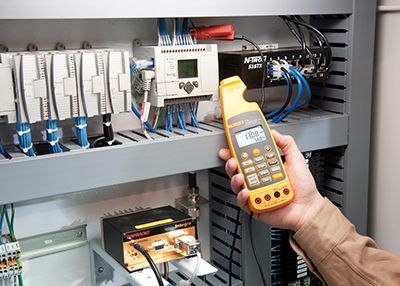
• Fluke 773 milliamp process clamp meter – determines whether a sensor is really bad or whether the card is just not generating the 4-20 mA output. “You can put the 773 on the PLC and it’ll tell you exactly what it is outputting, so you can tell whether you’ve got a blown channel or if the instrument is shot,” Rob explains.
For more information on this product contact https://bit.ly/3ET34ZC
| Tel: | +27 10 595 1824 |
| Email: | [email protected] |
| www: | www.comtest.co.za |
| Articles: | More information and articles about Comtest |






© Technews Publishing (Pty) Ltd | All Rights Reserved
 printer friendly version