



Operators of hazardous installations in South Africa are obligated to ensure that the risks associated with their facilities are ‘as low as reasonably practicable’ (ALARP). Fire and gas detection is a commonly utilised mitigation measure to ensure early detection of loss of containment.
The efficacy of the solution is heavily reliant on the accurate layout and placement of detectors. Prescriptive, geographic-based detector placement methodologies are often employed as they require less engineering effort upfront. The drawback is that these result in a higher detector count of questionable contribution, and therefore yield limited ability to evaluate the performance of the design.
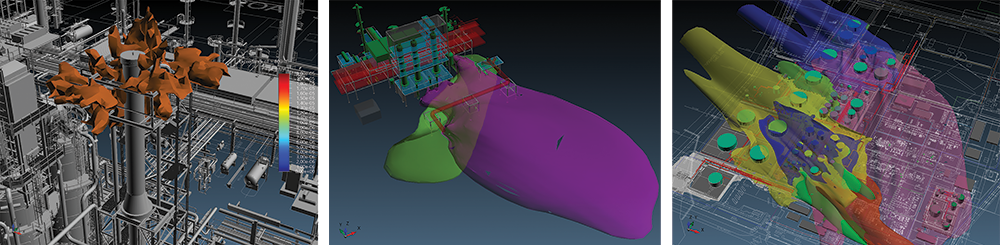
In contrast to the blunt approaches that ignore knowledge of physical and chemical conditions, Proconics completed a facility-wide risk-based mapping (RBM) study for a refinery in South Africa. Utilising comprehensive modelling techniques and engineering tools within the In:flux platform from Insight Numerics, a least-cost, performance-based solution in a brownfields environment was developed. Twenty-six processing units and two tank farms, comprising 1400 pieces of equipment, were assessed and gas detectors were placed to reduce the risk of undetected gas by 80 to 90%.
“Combining the skill sets across multiple disciplines, from the operator to the engineering firm to the software developer, we innovated together to push the limits for the safety industry. It was an exciting experience working with Proconics on this project and seeing the results produced for site-wide assessments. This is where the industry is going and Proconics is leading the way,” enthused Oliver Heynes, CEO of Insight Numerics.
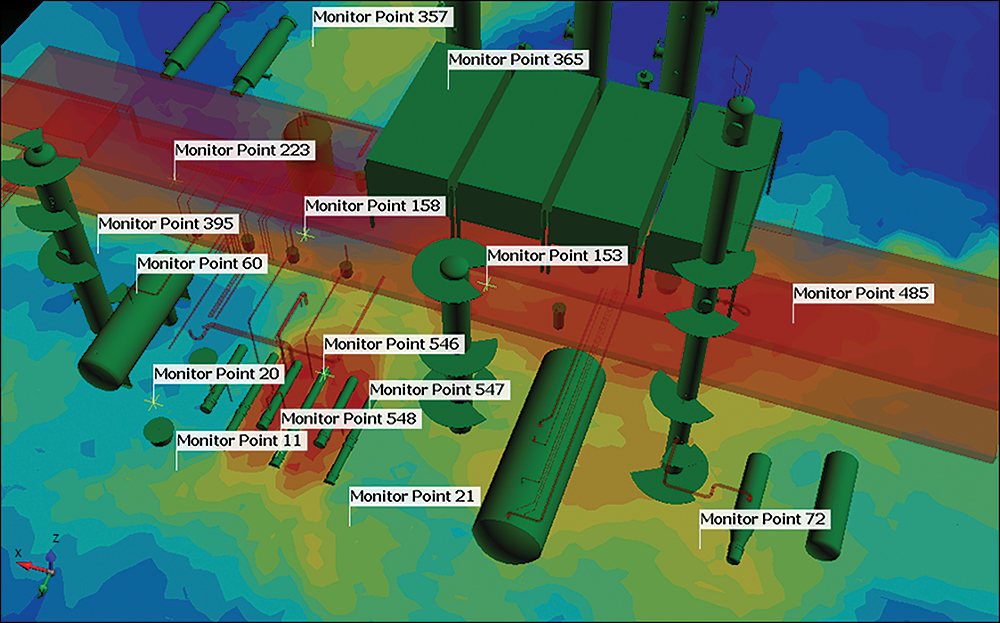
Comprehensive simulation and modelling incorporated detailed 3D models. Within this framework, multiple leak and composition combinations were contemplated. These leak scenarios were assigned leak frequencies, and based on the comprehensive simulations, dispersion models were developed. Each simulation considered site-specific meteorological data to account for the impact of ventilation (both natural and forced) as well as ambient temperatures.
A major differentiator between RBM and other methodologies is that RBM considers both likelihood and consequence. With dispersion models of gas clouds available, it is possible to determine the size of the resultant clouds. A consequent weighting is assigned to each leak, based on the severity of the vent/explosion and taking into account the size of the gas cloud. This approach ensures that gas detectors are placed to enable early detection, maximising the opportunity for intervention.
The ability to assess multiple leak scenarios simultaneously prevents blind spots and reduces superfluous detectors. This positions a single detector to detect leaks from several leak sources. Detectors are optimally placed by considering both the likelihood and consequence of each of the thousands of scenarios. Over the life of the facility, this approach achieves significant cost savings, avoiding over-capitalisation, reducing operational expenditure and most importantly preventing life-threatening incidents.
“When my team started sharing the details of this project, the suppressed engineer hiding deep in my soul forced his way out,” confesses Melvin Jones, Proconics Group CEO. “What the team has achieved in completing a risk-based mapping of an entire refinery is astounding. It demands that we sit up and take note.
“We have pushed the boundaries of best engineering practice, right here in South Africa. Local talent, solving local problems. This approach is truly disruptive – we blended multiple technologies in a unique way, protecting our clients’ assets better, with significantly lower capital investment and lower cost of ownership. Brilliance excites me!”
The implemented solution adheres to the following industry standards and guidelines:
• ISA-TR84.00.07-2018: Guidance on the Evaluation of Fire, Combustible Gas, and Toxic Gas System Effectiveness – August 2018.
• BS 60080 2020: Explosive and toxic atmospheres – Hazard detection mapping – Guidance on the placement of permanently installed flame and gas detection devices using software tools and other techniques.
• SANS 60079-29-2: Explosive atmospheres Part 29-2: Gas detectors – Selection, installation, use and maintenance of detectors for flammable gases and oxygen.
| Tel: | +27 11 568 4780 |
| Email: | proposals@proconics.co.za |
| www: | www.proconics.co.za |
| Articles: | More information and articles about Proconics |






© Technews Publishing (Pty) Ltd | All Rights Reserved
 printer friendly version