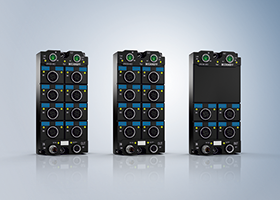
With the new EPX module series, Beckhoff now offers a compact option for Ex i signal acquisition from zones 0/20 and 1/21 as an addition to the wide range of EtherCAT Box modules. With robust IP67 protection, they enable direct and decentralised installation in machines and systems, even in harsh environments. This results in numerous advantages in all areas with explosion protection requirements, both in processing plants and in discrete manufacturing applications.
As a robust alternative to IP20 solutions with their elaborate housing protections, the EPX modules with IP67 protection rating enable reliable data collection, even in hazardous areas where no control cabinet or terminal box can or should be installed. The hhighly compact modular design leads to significant space savings. Furthermore, the previously required safety barriers are no longer necessary, which also saves space and reduces costs. Additional advantages of the new EtherCAT Box modules are their simple commissioning, the avoidance of errors due to incorrect contact assignments, and the system modularisation facilitated by on-site signal acquisition.
The EPX series initially comprises three modules with four or eight input channels:
The EPX1058 is designed for direct connection of up to eight intrinsically safe NAMUR field devices and records their signals pursuant to IEC 60947-5-6. In addition to the switching state, open circuits or short circuits are also detected. Channel by channel, it is possible to select whether a positive or negative switching sensor is connected, so that both NAMUR normally-open/break contacts and NAMUR normally-closed/make contacts can be integrated into the control system without changes in the program. Potential-free contacts can also be used.
The EPX3158 supplies a maximum of eight measuring transducers located in the field and transmits their analog 4-20 mA measuring signals, electrically isolated, to the automation device. Appropriate 2-wire and 3-wire sensors can be connected. With a maximum measuring range of +107% of the nominal range, this EtherCAT Box also supports commissioning with sensor values in the limit range, and evaluation according to NAMUR NE43. Any overload or wire break is signalled by LEDs.
The EPX3184, for connection of up to four intrinsically safe HART-capable field devices, provides information on the state of HART communication via LEDs, and signals any communication errors. HART connectivity enables two-way communication via analog 4-20 mA wiring and can also be used for the FDT/DTM concept. Field device DTMs can be directly integrated into the TwinCAT engineering environment via the TwinCAT FDT Container.
Economy drive system closes the drive gap in the entry-level segment Beckhoff Automation
Editor's Choice Motion Control & Drives
Beckhoff has launched an economy drive system pairing its new AX1000 servo drive and AM1000 servomotor with the AF1000 dual-axis variable frequency drive on a shared EtherCAT platform, targeting series machines and price-sensitive markets without sacrificing TwinCAT integration or functional safety.
Read more...Isolated Modbus gateways with built-in Wi-Fi for industrial IoT applications Vepac Electronics
Fieldbus & Industrial Networking
Vepac Electronics offers the Sielco Sistemi SS10680 series of isolated Modbus gateways with built-in Wi-Fi, providing three configurations for industrial data acquisition: cloud publishing via MQTT, local USB and FTP logging, and straightforward Modbus TCP to Modbus RTU conversion.
Read more...XPlanar aids innovation in laser processing Beckhoff Automation
Editor's Choice Motion Control & Drives
Aalborg University is among the first in the world to test Beckhoff’s XPlanar intelligent transport system in advanced laser processes, achieving micrometer-precise workpiece positioning and dramatically shorter lead times compared with traditional tool-based manufacturing.
Read more...XPlanar aids innovation in laser processing Beckhoff Automation
Fieldbus & Industrial Networking
Aalborg University is among the first in the world to test Beckhoff’s XPlanar intelligent transport system in advanced laser processes, opening the door to faster, tool-free production of metal parts.
Read more...Belden expands edge computing portfolio with ProLinx Edge Gateway
Fieldbus & Industrial Networking
Belden has released the ProSoft Technology ELX3 ProLinx Edge Gateway, combining operational technology protocol conversion with Docker-based edge application hosting on a single ruggedised hardware platform for deployment in harsh industrial environments.
Read more...Anybus Communicators are CRA-ready Industrial Data Xchange (IDX)
Fieldbus & Industrial Networking
HMS Networks has upgraded its Anybus Communicator range to meet new EU cybersecurity rules, giving industrial manufacturers and integrators an easier path to compliance.
Read more...Dynamic control of industrial solar plants and energy storage systems Beckhoff Automation
Editor's Choice IT in Manufacturing
Spanish group, Power Electronics uses Beckhoff embedded PCs and TwinCAT software to achieve switching times of 110 ms across solar and battery storage systems, enabling the delivery of grid support services that command higher energy prices.
Read more...PC-based control in surgery Beckhoff Automation
Editor's Choice PLCs, DCSs & Controllers
Researchers at the University of Basel are using Beckhoff PC-based control technology to develop a miniature laser robot for minimally invasive bone surgery.
Read more...Remote I/O modules provide flexible options for distributed applications
Fieldbus & Industrial Networking
Dinkle International is now stocking the iO-GRID NEMO industrial-grade remote input/output modules, offering support for five leading industrial Ethernet protocols and a range of discrete channel configurations for distributed automation applications.
While every effort has been made to ensure the accuracy of the information contained herein, the publisher and its agents cannot be held responsible for any errors contained, or any loss incurred as a result. Articles published do not necessarily reflect the views of the publishers. The editor reserves the right to alter or cut copy. Articles submitted are deemed to have been cleared for publication. Advertisements and company contact details are published as provided by the advertiser. Technews Publishing (Pty) Ltd cannot be held responsible for the accuracy or veracity of supplied material.










 printer friendly version