



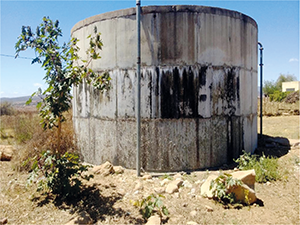
Whether it’s a single water tank or a large water dam, powering a monitoring system on a remote site several kilometres away with limited access to grid infrastructure is challenging. Often these sites go unattended for long periods of time and are vulnerable to overfilling. Because these systems are critical to ensuring continuity of supply and preventing overfill and waste, water utility mangers often must fund costly infrastructure projects to support installation.
Because manual inspections cannot be feasibly carried out regularly on a remote reservoir, utility managers will feel caught between a rock and a hard place when it comes to balancing cost, security and efficiency. So, what is a suitable solution?
Simply solar
It is a misconception that all solar-powered devices require an infrastructure. Yes, it was once the case that solar panels, battery chargers, backup power supplies and telemetry devices were fitted separately in costly and complex installation projects. However, with a growing reliance on automation and the need for monitoring devices to protect assets, new solar-powered telemetry systems have been developed that are cost-effective and easy to install.
Device manufacturers are now making programmable RTUs with integrated solar charge regulators in small footprints. These RTUs have terminals that directly plug in to the batteries, so all the system requires is for the device to be connected to a solar panel and a backup battery. Water utility managers can save considerable costs in upgrading the existing infrastructure by using devices such as Omniflex’s Teleterm S3 Series, weighing just 350 g. Being solar-powered, the device does not dissipate as much heat as mains-powered electronics. This, coupled with its compactness, allows it to sit comfortably in a secure, weatherproof
Considering the concerns
It is understandable that reservoir managers will have concerns over the efficacy and reliability of solar-powered devices. Power budgeting for batteries is a particular design constraint and battery selection is often made considering worst-case scenarios. For example, on days where there is less sunlight, panels cannot produce charge at maximum capacity and the batteries must take up the slack for repeated charge and discharge cycles. However, modern batteries have advanced quickly and now have greater tolerance for deep discharge cycling. This allows more technology to be deployed in these power-constrained applications.
Battery life concerns have been considered by device manufacturers. For example, the S3’s power consumption is low, at just 35 mA at 12 V DC. To save power, the devices are programmed to store data locally and only transmit intermittently on a cyclic basis. On a reservoir you might want to know the usage profile over a 24 hour period. The S3 series can be programmed to take a reading every hour, but report back once every 24 hours, saving power. All data is backed up and secured on an SD memory card and power is used sparingly, making the Teleterm S3 the ideal deployment for reservoir monitoring.
To avoid uncertainty when power is low, an internal backup battery is provided for the processor to power the real-time clock and keep synchronisation. If the external main batteries were to fail, the backups allow the device to shut down gracefully without corrupting any stored data. When communication comes back on, this data can then be securely transmitted back to the control room either via a cloud-based Data2Desktop network or licence-free band radio.
Omniflex has supplied solar-powered devices into extremely vulnerable locations successfully and solutions are available for remote sites. Solar-powered devices will continue to push the boundaries of what remote monitoring systems can offer. For remote locations where power is limited, safety is critical and cost-effectiveness is desired, water utility managers can be rest assured that their system remains reliable and secure in any eventuality.
| Tel: | +27 31 207 7466 |
| Email: | [email protected] |
| www: | www.omniflex.com |
| Articles: | More information and articles about Omniflex Remote Monitoring Specialists |






© Technews Publishing (Pty) Ltd | All Rights Reserved
 printer friendly version