March 2022System Integration & Control Systems Design
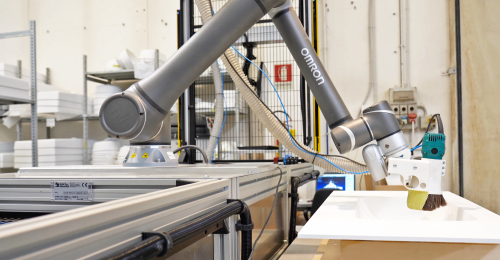
Topcustom, an Italian producer of custom-made bathroom sinks, has recently transformed part of its operations by deploying a collaborative robot (cobot) from Omron. The new cobot is being used to automate all the finishing operations of Topcustom’s products made from Ocritech. This is a light material that is easy to work with and guarantees perfect hygiene with excellent resistance to UV rays.
Topcustom is situated in central Italy and bases its success on the entrepreneurial tradition of the Le Marche region. Topcustom International was formed in 2018, in partnership with Nicos International Spa, which is responsible for marketing the products in Italy and abroad. Its strengths lie in understanding market needs and developing innovative products with the use of Ocritech, the company’s acrylic material. This has unique characteristics, which has allowed Topcustom to respond to the many customisation needs typical of this market, which is always looking for innovative and bespoke solutions, adaptability and speed of execution. Another strength of the company is its ability to respond to specific needs, carrying out projects in close collaboration with the customer’s design offices.
The 10-year experience of its production and technical departments enables every proposal, from the request to the finished product, to be completed in a maximum of three weeks. Each product, after passing through the industrial chain, is finished by hand. This ensures that each piece meets the required specifications and is of the right quality for the next stage of processing, up to packaging.
The company needed the cobot for the precision milling of its sinks. This includes the removal of acrylic glue residues (from 1,5 mm to a maximum of 3 mm). The glue is used to connect the thermoformed basin of the sink to its top. Omron’s TM12 robot has a reach of 1300 mm and operates on two sides of a very large working area. It eliminates all rough edges (burrs) and residues of the acrylic glue with maximum precision and minimum human intervention.
The path that guides the robot’s movements is determined by a three-dimensional model of the sink, generated from the final customer’s drawing. This is because the model can import all the data and the calculations of the path program from the CAD/CAM so that there is a reliable initial basis for handling. This can then be refined to compensate for any variation in tolerances. Employee safety is guaranteed by special safety barriers equipped with scanners. These communicate the presence of personnel to the cobot so that it can stop moving whenever necessary.
As a result of introducing the cobot, Topcustom has increased its production by 15% and is now producing more than 800 sinks per week, all different types and sizes. The entire process − from the initial order to the delivery of the finished product − can be managed in two weeks, with a level of precision and repeatability that is not possible with manual labour. This introduction to the world of Industry 4.0 has also enabled Topcustom to take advantage of the integration of future production data, by creating a link between the product codes and the associated processing programs.
How certified industrial automation channels become co-creators in the AI era Schneider Electric South Africa
System Integration & Control Systems Design
As industrial automation becomes software-driven and AI-enabled, the role of channel partners is shifting from equipment supply to outcome-based consulting, software integration and lifecycle services that require continuous certification and capability development.
Read more...Why integration defines the next competitive edge in pulp and paper
System Integration & Control Systems Design
ABB’s Arvin Ramjee argues that fragmented automation, assembled from different suppliers at different stages of a plant’s lifecycle has become one of the pulp and paper industry’s most overlooked commercial risks, and that true integration, rather than surface-level connectivity, is what delivers measurable business value.
Read more...Integrated automation enhances water treatment at dairy facility Process Dynamics
System Integration & Control Systems Design
Process Dynamics delivered the electrical, instrumentation, control and automation integration for an advanced water treatment and reverse osmosis system at a major South African dairy processing facility, achieving a 50% reduction in the client’s water utility costs.
Read more...Intelligent process control is reshaping cement production in Africa
System Integration & Control Systems Design
Advanced process control, predictive analytics and automation are helping African cement producers cut energy use and stabilise output as they contend with rising electricity costs and tighter margins.
Read more...Process Dynamics – Integrated Automation for Dairy Water Treatment Process Dynamics
System Integration & Control Systems Design Project and industry
Process Dynamics delivered the electrical, instrumentation, control and automation integration for an advanced water treatment and Reverse Osmosis (RO) system at one of South Africa’s ...
Read more...New SI programme strengthens Schneider Electric’s partner ecosystem Schneider Electric South Africa
System Integration & Control Systems Design
Schneider Electric’s SI Energise 2.0 programme offers system integrators a competency-based framework to develop deeper expertise in EcoStruxure and AVEVA software, enabling them to deliver full-lifecycle industrial automation solutions.
Read more...AI and smart solutions for underground proximity detection systems
System Integration & Control Systems Design
Booyco Electronics explains why fitting proximity detection systems underground is far more complex than installing sensors, and how integration, data and intelligent analytics are helping mines manage the challenge.
Read more...Why cloud-ready BMS is reshaping building operations Schneider Electric South Africa
System Integration & Control Systems Design
Smart sensors and non-contact radar are reshaping industrial measurement, feeding connected platforms that predict failures before they happen.
While every effort has been made to ensure the accuracy of the information contained herein, the publisher and its agents cannot be held responsible for any errors contained, or any loss incurred as a result. Articles published do not necessarily reflect the views of the publishers. The editor reserves the right to alter or cut copy. Articles submitted are deemed to have been cleared for publication. Advertisements and company contact details are published as provided by the advertiser. Technews Publishing (Pty) Ltd cannot be held responsible for the accuracy or veracity of supplied material.










 printer friendly version