



Hardly any other industry is subject to such high quality requirements and legal regulations as pharmaceutical companies. This applies to active ingredients, production and storage, as well as the labelling process. The labels must be robust and stick reliably for the drug’s usability of up to five years. Labels carry important information such as the name of the drug, active ingredient(s), manufacturer, and variable data such as expiration date, lot number and serialisation information. Establishing a valid labelling process is key. At the same time, the processes should also be as efficient, fast and sustainable as possible.
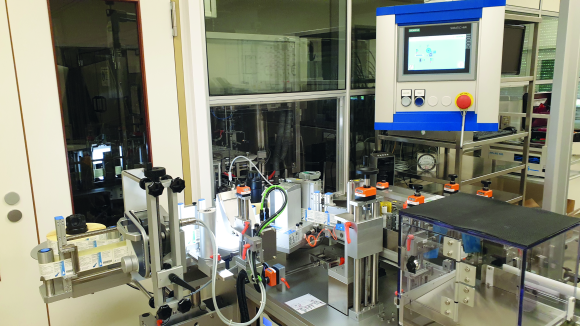
Steierl-Pharma, from Herrsching in Bavaria, Germany, relies on the support of Omron automation experts in this regard. By using a new labelling system with smart camera technology, Steierl-Pharma can label its pharmaceuticals with high process speed and reliability. These labels are printed with variable data on batch designation, expiration date and, if required, the dispensing notice “Sample not for sale”.
Steierl-Pharma is a medium-sized pharmaceutical company in the field of naturopathy and produces medicines in liquid dosage form, in cylindrical glass containers. The product range of the company includes medicines for the musculoskeletal system, for lowering blood pressure, for relieving migraines or skin diseases, or for treating flu-like infections.
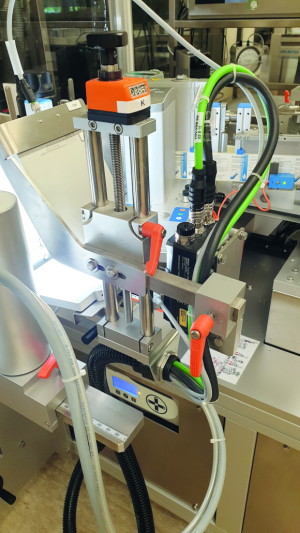
3600 units pass through production line in one hour
The producer has the legally required manufacturing licence for medicinal products as well as a GMP certificate. The Good Manufacturing Practices (GMP) certification guarantees process integrity in drug production and conformity with applicable regulations. When it comes to filling and packaging the drugs, Steierl-Pharma uses a production line designed for around 3600 units per hour.
It consists of a filling and capping machine, a labeller and a packaging machine. The line ensures a continuous and seamless process consisting of filling and closing the bottles with a dropper insert and a screw cap. The closed bottles then leave the cleanroom and enter the labeller, where they are labelled and then packed in a folding box, together with an information leaflet, in the packaging machine.
Challenge: Avoiding unintentional machine stops and read errors
In 2019, a project team at Steierl-Pharma began initial considerations to introduce a replacement for an older labelling machine. “The labelling machine used until then already had a smart camera-based inspection system to check the identity of the label and the variable data (batch name and expiration date). This, however, had two drawbacks: first, labels were repeatedly misread as bad labels, and second, bad units were not rejected but the labelling process was stopped. This meant that when the machine stopped, the bottles backed up into the filling machine and the packaging machine ran empty. So, we had a ‘bottleneck’ in our process,” reports Steffen Wegner, managing director of Steierl-Pharma.
Requirements: Precision and speed
Wegner explains: “That’s why we worked with the manufacturer Herma to find a suitable inspection system. The focus here was on high reliability and pricing.” The aim was to develop a labelling machine that on the one hand met the high requirements in the GMP area, but on the other hand, also ran without interruption during regular operation. One of the central criteria was that the new inspection system should work particularly precisely – bad units such as an incorrect or illegible barcode, as well as batch or expiry date errors, should be detected reliably and with the appropriate sensitivity.
Steierl-Pharma wanted a high level of specificity: the system should only detect actual bad units and eject them from the process. Furthermore, with an output of around 60 labels per minute, the inspection system only has a time window in the range of milliseconds for the complex inspection tasks.
FHV7 smart camera supports testing and quality control
The central component here is the inspection system, as Wegner explains: “We decided on the Omron FHV7 smart camera after a test on our label material on site, overseen by an Omron application engineer. We were effectively supported by Omron throughout the entire development process, up to commissioning and qualification of the machine and beyond.”
With the help of the FHV7, the Herma labelling machine at Steierl-Pharma checks the identity of the label based on the pharmaceutical code and verifies batch and expiration via OCV (optical character validation) for compliance with the specifications.
The FHV7-series smart camera provides illumination and image processing functionality for enhanced visual inspections. Due to its world-first multi-colour light and a powerful, high-resolution 12-megapixel camera, only a single FHV7 camera is needed to perform high-precision visual inspections of the production line.
During the performance qualification, the project managers involved were surprised by the extremely high specificity of the FHV7. “We could not believe how extremely reliable the Omron FHV7 inspection system is. As part of the challenge testing, we deliberately introduced mislabels, all of which were reliably detected. With a throughput of several tens of thousands of labels, not a single good label was incorrectly read as a bad label,” reports Wegner.
Even a single faulty unit could cause a lot of trouble in the GMP environment. By using the new camera, such situations do not occur, and the machine outages caused by the incorrect reading of actual good units can also be prevented.
Another advantage of the Omron camera is the software, which is intuitive to use and does not require lengthy training. “I also really like the option of a customisable user interface, and so do the users. There is only one window in which, for example, the target code, batch designation and expiration date can be entered. Code verification and OCV can also be performed. It’s all very clear and simple,” explains Wegner.
The software runs on any current Windows system and communicates directly with the FHV7 via the local network. Wegner also praises the high inspection speed of the Omron system. The complex individual inspection of a label takes just 80 milliseconds, which he describes as “impressively fast.”
Inspection system and support
“We are very satisfied with the new labeller and especially Omron’s inspection technology. In a highly regulated environment such as the pharmaceutical industry, manufacturers must be able to fully rely on the technology that is used – and also be able to successfully complete the qualification. This is the case with us,” Wegner sums up. “The cooperation with the sales and application team continues to be excellent.”
Since the company has had such a good experience with Omron, it is planning to convert an existing packaging machine to Omron inspection technology within the near future.
| Tel: | +27 11 579 2600 |
| Email: | info_sa@omron.com |
| www: | www.industrial.omron.co.za |
| Articles: | More information and articles about Omron Electronics |






© Technews Publishing (Pty) Ltd | All Rights Reserved
 printer friendly version