


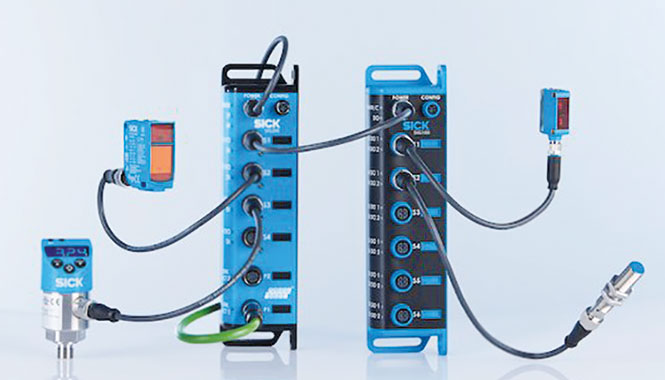
Sensor specialist company SICK recently announced its new SIG200 Profinet Sensor Integration Gateway. The product is the first of a new line of gateways created to work as both IO-Link masters and small distributed control systems, simultaneously. The SIG200 is designed to facilitate the configuration of localised sensor applications, while also providing high-speed, cloud-based capabilities for the sensors to share status, parameter and diagnostics data.
As the focus of the SICK SIG200 is to simplify sensor application tasks, the gateway utilises binary switching signals or measured values from IO-Link sensors and actuators, without the need for additional control components. Concurrently, diagnostics, process parameters and status information from IO-Link devices can be accessed both at the machine and company level, using MES, ERP, and cloud-based software.
The system’s four master ports allow IO-Link sensor and actuator connections, but its data integration capabilities extend to standard binary sensors with SICK’s SIG100 sensor hub. Using the hub, engineers will be able to bundle together, with up to 12 standard I/Os in a single IO-Link data packet, while communicating to machine controllers and cloud-based systems.
The device uses SICK’s SOPAS engineering tool software as a user interface, accessible with a PC via standard M8 USB, Ethernet or web browser. In order to allow engineers to monitor the sensors connected to the device, the SICK SIG200 comes with a software user interface: SICK’s SOPAS Engineering Tool. To simplify the configuration process, it has an embedded IODD interpreter, allowing the user to configure and connect IO-Link devices, by uploading the IODD files. The SIG200 can then work with any third-party products, as parameterisation of connected devices, and device replacement are possible when sharing the IODD file.
Simplifying processes for engineers
Clearly, the SIG200 makes it quick and easy for engineers to create and run distributed sensor applications, even independently of the PLC. “This new product offers all the Industry 4.0 benefits of setting up a system by using an IO-Link master, PLC and sensors,” said David Hannaby, SICK’s UK product manager for presence detection.
Hannaby further explained that this opens a second route, where engineers can bypass the PLC and create their own data gathering system, linking straight to the cloud. The SOPAS logic editor’s drag-and-drop function enables visualisation of the entire connected sensor, actuator signals and measured values, without the need for software knowledge. “It saves a huge amount of programming time, effort and cost,” he added, “allowing process control functions to be configured and set to operate autonomously, without the need for the PLC, additionally reducing the communication load in the fieldbus.”
The SIG200 is available with the ProfiNet Ethernet fieldbus protocol, and additional fieldbus versions of the gateway will follow in the future. The company is also offering an IO-Link master Starter Kit, containing everything needed to set up an application.
Why secure industrial communication depends on deployment as well
Fieldbus & Industrial Networking
The Industrial Security Harmonisation Group has released a joint industry perspective highlighting a critical truth in industrial cybersecurity: secure communication is not determined by protocols alone, but by how they are deployed and managed in real-world environments.
Read more...A single platform for all automation functions Beckhoff Automation
Fieldbus & Industrial Networking
The introduction of TwinCAT in 1996 marked a decisive evolutionary step for PC-based control. Today, the TwinCAT platform combines all automation functions in a strictly deterministic real-time environment, from PLC and motion control through CNC and measurement technology and beyond, to vision, robotics and pioneering AI tools.
Read more...Loop signature Part 2-4: Feedforward Control: Part 3 Michael Brown Control Engineering
Editor's Choice Fieldbus & Industrial Networking
In the previous articles in this series, the basic theory behind feedforward control was discussed, and it was also shown how to apply feedforward in practice. In this article, it will be shown how well feedforward can work in practice by giving a couple of examples.
Read more...Control Station and Dimension Software partner to connect control performance monitoring with enterprise operations intelligence
Fieldbus & Industrial Networking
Control Station has entered into a strategic technology partnership with Dimension Software, a leading provider of industrial operations management platforms. The collaboration connects Control Station’s PlantESP control loop performance monitoring platform with Dimension Software’s Asset Intellect operations intelligence environment, enabling manufacturers to operationalise control performance insights across their organisations.
Read more...SICK earns Great Place To Work certification SICK Automation Southern Africa
News
Sensor specialist SICK South Africa has been awarded Great Place to Work certification recognising the positive working environment and strong workplace culture it has developed.
Read more...Precise, synchronised control for automated steel mesh handling system
Fieldbus & Industrial Networking
Automation specialist Hambi Maschinenbau has developed a world-first system that automates the cutting, handling and stacking of heavy reinforcing steel mesh – a task that previously required up to six human operators.
Read more...Loop signature Part 2-3: Feedforward Control: Part 2 Michael Brown Control Engineering
Editor's Choice Fieldbus & Industrial Networking
Feedforward control tuning is not nearly as critical as feedback tuning, and fairly simple models are usually fine for the purpose in hand.
Read more...Upgrading radiological surveillance systems in nuclear facilities Omniflex Remote Monitoring Specialists
Fieldbus & Industrial Networking
Nuclear plant operators face an uncomfortable reality. Many of the control and monitoring systems still in use today were never designed to support the full operational lifespan of the facilities they serve.
Read more...Next-level CAN Software enables easy access to CAN XL Industrial Data Xchange (IDX)
Fieldbus & Industrial Networking
With the release of its PCAN-Explorer 7, PEAK delivers a major update that adds full support for CAN XL, multiple symbol files per connection, Python scripting and flexible licensing including floating licenses.
While every effort has been made to ensure the accuracy of the information contained herein, the publisher and its agents cannot be held responsible for any errors contained, or any loss incurred as a result. Articles published do not necessarily reflect the views of the publishers. The editor reserves the right to alter or cut copy. Articles submitted are deemed to have been cleared for publication. Advertisements and company contact details are published as provided by the advertiser. Technews Publishing (Pty) Ltd cannot be held responsible for the accuracy or veracity of supplied material.

