



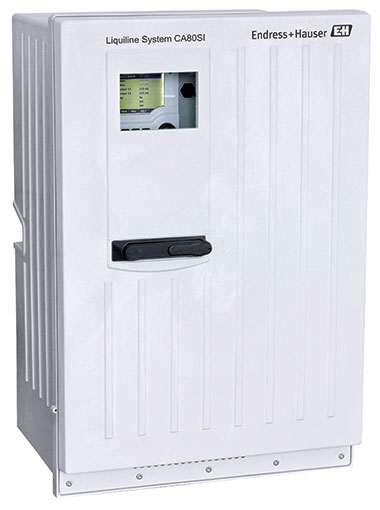
Reliability and reproducibility are of paramount importance when it comes to online measurement. Some industries, including the power industry for example, also have extremely high expectations in terms of measuring sensitivity, particularly with regard to the key parameter silica.
A low concentration of silica in the boiler feedwater prevents the formation of build-up on turbines and heat exchangers. The quality of feedwater to be used is often contractually agreed between the power plant operator and the turbine manufacturer, and audited. This gives rise to stringent requirements for measuring devices, sampling, reference analytics, and the quality of reagents used.
Silica measuring points and measuring tasks in power plants
Silica measurements play a crucial role in power plant analytics in terms of guaranteeing the reliability and efficiency of the plant. After all, even traces of silica in steam can cause glass-like build-up on the turbine blades. The initial measuring point for silica in the water/steam circuit of power plants is typically located downstream from the feedwater preparation. The purpose of this measuring point is to monitor the ion exchangers to ensure they are functioning properly. Once the water has been preheated, the silica concentration is measured again before the water is fed into the steam generator. This measurement can be used to reduce the transfer of silica into the steam. Both the steam and the resulting condensate are also analysed to determine their silica concentration. Well-managed plants can use silica measurement to reduce the number of blowdown cycles and decrease maintenance costs.
In search of the ‘true’ measured value
Process analysers are often referenced against a laboratory analysis. In some cases, the laboratory value is unquestioningly accepted as the ‘true’ value. This may be justified with some substances where the detection methods and instrumentation used in the laboratory are significantly more sensitive than the online analyser used. However, the same is not true for silica. The specified accuracy and sensitivity of the online analysers are extremely high, usually better than 1 µg/l. However, these manufacturer specifications typically include only the measured errors of the actual analyser. Measuring uncertainties introduced by the standard solutions used as a reference are not included in this data.
To guarantee the quality of the online measurement, an analyser should be inspected regularly. With online analysers for silica, the analyser can be adjusted regularly and automatically, enabling compensation for process-related effects on the measuring device. Compared to laboratory analyses, sources of error are avoided during sampling and transportation of the sample to the laboratory.
However, the quality of a regular adjustment is directly dependent on the quality of the zero-standard used. In fact, samples of various commercially available zero-standard solutions have sometimes produced unsatisfactory results. It is only through targeted investment in ultra-pure water systems in production laboratories, as well as a comprehensive quality management system, that the water quality required for zero-point adjustment of online analysers can be guaranteed. It is generally accepted in the field of analytics that any measurement can only be as accurate as the reference used. This is particularly true when comparing online and laboratory analyses.
Accurate measurement using the Liquiline System CA80SI silica analyser
In addition to the quality of the zero-standard used, exact reagent dosing is crucial for measurement accuracy. That is why the Liquiline System CA80SI uses high-precision dispenser pumps that are specially designed for low-volume dosing. To further increase dosing precision, the reagents are dispensed directly into the cuvette through capillaries. The pressurised sample is placed in a flow-through cuvette. Since the colour reaction of silica is greatly dependent on temperature, the sample undergoes precision tempering in a two-stage process.
Key factors in quality-led reagent production include:
• Complete traceability of all source chemicals.
• Mandatory scanning of source chemicals and end products.
• Networked electronics scales for all components.
• Consolidation of data in an electronic laboratory book.
• Process of continuous improvement with systematic idea management within the production environment.
• Feedback loop from production to R&D.
• Professional complaince management.
Practical process connection with up to six channels
In power plants, it is common to make sample lines from different measuring points available at a central point for analysis. This may involve what is referred to as an ‘industry panel’ or the use of individual analysis rooms. The most important measuring parameters are determined centrally here, e.g. different types of conductivity, free available chlorine, pH value, silica, sodium, ortho-phosphate and turbidity. To enable the different samples to be measured using just one silica analyser, the Liquiline System CA80SI can be fitted with a process connection for up to six sample channels. The electrical connection for switching the valves is already pre-wired in the analyser and can be connected using a single plug. This saves on installation costs and makes for easier commissioning.
Process reliability even in the event of unexpected faults
The day-to-day operation of a power plant can involve unforeseen maintenance activities or the temporary failure of a single sample line. In these types of situations, it is particularly important that, on the one hand, the measurement of the other channels continues without interruption, and, on the other, that a valid measured value is available for the affected channel as soon as possible once the fault has been cleared. The Liquiline System CA80SI guarantees both. Each channel is independently equipped with a flow controller, which checks if sufficient sample is available at sufficient pressure. If this is not the case, the analyser continues with the measurement of the next channel in line. Once the fault has been cleared, the measurement of the failed channel is resumed. The sequence of the measuring channels can be programmed by the user however they wish.
The overall package has to be right
In addition to online analysers, Endress+Hauser is a one-stop shop for high-quality reagents and standard solutions. Together with sample preparations, Memosens sensors and industry panels, Endress+Hauser provides complete measuring points along with the associated services and solutions. A thorough understanding of all components results in an automation solution that is reliable throughout the entire product life cycle.
| Tel: | +27 11 262 8000 |
| Email: | info.za.sc@endress.com |
| www: | www.endress.com |
| Articles: | More information and articles about Endress+Hauser South Africa |






© Technews Publishing (Pty) Ltd | All Rights Reserved
 printer friendly version