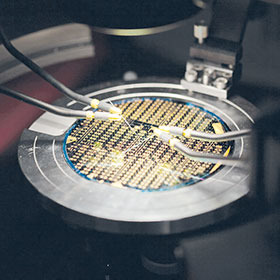
Semiconductor wafers can be transparent or reflective, both of which can be challenging for sensors to detect. Because of this, it is important to use a technology that can detect both types of wafers reliably. Sensor mounting can also be a challenge when detecting wafers in a vacuum chamber. Banner Engineering offers several solutions that can be used to detect both clear and reflective wafers reliably in a vacuum chamber. There are three technologies that can be used to solve this application.
Dual mode laser distance sensor through window glass
The first type of sensor that can be used to detect wafers is a dual mode laser distance sensor mounted through a window glass. Laser sensors with dual mode capability like the Q4X from Banner detect not only changes in distance but also changes in light intensity from a stable background condition. This allows the Q4X to detect challenging targets such as clear and reflective wafers with a high level of accuracy.
A laser distance sensor with dual mode can detect not only when the target is present within a certain distance, but also when it returns a certain amount of light to the receiver. For this to work, a stable reference surface must be taught, and the distance and intensity of the reference surface are recorded and used as a baseline. The presence of a transparent or reflective wafer entering the sensing range of the beam alters the perceived distance and light intensity from the background condition. The Q4X from Banner is also able to detect through a glass window without interference.
Photoelectric sensor through window glass
Another sensor that accurately detects challenging wafers targets is a retro-reflective photoelectric sensor with a coaxial optical design. The QS18 with Clear Object Detection emits and receives light along a single narrow axis. This optimises the detection of transparent wafers by dramatically reducing the risk of false detection from reflected light.
Additionally, because light emitted and received travels on a single narrow beam, these sensors can see through a small aperture, allowing them to be used through a glass window for vacuum chamber applications. Photoelectric sensors with polarising filters will emit and detect light waves of a specific polarisation, ignoring all other light waves. This further reduces the risk of false detection caused by reflected light.
Vacuum chamber-rated fibre
Finally, a fibre optic solution that is rated for use in a vacuum chamber can also be used to detect transparent or reflective wafers. With a fibre optic solution, the fibre amplifier is mounted outside of the vacuum chamber. A special pass-through fitting with a vacuum-rated glass fibre mounted inside brings fibre optic light into the chamber.
The fibre is then positioned so that the light shines towards a vacuum-rated glass reflector, detecting both glass and reflective wafers that pass between the fibre and the reflector.
Telco sensors in conveyor belt monitoring
Sensors & Transducers
Gail Norton Instrumentation Agencies has developed a low-maintenance conveyor belt monitoring unit built on robust Telco infrared sensors, detecting belt tear and misalignment reliably in harsh coal mining environments.
Read more...Inductive ring sensors monitor material flow in feeding technology ifm - South Africa
Sensors & Transducers
ifm’s inductive ring sensors detect metallic parts such as screws and nuts as they pass through tubes at speeds up to 35 m/s, enabling precise counting, flow control and blockage detection, with sensitivity and output functions configurable via IO-Link.
Read more...Reliable 1D and 2D code reading made simple SICK Automation Southern Africa
Sensors & Transducers
SICK’s new sensingCam SEC200 image-based code reader brings supermarket-checkout simplicity to logistics and industrial identification, reading 1D and 2D codes reliably with quick browser-based setup, rugged IP65 construction and CRA-compliant cybersecurity.
Read more...Market opportunity for sensors in humanoid robots
Sensors & Transducers
A new IDTechEx report forecasts the market for sensors in humanoid robots will exceed $6,59 billion by 2037, driven by perception sensors, force/torque sensors, encoders and inertial measurement units across a growing range of commercial robot platforms.
Read more...The wireless route to safer, more efficient mining operations Emerson Automation Solutions
Editor's Choice Sensors & Transducers
Modern wireless level measurement technologies are helping mining operations improve process control, increase safety and reduce installation costs. Emerson’s Rosemount 3408 wireless non-contacting radar level transmitter uses 80 GHz frequency-modulated continuous wave radar with HART communication to reach remote assets where cabling is impractical.
Read more...Telco sensors for harsh environments
Sensors & Transducers
Telco sensors are designed to operate where moisture, particulate contamination and surface fouling would disable conventional sensors, with a range including an adjustable five-metre infrared proximity sensor for harsh industrial environments.
Read more...The data-driven path to sustainable manufacturing ifm - South Africa
Editor's Choice Sensors & Transducers
Smart automation is closing the gap between operational efficiency and environmental responsibility, and the data to do it is already inside the plant. With ifm’s sensing and digitalisation technologies, manufacturers can turn machine intelligence into measurable sustainability gains.
Read more...Expanding visibility in mining operations Emerson Automation Solutions
Editor's Choice Sensors & Transducers
Advances in wireless communications, condition monitoring and sensing technologies are helping mining operators extend measurement into previously under-monitored areas, improving equipment reliability, process performance and water stewardship.
Read more...Fiber-optic amplifiers for precise object detection ifm - South Africa
Sensors & Transducers
The OCF fibre-optic amplifier detects even the smallest or most transparent objects in confined spaces, making proven fibre-optic technology easier and more user-friendly than before.
While every effort has been made to ensure the accuracy of the information contained herein, the publisher and its agents cannot be held responsible for any errors contained, or any loss incurred as a result. Articles published do not necessarily reflect the views of the publishers. The editor reserves the right to alter or cut copy. Articles submitted are deemed to have been cleared for publication. Advertisements and company contact details are published as provided by the advertiser. Technews Publishing (Pty) Ltd cannot be held responsible for the accuracy or veracity of supplied material.










 printer friendly version