



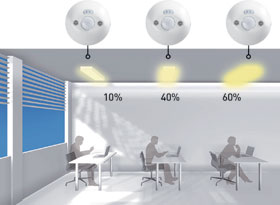
Legrand’s lighting and motion management systems, which are designed to make industrial, commercial and domestic buildings more energy efficient, encompass switch sensors that reduce the amount of time lighting is left on unnecessarily.
“Lighting, together with heating and air-conditioning, accounts for the greatest energy consumption and electricity costs of a building,” says Luk Ivens, general manager, Legrand Southern Africa. “With the installation of an automatic lighting and motion management system, which ensures there is exactly the right amount of light when and where it is needed, energy savings of up to 60% can be achieved.
“Reduced lighting usage not only lowers operating costs, but also helps decrease green house gas emissions. Additional savings include reduced lamp replacement and maintenance requirements and lower power demand during peak hours.
“Because various areas in a building require different lighting control strategies, we recommend a number of solutions to maximise energy savings and to ensure absolute comfort for occupants of the building.”
Occupancy detection
Legrand’s lighting management sensors are used to monitor the detection area for occupancy and to control lighting and HVAC circuits. Lighting is automatically switched on when a person is sensed. Where sensors are equipped with a built-in light level sensor, the lighting will be kept off when sufficient natural light is available. When the area is vacated, the lighting automatically switches off after a pre-set time delay.
Motion sensors, with an automatic switch on/off facility, are recommended for areas with little or no natural light, for example in passageways, bathrooms and equipment rooms.
Passive infrared technology motion sensors detect occupancy at up to 8 metres by identifying the difference between heat emitted from the human body in motion and the background space.
Lighting management sensors designed for shops, offices, healthcare buildings and warehouses have a manual or automatic switch on/off, according to whether there is anyone present. These sensors also have built-in adjustable lux sensors that keep the lighting switched off if there is sufficient natural light.
Detection of lighting management sensors is based on passive IR and dual technology, which ensures maximum sensitivity and coverage in applications for optimum reliability and energy saving.
Legrand sensors work in occupancy mode, where lights are automatically switched on or off according to occupancy, or in vacancy mode for additional energy saving, where lights are manually switched on and automatically switched off when the person leaves the area.
For enhanced flexibility, switch sensors can be combined with room controllers to manage a number of lighting and ventilation circuits. For example, in areas where daylight is unevenly distributed, a sensor can be combined with a row of luminaires to measure motion and light levels. The dimming controller regulates each row of luminaires and supplements the external light to obtain the required pre-set light level.
Once the sensor and controls have been selected for each installation, Legrand offers a choice of local BUS/SCS control or the global BUS/KNX solution for lighting management.
BUS/SCS (simplified cabling system) wiring enables local and remote presence and light level detection and management. Every installation, which also includes time and scenario management functions, is designed, monitored and supervised on a PC, using Legrand’s advanced software.
As an addition to this local control system, the wireless Radio/ZigBee system can be used to install new radio control points, without damaging walls. This system is ideal for refurbishment installations or glazed surfaces.
In addition to BUS/SCS, BUS/KNX wiring enables supervision and integration of other building applications, including emergency lighting, HVAC and fire alarms. This building control system enhances energy and operating performance, also ensuring ease of maintenance.
| Tel: | +27 11 444 7971 |
| Email: | legrand.south-africa@legrand.co.za |
| www: | www.legrand.co.za |
| Articles: | More information and articles about Legrand Southern Africa |






© Technews Publishing (Pty) Ltd | All Rights Reserved
 printer friendly version